
Understanding seasons Addition & Subtraction Worksheets for Ages 5-7
4 filtered results
Difficulty Level
Grade
Age
-
From - To
Subject
Activity
Standards
Explore our "Understanding Seasons Addition & Subtraction Worksheets" designed for children ages 5-7. These engaging worksheets combine basic math skills with seasonal themes, making learning both fun and relevant. Your little ones will practice addition and subtraction using beautiful visuals inspired by spring, summer, autumn, and winter. Each worksheet promotes essential counting skills and encourages students to solve easy arithmetic problems related to seasonal activities and nature. Perfect for both classroom settings and homeschooling, these worksheets aim to reinforce mathematical foundations while fostering an appreciation for the changing seasons. Start your child's educational journey today with these delightful resources!
Favorites
With answer key
Interactive
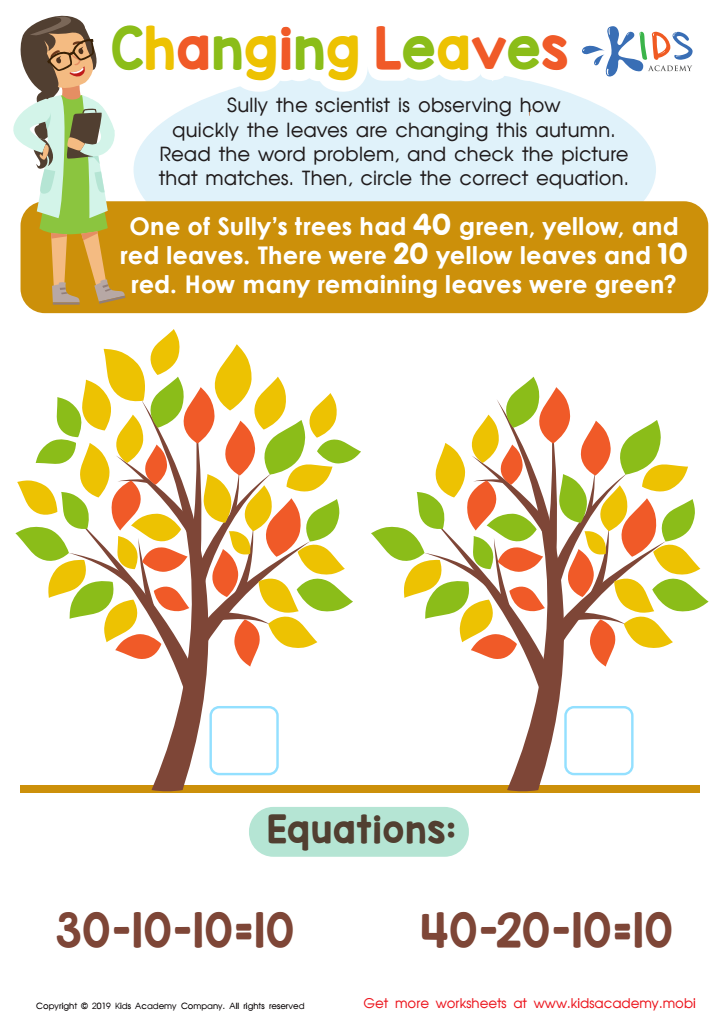
Changing Leaves Worksheet
Fall is the perfect time for kids to help Sully the scientist observe the changing leaves! Download the free worksheet with a subtraction word problem and bolded info to find the matching equation and picture. It's a fun way for your tots to learn while they admire the reddening, yellowing, and orange leaves.
 Assign to My Students
Changing Leaves Worksheet
Worksheet
Join Kids Academy for Free
Who is primarily going to use this learning content?








Understanding seasons and mastering addition and subtraction are essential components of early childhood education for children ages 5-7. The connection between these two topics provides a holistic learning experience that enhances cognitive skills.
When kids learn about seasons, they grasp the concept of time and changes in nature, fostering curiosity and encouraging observational skills. These themes can be tied into math activities, such as counting seasonal items (like leaves or snowflakes) and solving simple addition and subtraction problems. For example, a fun activity might involve counting how many trees are green in summer and how many turn orange in fall.
Additionally, mastering basic arithmetic sets a strong foundation for future mathematical concepts. At this age, kids begin developing number sense, which is crucial for problem-solving and logical thinking. Incorporating seasonal themes into math lessons not only makes learning more engaging but also helps children relate math to real-world experiences.
By caring about and supporting this integrated approach, parents and teachers can nurture a holistic understanding in children, supporting their intellectual growth and curiosity about the world around them, thereby promoting culturally and contextually rich learning that lasts a lifetime. This interdisciplinary approach fosters critical thinking, creativity, and a love for learning.








