Understanding Quantities Math Worksheets for Ages 5-7 - Page 3
50 filtered results
-
From - To
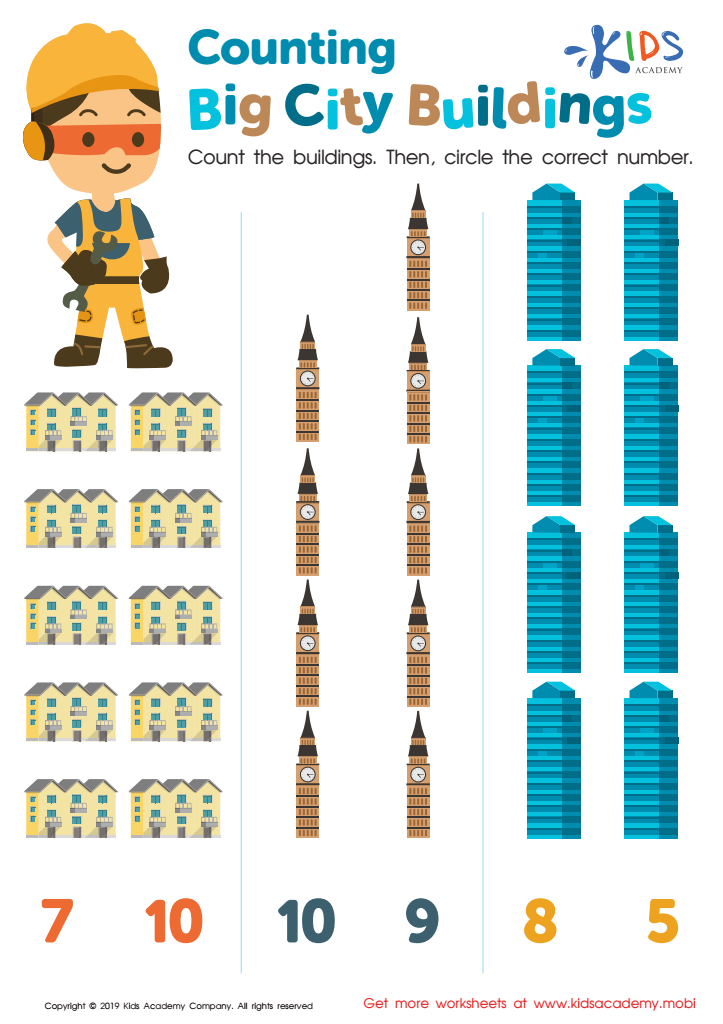
Counting Big City Buildings Worksheet
 Assign to My Students






Understanding quantities math for ages 5-7 is a foundational skill critical for children’s overall mathematical development. At this early stage, children begin to grasp essential concepts such as counting, comparing numbers, and recognizing patterns, which serve as building blocks for more complex math later on. Parents and teachers should prioritize this understanding because it fosters critical thinking and problem-solving abilities essential in everyday life.
When children learn about quantities, they develop a strong numerical sense, enabling them to make connections between abstract numbers and real-world situations. This comprehension leads to improved confidence in their math abilities, reducing anxiety around numbers as they advance in their education. Additionally, early mastery of these concepts supports literacy development, as language frequently intertwines with mathematical thinking.
Engaging parents in their child's exploration of quantities through games and daily activities can strengthen these skills further, creating a supportive and enriching learning environment. By recognizing the importance of quantities math, educators and parents foster a love for learning and prepare children for future academic success, ensuring they are well-equipped for the challenges of higher mathematics and logical reasoning in life.








