
Practice problem-solving Worksheets for Ages 5-8
5 filtered results
Difficulty Level
Grade
Age
-
From - To
Subject
Activity
Standards
Unlock your child's potential with our Practice Problem-Solving Worksheets for Ages 5-8. These engaging and educational worksheets are expertly crafted to enhance critical thinking, improve logical reasoning, and develop essential problem-solving skills. With fun puzzles, games, and interactive activities, children will enjoy learning while building vital cognitive abilities. Perfect for both classroom and at-home learning, our worksheets cater to various learning styles, ensuring every child thrives. Foster a love for problem-solving and help your child succeed academically and beyond. Discover the joy of learning with Kids Academy's top-notch resources today!
Favorites
With answer key
Interactive
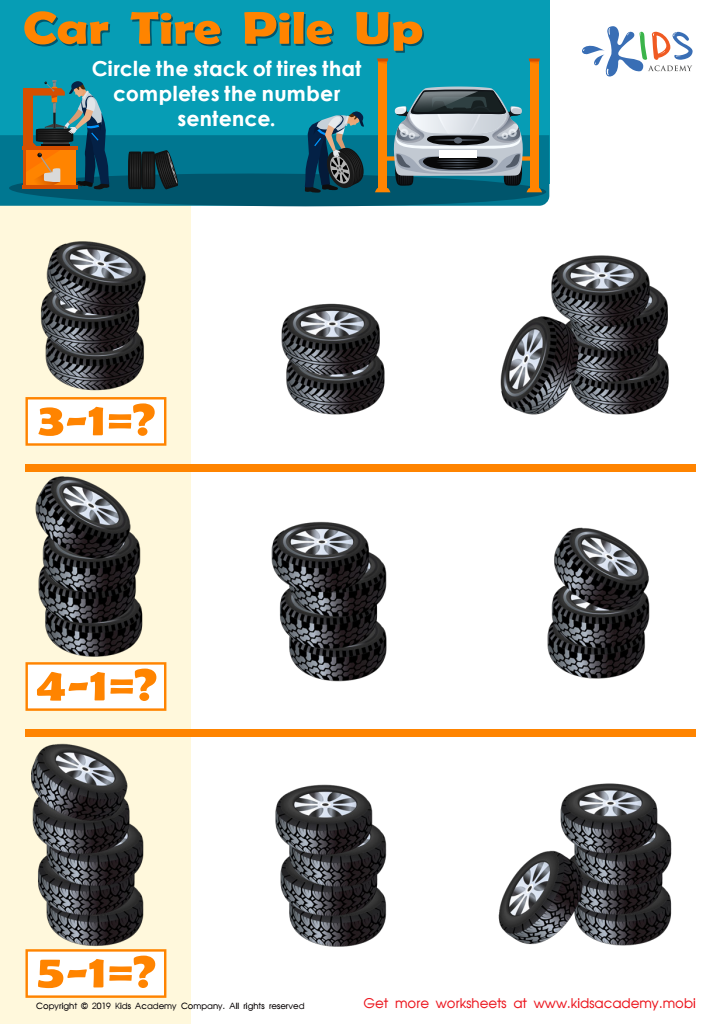
Car Tire Pile Up Worksheet
Examine the pic with your kids. Can they recognize the items piled up? The tires are organized in different quantities. Equations are on the left. Have your children work out the equations, counting the tire stacks to identify the correct answer.
 Assign to My Students
Car Tire Pile Up Worksheet
Worksheet
Join Kids Academy for Free
Who is primarily going to use this learning content?








Fostering problem-solving skills in children aged 5-8 is crucial for their cognitive and social development. During this formative stage, young minds are highly adaptable and absorb new information rapidly. Helping children become proficient problem solvers prepares them for academic success and practical life challenges.
Firstly, problem-solving enhances cognitive abilities. It encourages critical thinking, as kids learn to ask 'why' and 'how,' deepening their understanding of concepts rather than just memorizing information. This cognitive flexibility promotes higher-order thinking, essential for subjects like math and science.
Moreover, effective problem-solving skills build emotional resilience. Children learn to manage frustration and develop persistence when faced with difficulties. They begin to see challenges as opportunities for growth rather than insurmountable obstacles, fostering a positive mindset.
Social interactions also benefit. Problem-solving in collaborative settings teaches children to communicate their ideas clearly, listen to others, and reach compromises. This helps build cooperation and empathy.
Furthermore, real-world skills like planning, predicting outcomes, and adapting strategies are nurtured. These skills are invaluable beyond the classroom, preparing children for future life situations and ensuring they grow into independent, competent individuals.
Overall, prioritizing problem-solving for young children sets a robust foundation for lifelong learning and interpersonal success, underscoring its importance for parents and teachers.








