Telling time Worksheets for Ages 5-8
4 filtered results
-
From - To
Discover a fantastic collection of "Telling Time" worksheets specially crafted for kids ages 5-8. At Kids Academy, we offer a variety of printable activities that make learning to tell time both fun and engaging. These resources are designed to reinforce essential time-telling skills, from reading analog and digital clocks to understanding the concepts of hours, minutes, and everyday schedules. Perfect for classroom use or at-home practice, our worksheets provide a solid foundation in time literacy, ensuring young learners develop confidence and proficiency. Transform time-telling challenges into enjoyable learning moments with our expertly designed worksheets!
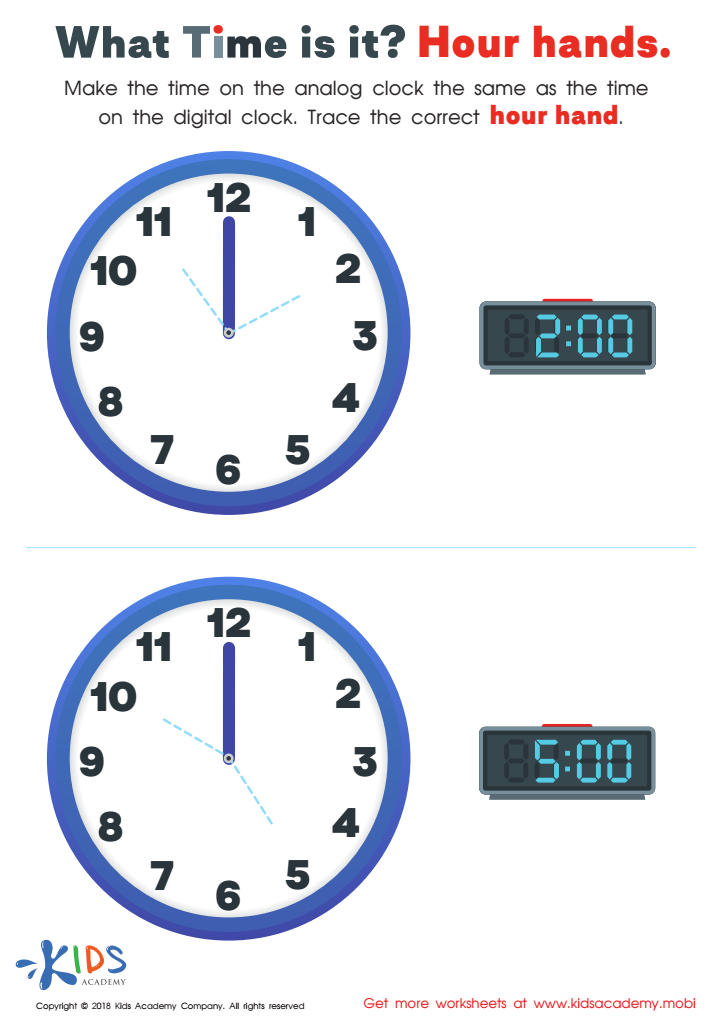
What Time Is it? Hour Hands Worksheet
 Assign to My Students




Telling time is a fundamental skill that plays a crucial role in a child's daily routines, time management, and comprehension of the world. For children aged 5-8, learning to tell time helps develop a sense of structure and routine, both at home and in school. This age group thrives on predictability, and knowing how to read a clock not only provides them with independence but also aids in understanding the concept of sequences and scheduling.
Moreover, learning to tell time supports the development of mathematical skills. By reading both analog and digital clocks, children practice counting, adding, and subtracting. Hours, minutes, and seconds introduce them to fractional concepts and the base-60 numerical system, which expands their numeric understanding beyond the typical base-10.
Telling time also nurtures a child's language development and comprehension. It enriches their vocabulary with terms like "quarter past," "half past," and "o'clock." Furthermore, it enhances their cognitive skills, including memory and attention to detail, as they learn to recognize the position of clock hands and associate them with specific times.
Ultimately, the ability to tell time empowers children, allowing them to become more self-sufficient and responsible. It equips them with the tools needed for managing everyday activities, fostering future skills in planning and prioritization. For parents and teachers, investing in this essential life skill fosters a child's confidence and paves the way for lifelong learning habits.








