Understand fractions Adding up to 100 Misc Worksheets for Ages 5-8
3 filtered results
-
From - To
Explore our "Understand Fractions: Adding Up to 100" worksheets designed specifically for children ages 5-8. These engaging and interactive resources help young learners grasp the concept of fractions with fun and creative exercises. Each worksheet encourages students to visualize and manipulate fractions, enhancing their mathematical understanding as they work towards adding up to 100. Emphasizing hands-on learning, these worksheets foster critical thinking and problem-solving skills while making math enjoyable. Perfect for home or classroom use, our worksheets aim to help children build a solid foundation in fractions, preparing them for more advanced math concepts in the future.
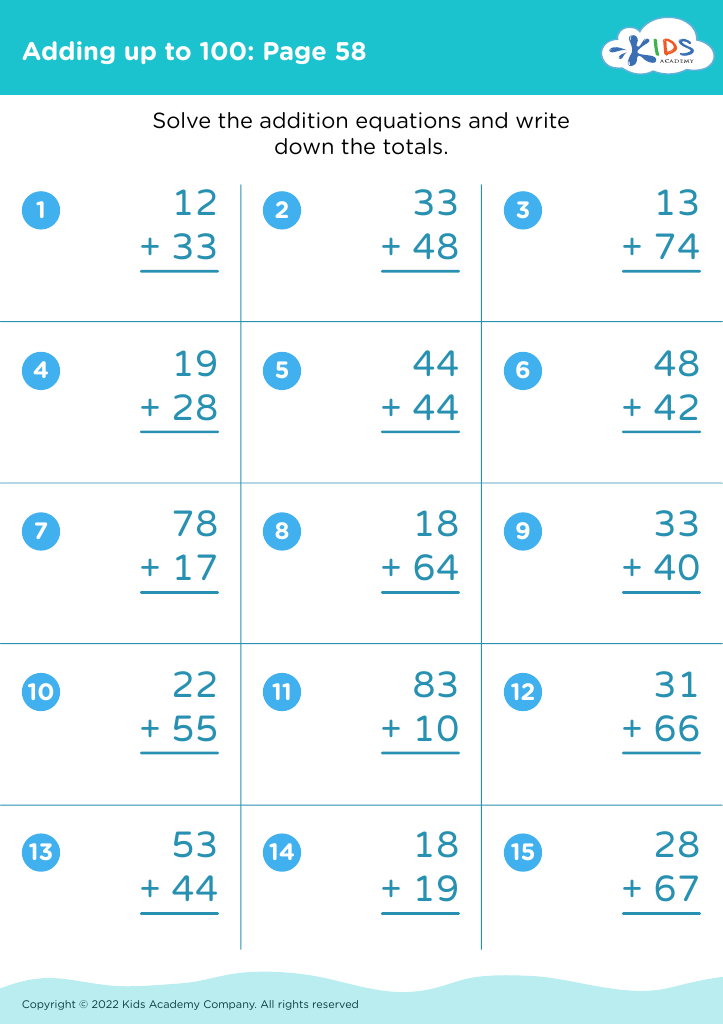


Understanding fractions is crucial for young learners, especially those aged 5-8, as it lays the foundation for more advanced mathematical concepts and daily decision-making skills. Fractions represent parts of a whole, enabling children to grasp the idea of quantities in a more nuanced way. This understanding starts with simple concepts, such as recognizing halves and quarters, and evolves into more complex operations, including adding fractions.
For parents and teachers, teaching fractions is vital because it promotes critical thinking and problem-solving skills. Children learn to compare sizes, make estimates, and understand relationships between numbers. Adding up to 100 using fractions can further reinforce this concept, illustrating that wholes can be comprised of many parts.
Moreover, strong foundational skills in mathematics contribute to academic success and confidence, impacting a child’s attitude towards learning. Engaging with fractions in interactive, practical activities nurtures a positive learning experience. It equips children with essential life skills, like sharing, cooking, and budgeting, all of which require fractional understanding.
Ultimately, when parents and teachers prioritize this learning, they empower children to build a solid mathematical future and foster a lifelong appreciation for numbers and problem-solving.