Improve math skills Adding up to 1000 Misc Worksheets for Ages 5-8
3 filtered results
-
From - To
Boost your child’s confidence in math with our "Improve Math Skills Adding up to 1000" printable worksheets, designed for ages 5-8. Perfect for young learners, these engaging sheets offer a variety of activities to practice adding numbers up to 1000, helping to strengthen essential math skills. Created by experts, these resources blend fun with learning, ensuring that kids stay captivated while grasping key concepts. Download now to help your child excel in math, build a solid arithmetic foundation, and achieve success in their educational journey.
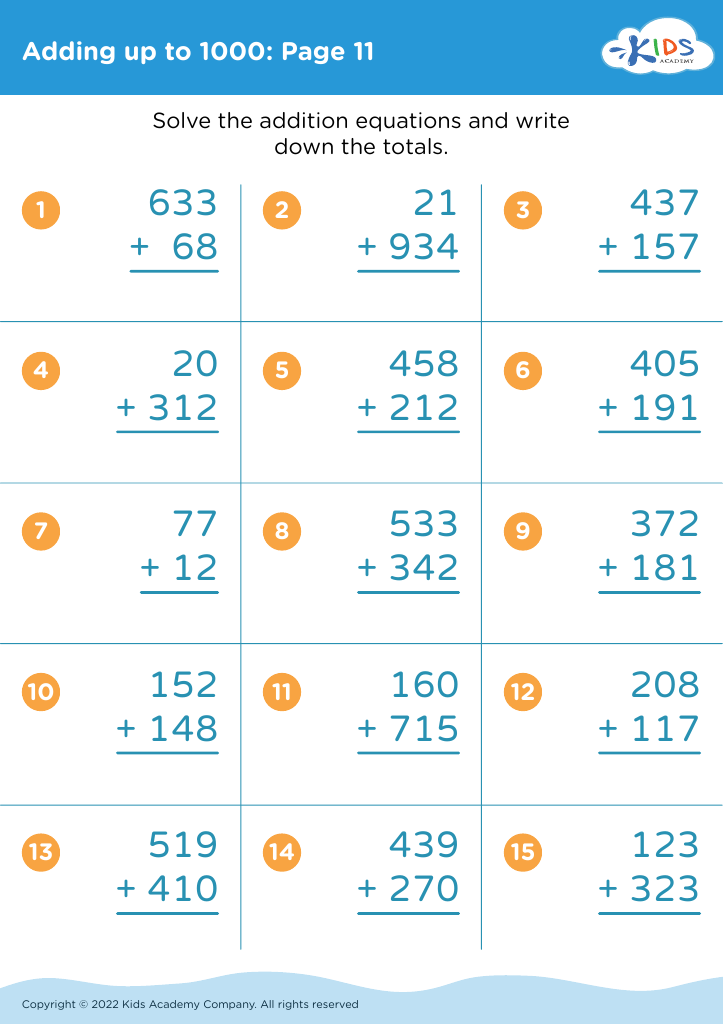
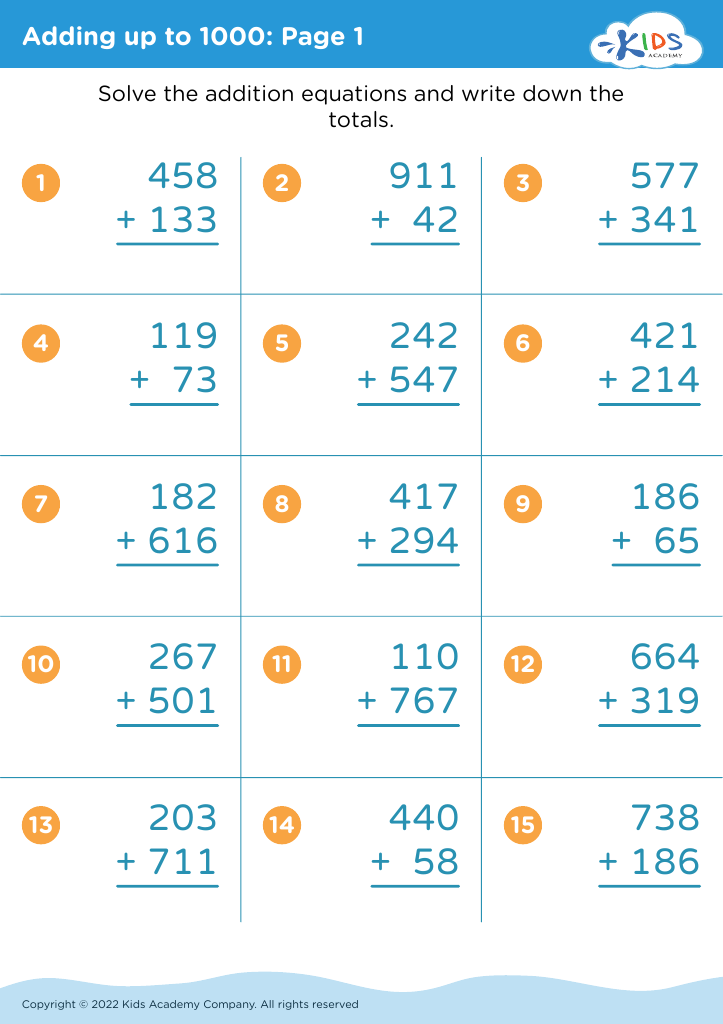
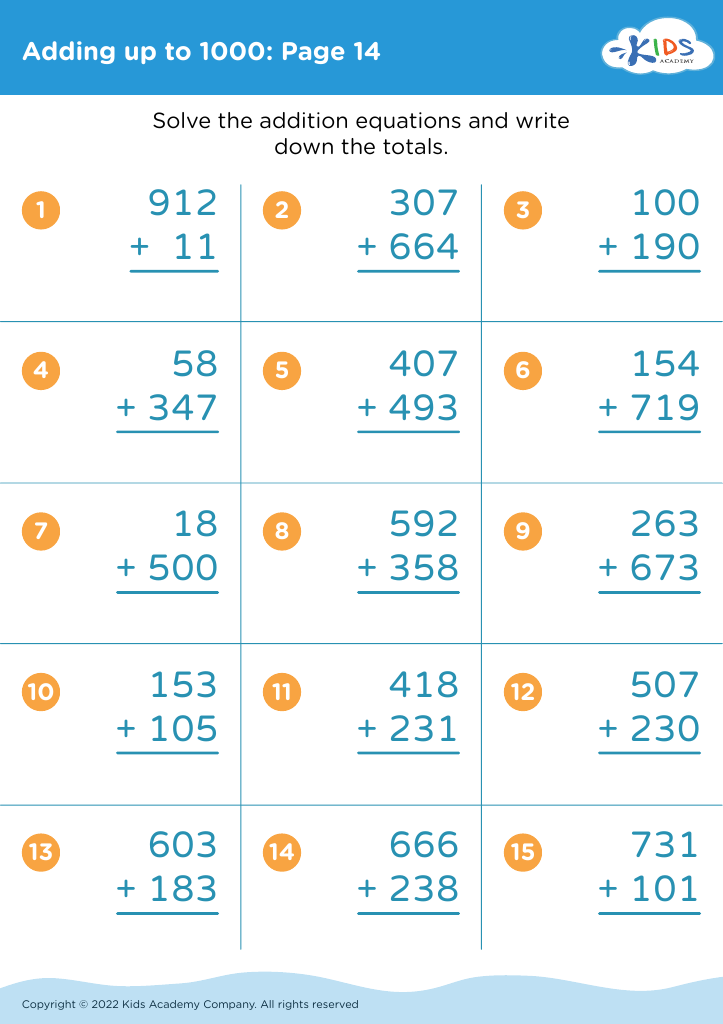


Parents and teachers should prioritize improving math skills, such as adding up to 1000, for children ages 5-8 because these foundational skills are critical for academic success and everyday problem-solving. During these formative years, children's brains are extremely adaptable and capable of absorbing complex information, making it an ideal time to develop essential numerical proficiency. Mastering addition up to 1000 not only boosts their arithmetic skills but also enhances cognitive functions like memory, logical thinking, and pattern recognition.
Proficiency in basic math prepares children for more advanced mathematical concepts and subjects they will encounter in their academic journey. It fosters confidence and enthusiasm towards learning, minimizing math anxiety in later years. Additionally, strong math skills are intertwined with STEM (Science, Technology, Engineering, Mathematics) education, fields that are becoming increasingly important in our technology-driven world.
Math competences also translate into essential life skills; they help kids understand and manage money, time, and various day-to-day tasks more effectively. By promoting early math proficiency, parents and teachers are giving children tools that will help them succeed academically, professionally, and personally, thus laying down a robust foundation for lifelong learning and problem-solving abilities.