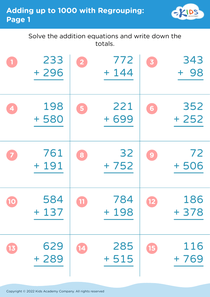
Counting practice Adding up to 1000 Without Regrouping Worksheets for Ages 5-8
4 filtered results
-
From - To
Enhance your child's math skills with our "Counting Practice Adding up to 1000 Without Regrouping" worksheets, designed for ages 5-8. Perfect for developing fundamental addition skills, these engaging worksheets offer a fun way to practice adding large numbers without the stress of regrouping. Through diverse activities, children will build confidence and improve their counting proficiency, laying a strong foundation for future math success. Whether for classroom use or at-home practice, these printable worksheets provide an excellent resource for young learners to advance their abilities in a supportive and enjoyable manner. Start your child's math journey today!
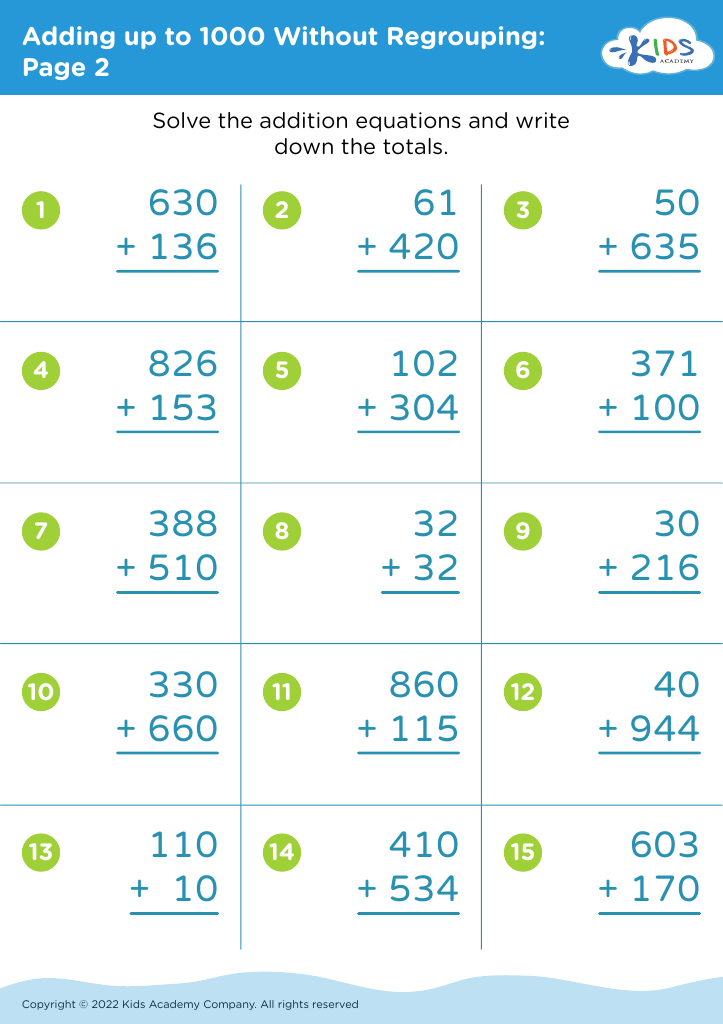
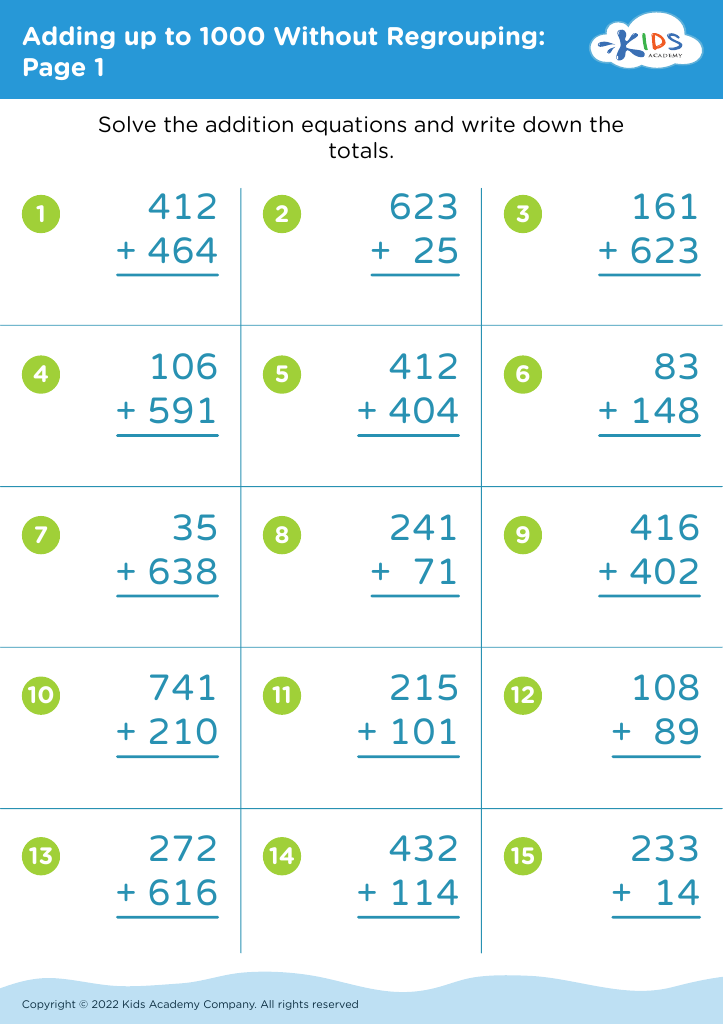
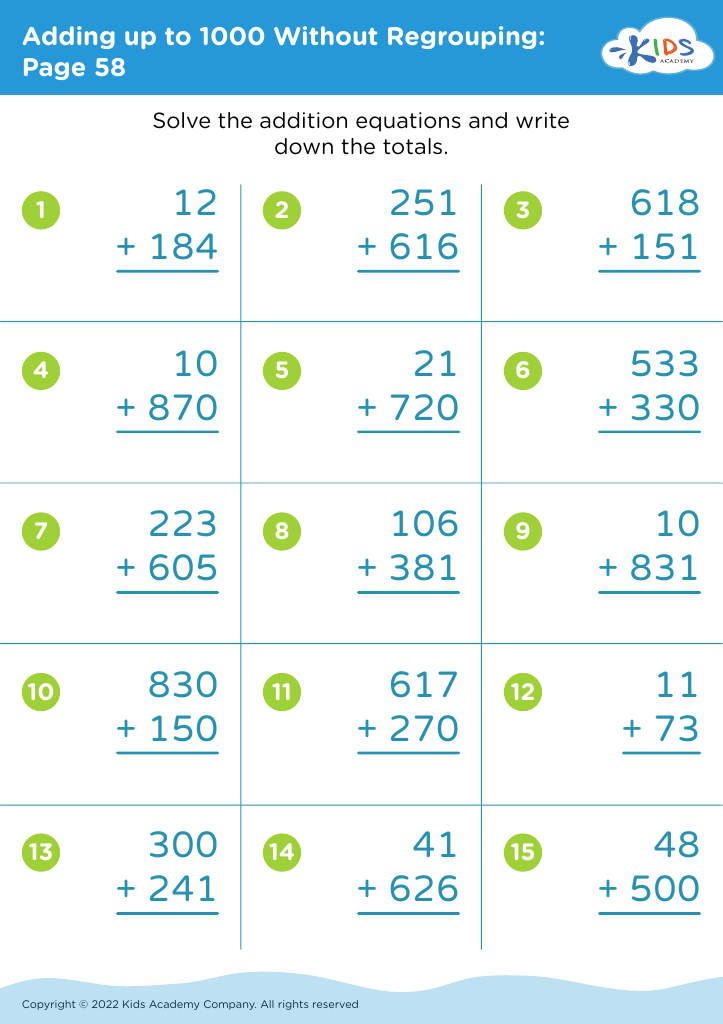
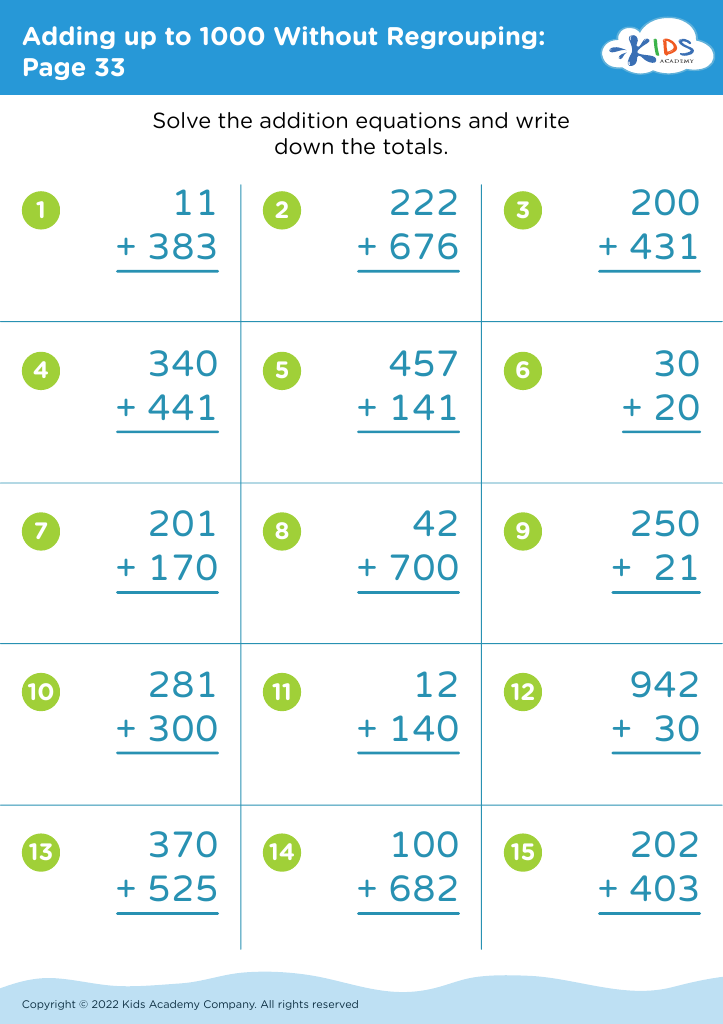


Counting practice and adding up to 1000 without regrouping are foundational math skills that play a crucial role in a child's cognitive and academic development. For ages 5-8, mastering these skills is vital for several reasons. First, it builds a strong numerical foundation. Young children, when engaged in counting, learn to sequence numbers correctly and understand the concept of quantity, both of which are essential for higher mathematical operations like addition and subtraction.
Second, adding up to 1000 without regrouping helps children develop mental math skills, which increase their ability to solve problems quickly and efficiently. Mastering addition within this range allows students to engage in more complex calculations with confidence, laying the groundwork for understanding place value and more intricate mathematical concepts later.
Moreover, practicing these skills helps in improving memory and concentration. When children count and add numbers repeatedly, they increase their attention span and ability to focus on tasks. Importantly, a strong grasp of early math skills is correlated with better academic performance not just in math but across various subjects.
Teachers and parents should care about these practices as they foster a positive attitude towards math, reduce anxiety related to the subject, and provide children with the required skills to succeed academically and in daily life. Through engaging activities and supportive learning environments, children can gain confidence and enjoy the challenges math offers.