Develop counting skills Adding up to 1000 Without Regrouping Worksheets for Ages 5-8
3 filtered results
-
From - To
Enhance your child's counting skills with our "Adding Up to 1000 Without Regrouping" worksheets, specifically designed for ages 5-8. These engaging resources help young learners practice addition within 1000 without the complexity of regrouping. Through fun, interactive exercises, children will develop a solid foundation in counting and enhance their mathematical fluency. These worksheets also promote critical thinking and problem-solving skills, making math enjoyable and effective! Ideal for both classroom settings and at-home practice, our materials cater to different learning paces and styles, ensuring that every child can master essential counting skills with confidence and ease. Empower your child's learning journey today!
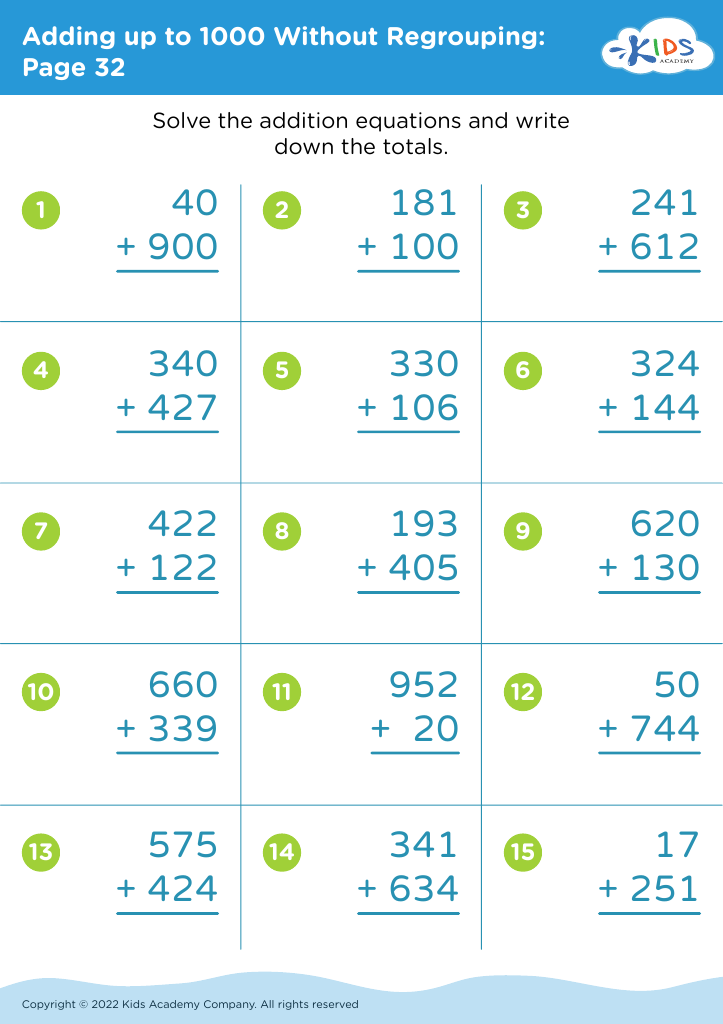
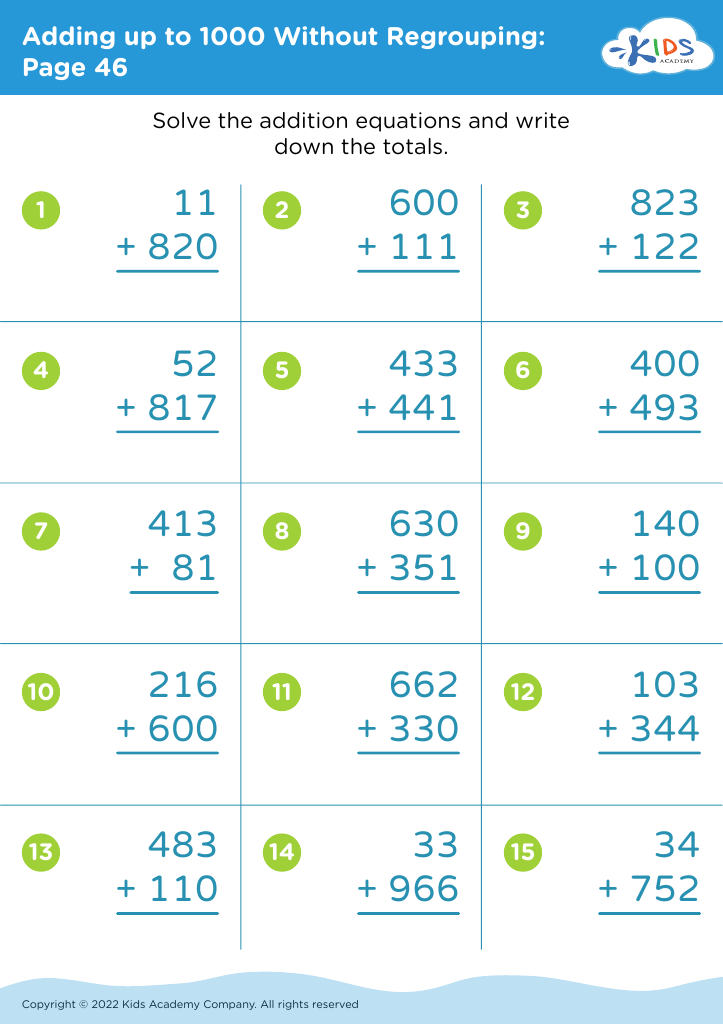
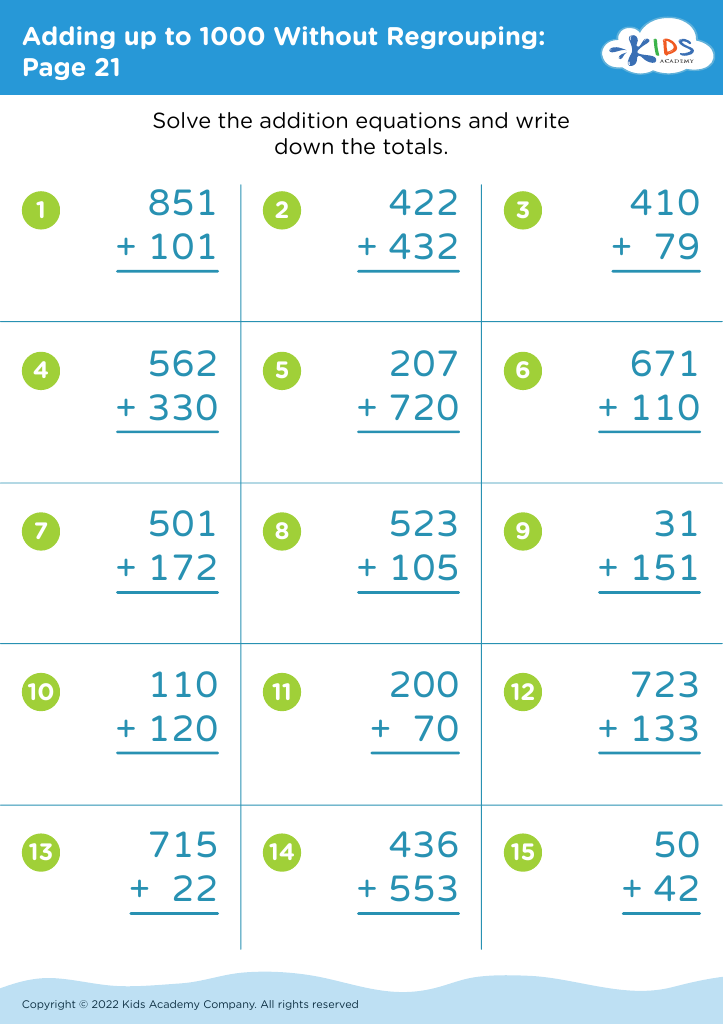


Developing counting skills, particularly the ability to add up to 1000 without regrouping, is crucial for children ages 5-8 for several reasons. First, these foundational skills are essential for both academic success and everyday life. Early mastery of counting sets the stage for more complex mathematical concepts, including addition, subtraction, and understanding number relationships.
Additionally, strengthening counting skills fosters cognitive development. Engaging with numbers enhances problem-solving abilities and logical thinking as children learn to recognize patterns and relationships between quantities. Moreover, counting is a gateway to building confidence in mathematics; children who experience early success are more likely to develop a positive attitude toward math, which can influence their willingness to engage with the subject in later years.
For parents and teachers, nurturing these skills through engaging activities and repetition can significantly benefit a child’s overall educational journey. Through play and interactive techniques, adults can make learning fun, thus encouraging children to embrace challenges. Furthermore, an early emphasis on counting can also improve future financial literacy, as a strong numerical foundation will aid children when they encounter real-world situations involving money, time management, and project planning, ultimately equipping them with essential life skills.