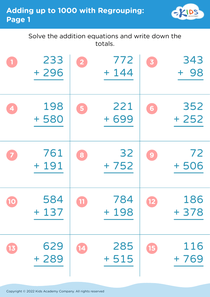
Improving counting skills Adding up to 1000 Without Regrouping Worksheets for Ages 5-8
4 filtered results
-
From - To
Unlock your child's mathematical potential with our "Improving Counting Skills: Adding Up to 1000 Without Regrouping" worksheets, specially designed for ages 5-8. These engaging, interactive worksheets help young learners build essential counting and addition skills in a fun and stress-free way. By focusing on adding numbers up to 1000 without regrouping, children can develop a strong foundation in arithmetic. Each worksheet encourages practice and reinforces understanding through colorful visuals and relatable scenarios. Perfect for both classroom settings and home learning, these resources will boost confidence and solidify counting abilities, paving the way for future math success. Get started today!
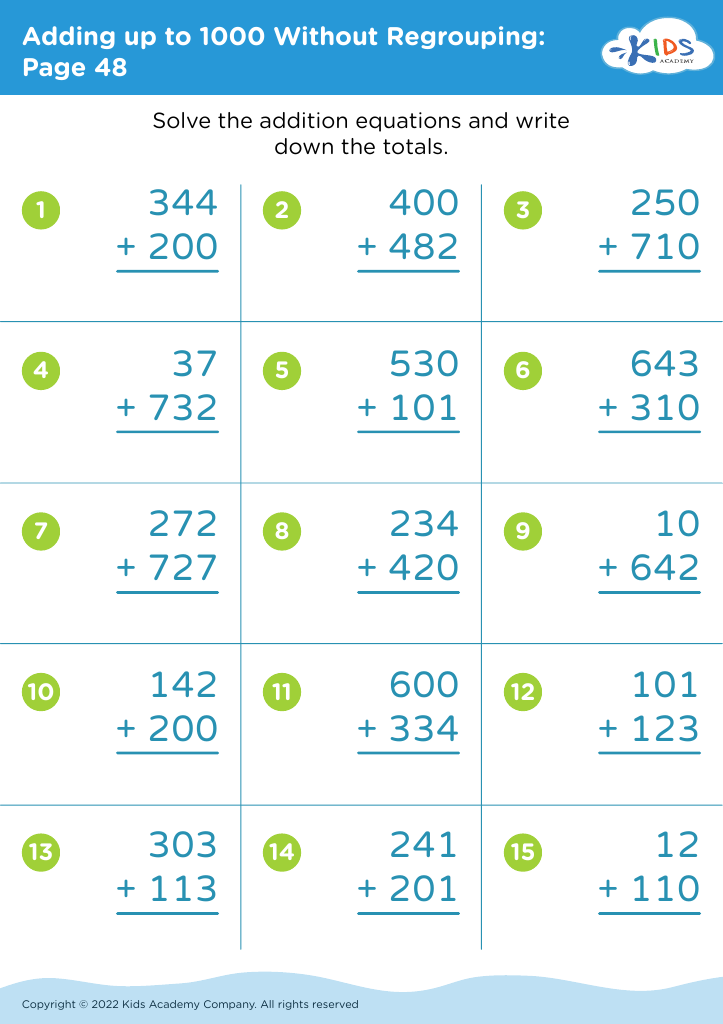
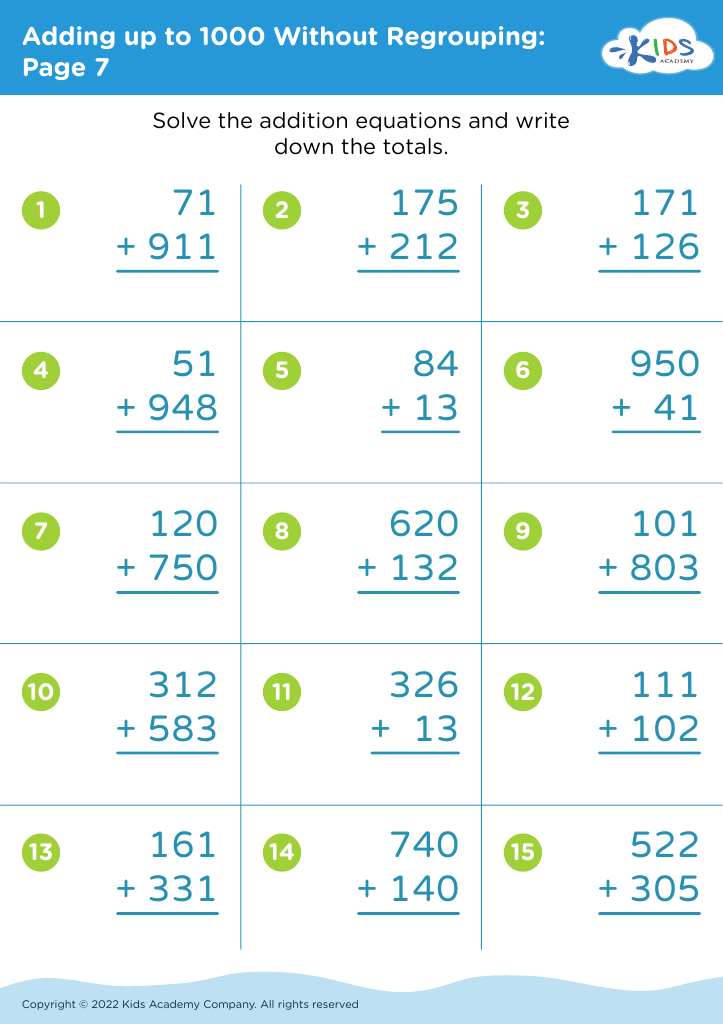
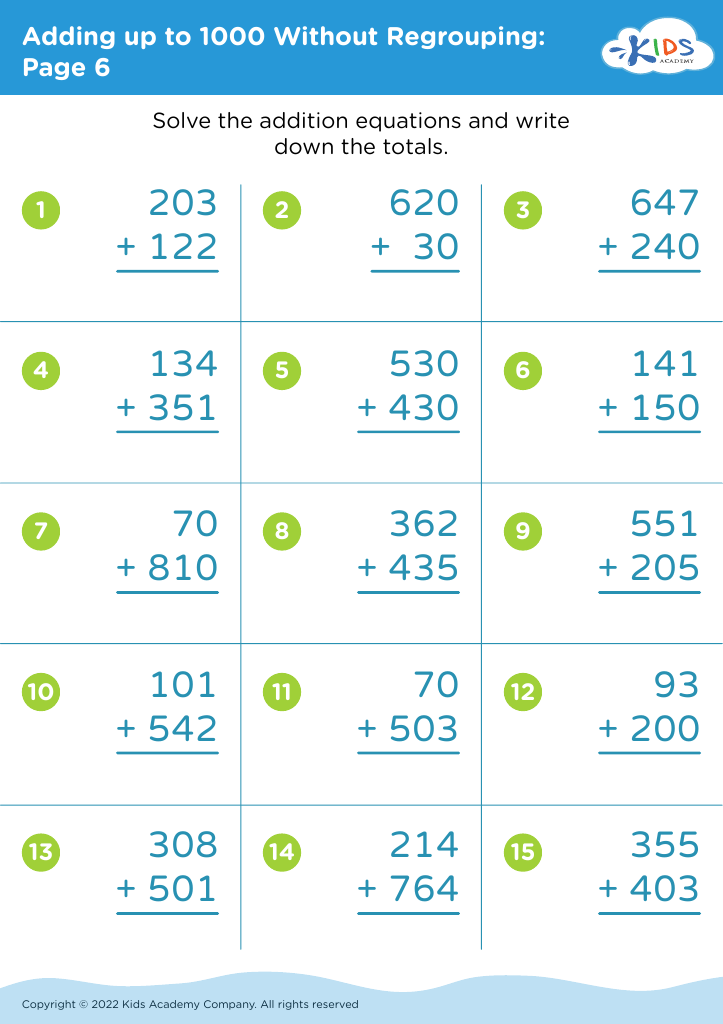
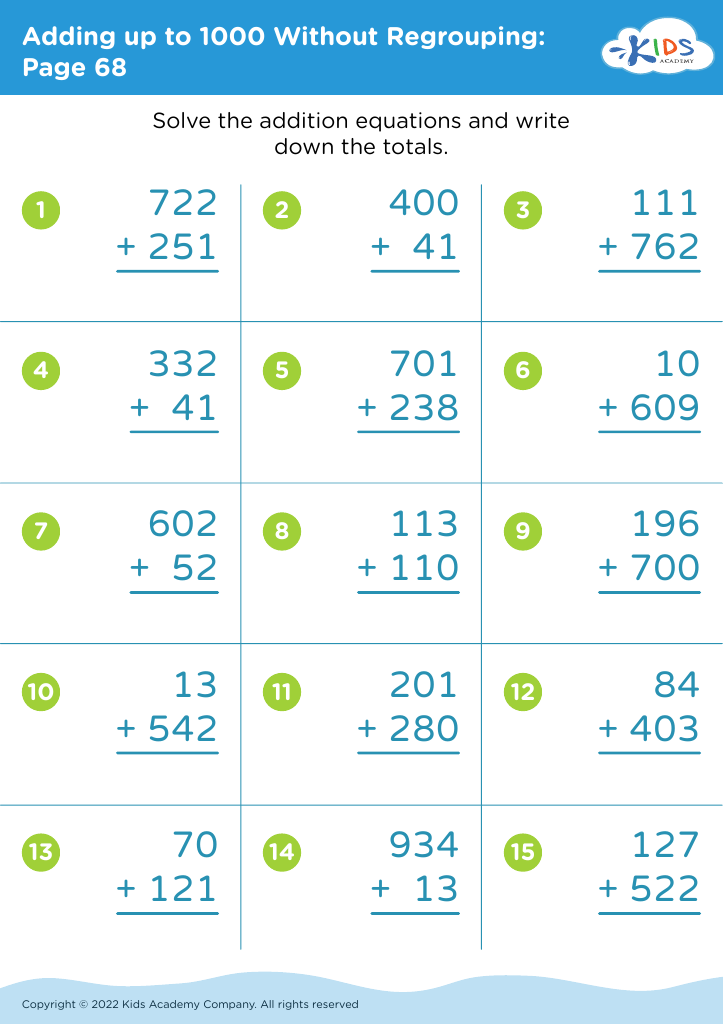


Improving counting skills, particularly the ability to add up to 1000 without regrouping, is essential for children aged 5-8 as it forms a foundational mathematical competence. At this age, children are typically developing their understanding of numbers and enhancing critical cognitive skills. Mastering counting skills sets the stage for more complex mathematical concepts later on, such as subtraction, multiplication, and division.
Parents and teachers play a vital role in several ways. First, they can identify early gaps in students' numerical fluency, ensuring timely intervention that can prevent future struggles in math. Second, strong counting and addition skills foster confidence, as children see their progress and capabilities grow, promoting a positive attitude towards learning.
Moreover, incorporating fun, engaging activities in practice helps them view mathematics less as a chore and more as an enjoyable subject. It enhances problem-solving abilities and fosters logical thinking, crucial skills not just in academic settings but in everyday life.
By prioritizing counting skills improvement, parents and teachers create a solid groundwork for children's ongoing education, ultimately setting them up for long-term academic success and an appreciation for mathematics.