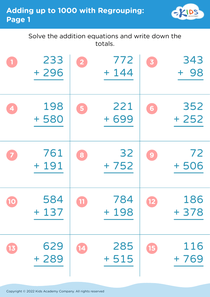
Understanding division Adding up to 1000 Without Regrouping Worksheets for Ages 5-8
3 filtered results
-
From - To
Explore our engaging "Understanding Division: Adding Up to 1000 Without Regrouping Worksheets" specifically designed for children ages 5-8. These worksheets simplify division concepts by focusing on intuitive methods that help young learners grasp the fundamentals of dividing whole numbers within 1000, all without the need for regrouping. Each printable worksheet employs a variety of fun and interactive exercises that build confidence and competence in mathematical skills. Dive into hands-on activities that make division less intimidating and more enjoyable, allowing children to strengthen their understanding while reinforcing critical thinking and problem-solving abilities. Perfect for home or classroom use!
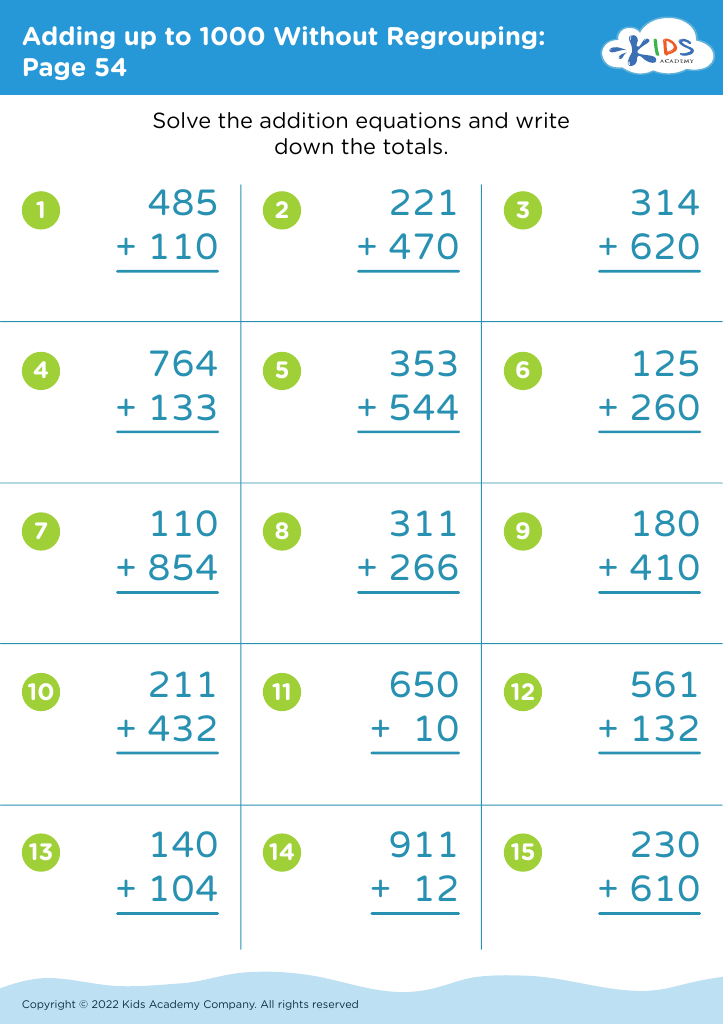
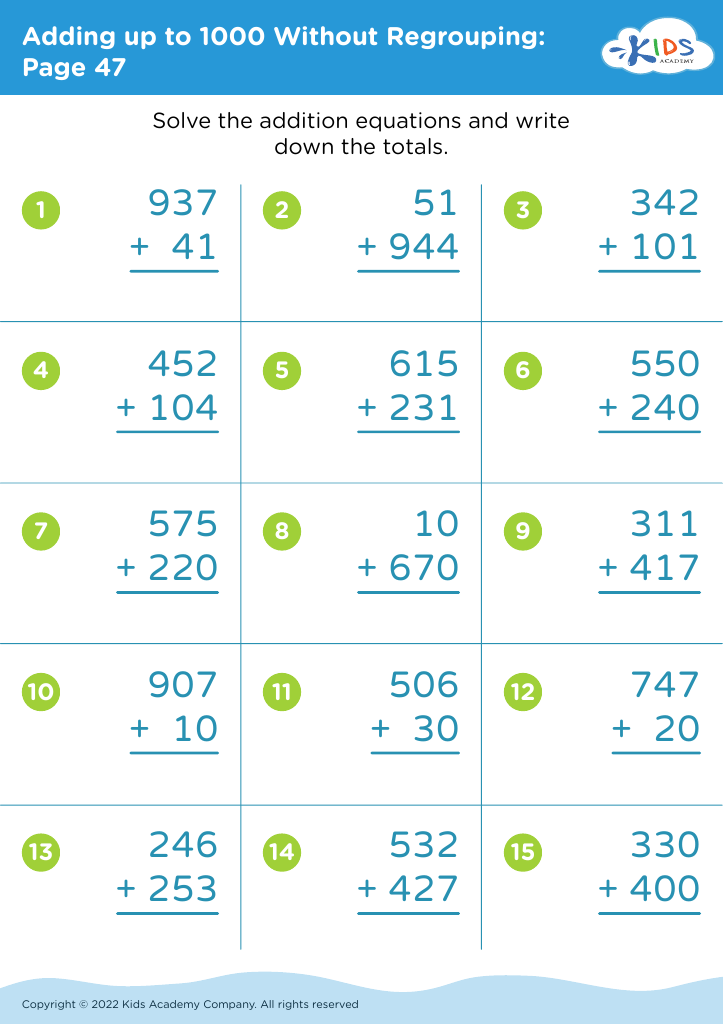
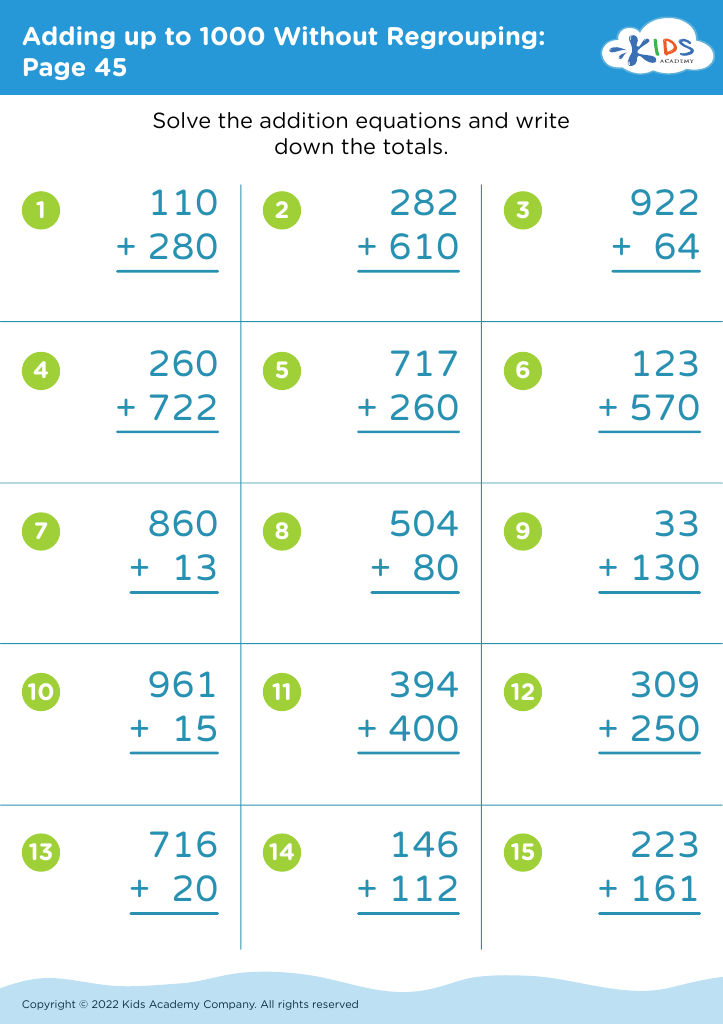


Understanding division, particularly concepts like "adding up to 1000 without regrouping," is essential for children ages 5-8 as it lays the foundation for their mathematics learning journey. At this early age, children begin to develop critical thinking and problem-solving skills, which are integral for their academic success. Introducing division concepts helps them grasp relationships between numbers, fostering a deeper comprehension of how quantities are distributed and shared.
For parents and teachers, emphasizing this understanding can significantly enhance a child's confidence and enthusiasm for math. Cognitive development during these formative years means that solidifying simple concepts can prevent difficulties in advanced topics later on. By employing engaging methods, such as visual aids and interactive games, educators can create an enjoyable learning atmosphere that encourages exploration and inquiry.
Additionally, understanding division aids in building skills like estimating, measuring, and recognizing patterns, which are crucial for real-world application. Ensuring children master these fundamentals can promote a lifelong love for mathematics, ultimately leading to better academic outcomes. Receiving support from both home and school can cultivate positive attitudes toward learning, empowering children to tackle challenges with resilience and curiosity. In essence, investing time in these concepts is integral to shaping well-rounded, capable learners.