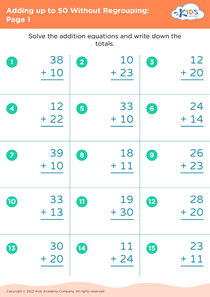
Addition skills Adding up to 50 with Regrouping Worksheets for Ages 5-8
3 filtered results
-
From - To
Enhance your child's arithmetic abilities with our "Addition Skills: Adding up to 50 with Regrouping Worksheets." Designed for children ages 5-8, these engaging activities help little learners master addition while introducing them to the concept of regrouping. Our meticulously-crafted worksheets provide step-by-step guidance and abundant practice opportunities. Curated to align with common core standards, these printables support both in-class learning and at-home enrichment, making math fun and accessible. Give your child the confidence and skills to excel in addition, setting the foundation for future math success. Explore our collection and watch them thrive with numbers seamlessly!
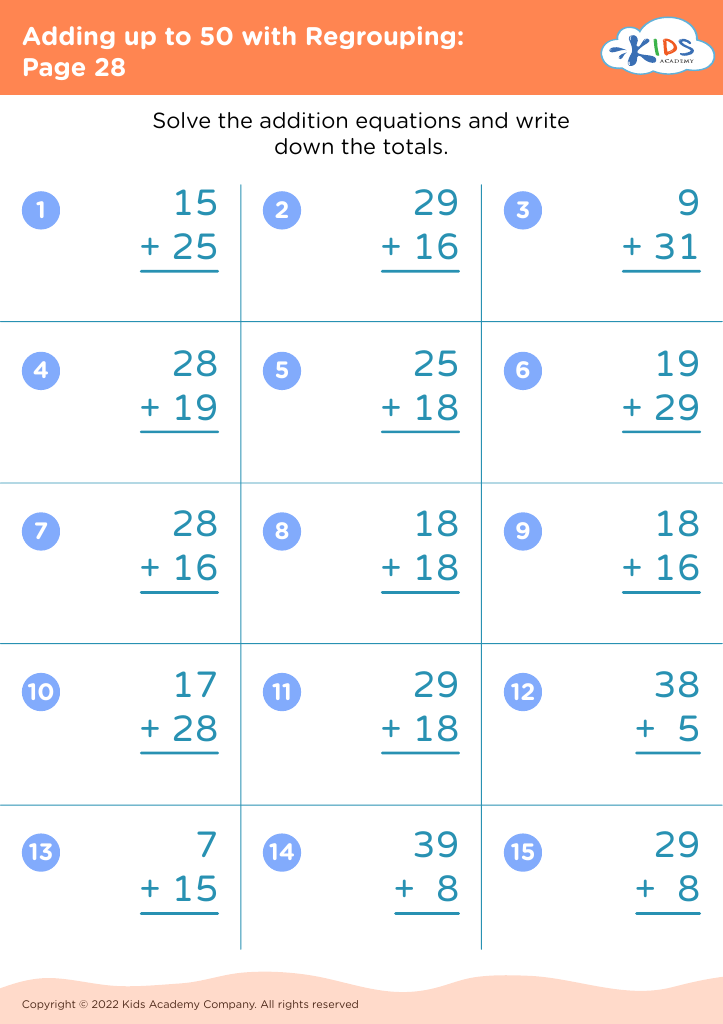
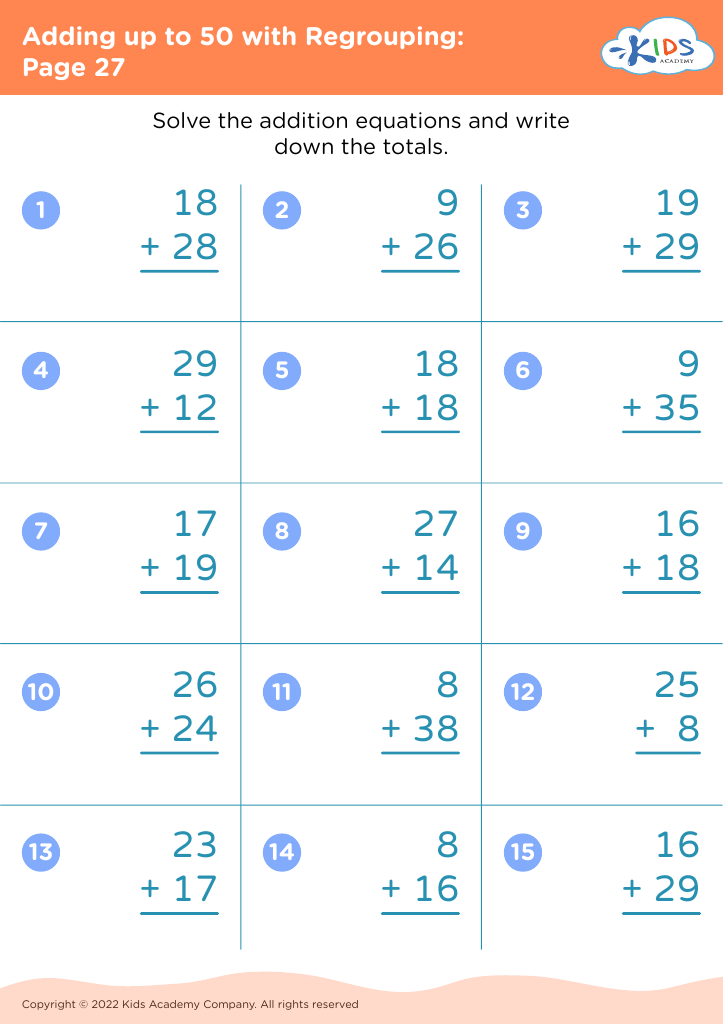
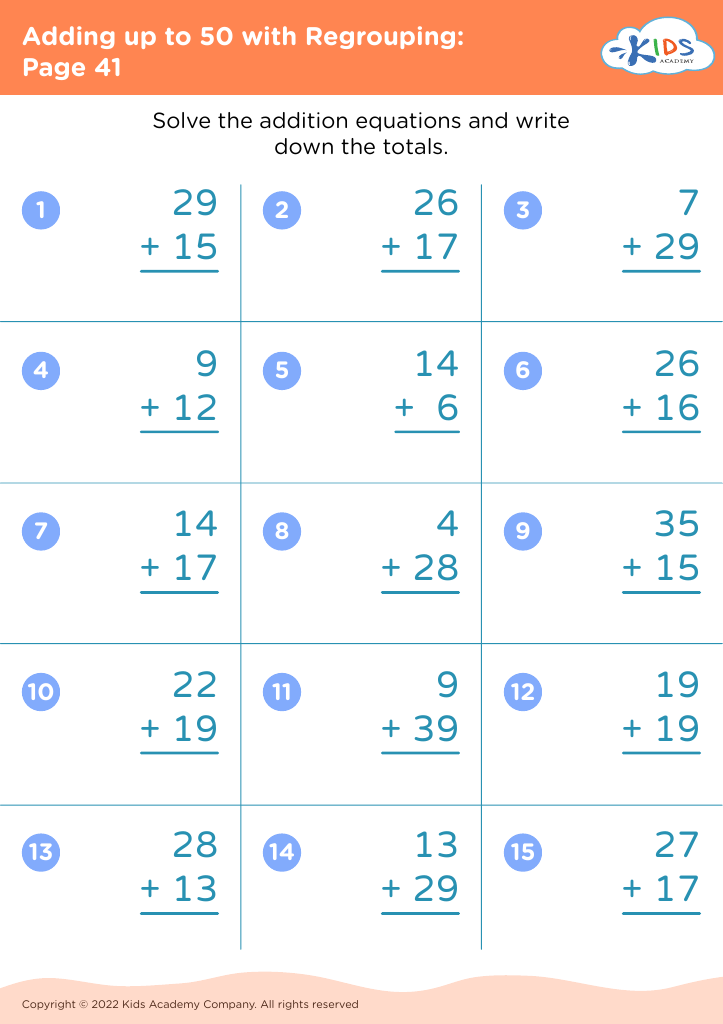


Mastering addition skills, particularly adding up to 50 with regrouping, is crucial for children aged 5-8 and should matter to parents and teachers for several compelling reasons. First, it lays a solid mathematical foundation. Understanding how to regroup in addition teaches children how numbers work together, creating a bedrock for more complex arithmetic like subtraction, multiplication, and division.
Second, acquiring these skills improves cognitive development. The mental process of regrouping fosters critical thinking and problem-solving abilities, both of which are applicable beyond math, nurturing overall intellectual growth.
Third, mastering addition boosts confidence. Children who perceive themselves as capable in math are more likely to approach future mathematical challenges with a positive attitude, reducing math anxiety.
Fourth, these skills have practical daily applications. Basic arithmetic is used in everyday tasks such as calculating money, measuring ingredients, and keeping track of time. This makes learning addition not just a school requirement but a life skill.
Lastly, early competence in math may positively influence academic performance across subjects. Research indicates that strong early math skills correlate with better literacy and general academic abilities, underscoring its critical role in comprehensive education. Thus, both parents and teachers should prioritize helping children master addition up to 50 with regrouping.