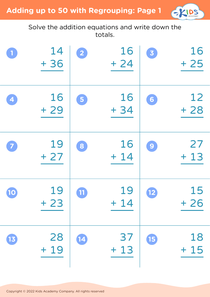
Enhance number recognition Adding up to 50 Without Regrouping Worksheets for Ages 5-8
3 filtered results
-
From - To
Boost your child's number recognition skills with our "Adding up to 50 Without Regrouping Worksheets" designed for ages 5-8. These engaging worksheets help early learners understand basic addition, while reinforcing the ability to recognize and work with numbers up to 50. Perfect for home or classroom use, our resources foster confidence in young mathematicians by offering a variety of fun, expertly-crafted activities. Whether your child is just starting to explore the world of numbers or looking to solidify their foundational math skills, these worksheets provide the perfect blend of education and enjoyment. Visit us to download and start learning today!
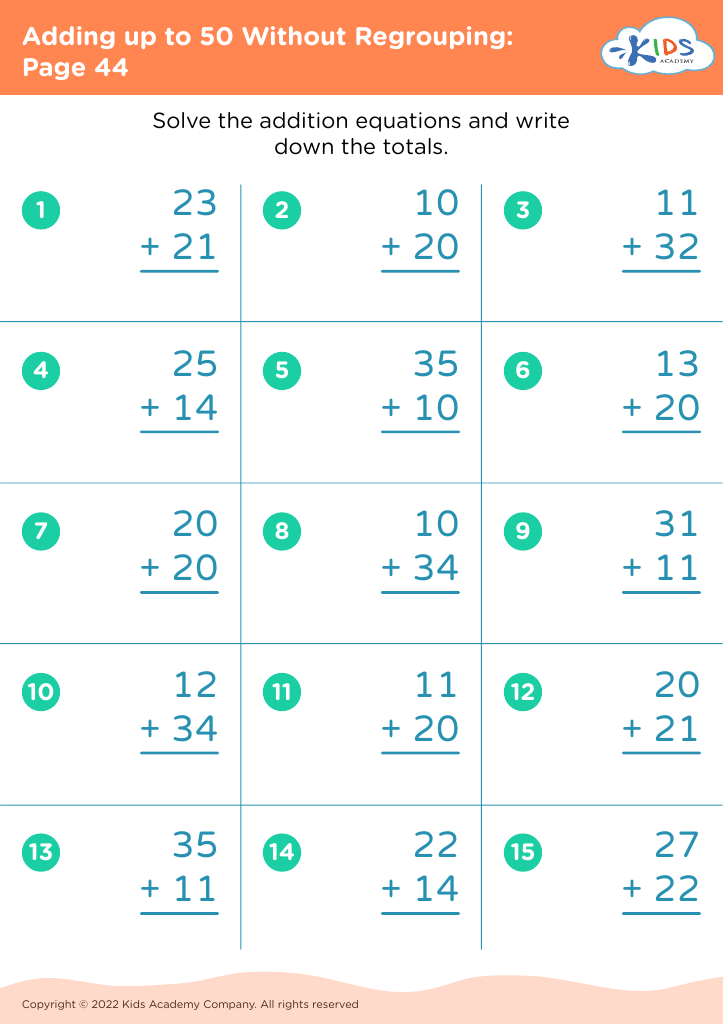
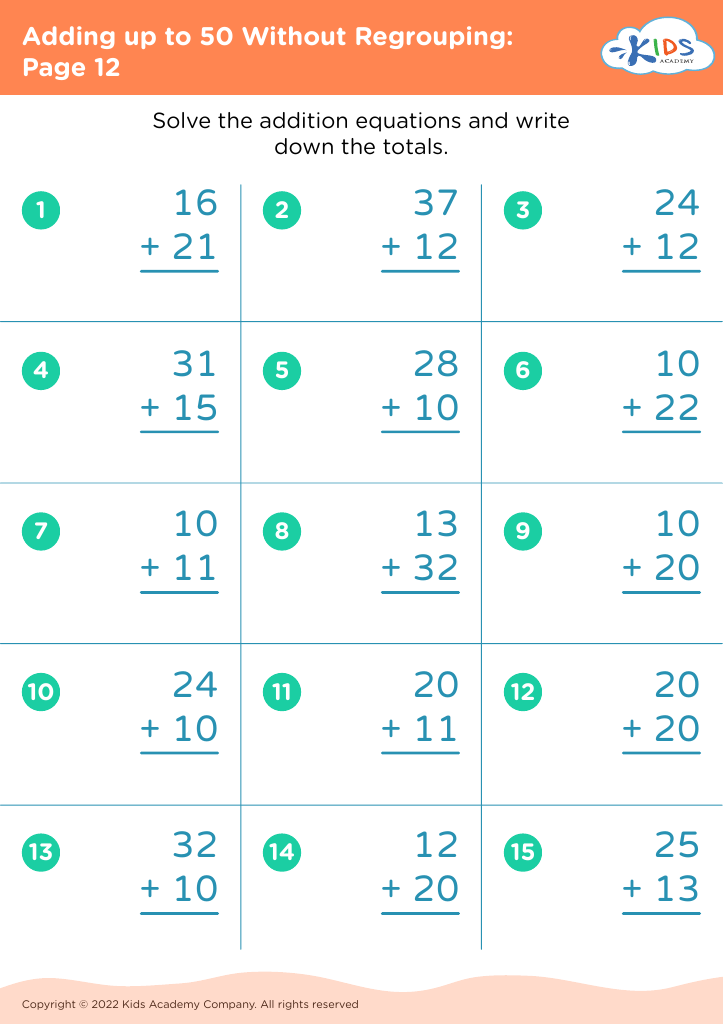
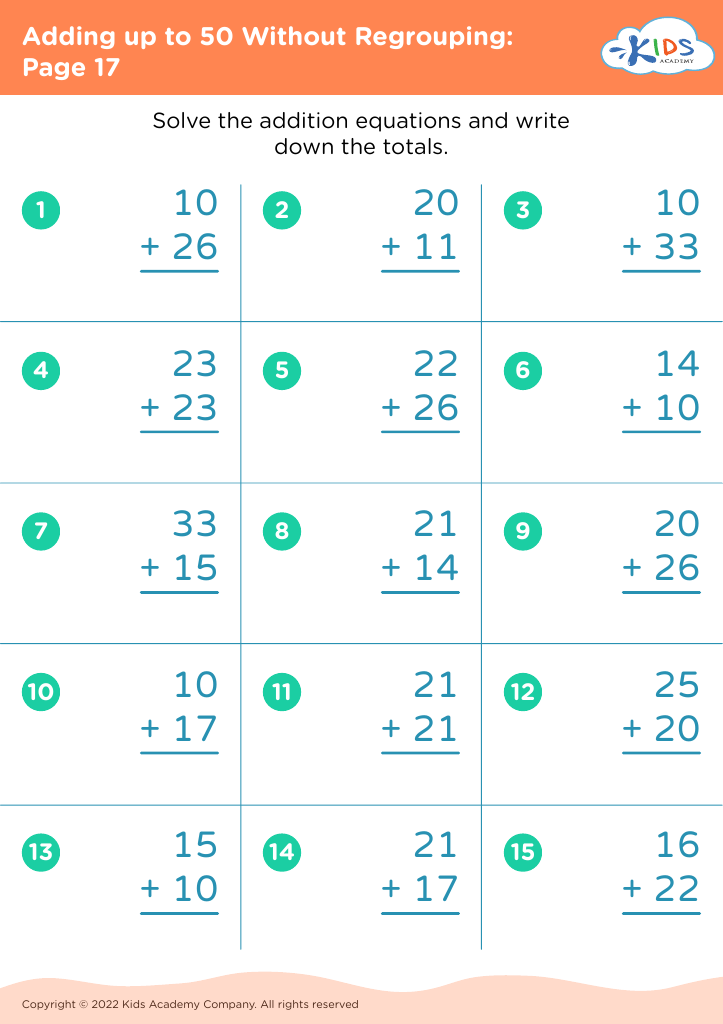


Enhancing number recognition and the ability to perform addition up to 50 without regrouping for children ages 5-8 is crucial for several reasons. During these formative years, children are developing their foundational math skills, which are vital for their future academic success and everyday life.
Firstly, number recognition helps children understand the concept of quantity and how numbers represent objects and value. This foundational skill is essential for more complex math operations and for recognizing numbers in everyday contexts such as telling time, reading dates, and handling money.
Secondly, mastering addition up to 50 without regrouping at an early age builds confidence and fluency in basic arithmetic. This fluency enables greater ease in learning more advanced mathematical concepts later on. When children are comfortable with simple addition, they can focus more on problem-solving and higher-order thinking skills without being hindered by a lack of basic knowledge.
Moreover, lesson planning around enhancing number recognition and addition skills can be engaging and fun, incorporating games and activities to cater to various learning styles. This engagement fosters a positive attitude towards math, encouraging children to enjoy and appreciate the subject rather than fear it.
In conclusion, emphasizing these skills in early education sets a solid groundwork, ensuring children develop strong, confident mathematical abilities that will benefit them throughout their education and life.