Understanding equality Addition & Subtraction Worksheets for Ages 5-8
4 filtered results
-
From - To
Explore our "Understanding Equality Addition & Subtraction Worksheets" designed for children ages 5-8! These engaging and interactive worksheets help young learners grasp the fundamental concepts of addition and subtraction while emphasizing the importance of equality. By working through a variety of exercises, students will develop their mathematical skills, boosting their confidence in solving equations. Each worksheet is thoughtfully designed to foster critical thinking and problem-solving abilities, making math enjoyable and accessible. Perfect for home or classroom use, our resources align with educational standards and cater to different learning styles. Start your child's mathematical journey today with these fun, printable worksheets!
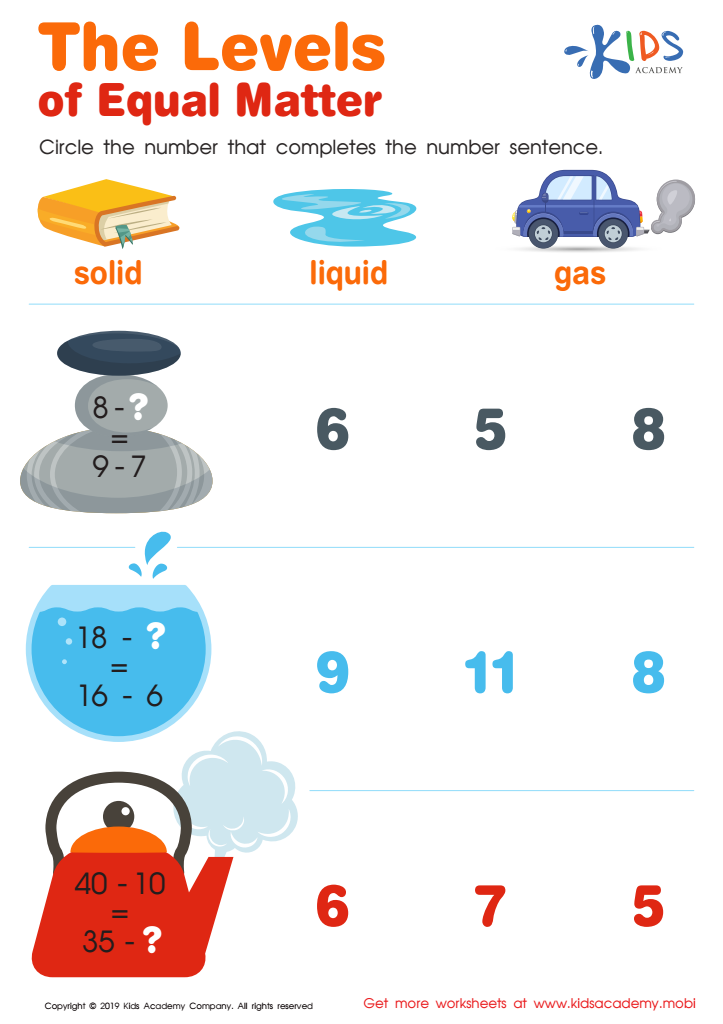
The Levels of Equal Matter Worksheet
 Assign to My Students








Understanding equality in addition and subtraction is crucial for children aged 5-8 as it lays the foundation for their mathematical comprehension. At this stage, children are developing essential skills in number sense, and their ability to grasp the concept of equality helps them understand how numbers relate to one another. Recognizing that equations like 3 + 2 = 5 and 5 - 2 = 3 represent the same relationship fosters flexible thinking and problem-solving skills.
Parents and teachers should prioritize this understanding because it enhances not only arithmetic skills but also critical thinking abilities. When children learn to see both sides of an equation as equal, they are better equipped to tackle more complex mathematical concepts in the future, such as balancing equations or understanding basic algebra. Moreover, this foundational understanding promotes mathematical reasoning, enabling children to check their work and make logical decisions throughout their learning journeys.
Additionally, fostering an appreciation for equality in mathematics creates a positive attitude towards math as a subject. It encourages children to explore and ask questions, ultimately building their confidence. As they engage with numbers more intuitively, they become more adept at interpreting information in everyday life, from handling money to understanding time and measurements.








