Counting skills improvement Math Worksheets for Ages 5-8
3 filtered results
-
From - To
Enhance your child's counting skills with our engaging Math Worksheets designed specifically for children ages 5-8. Our printable resources provide a fun and interactive way for young learners to master essential counting concepts. Featuring colorful visuals and varied activities, these worksheets cater to different learning styles, ensuring every child can thrive. From basic number recognition to more challenging counting exercises, our worksheets promote a solid mathematical foundation while boosting confidence. Perfect for homeschooling, classroom use, or extra practice at home, our Counting Skills Improvement worksheets are an invaluable tool for fostering a love for math and encouraging skill development.
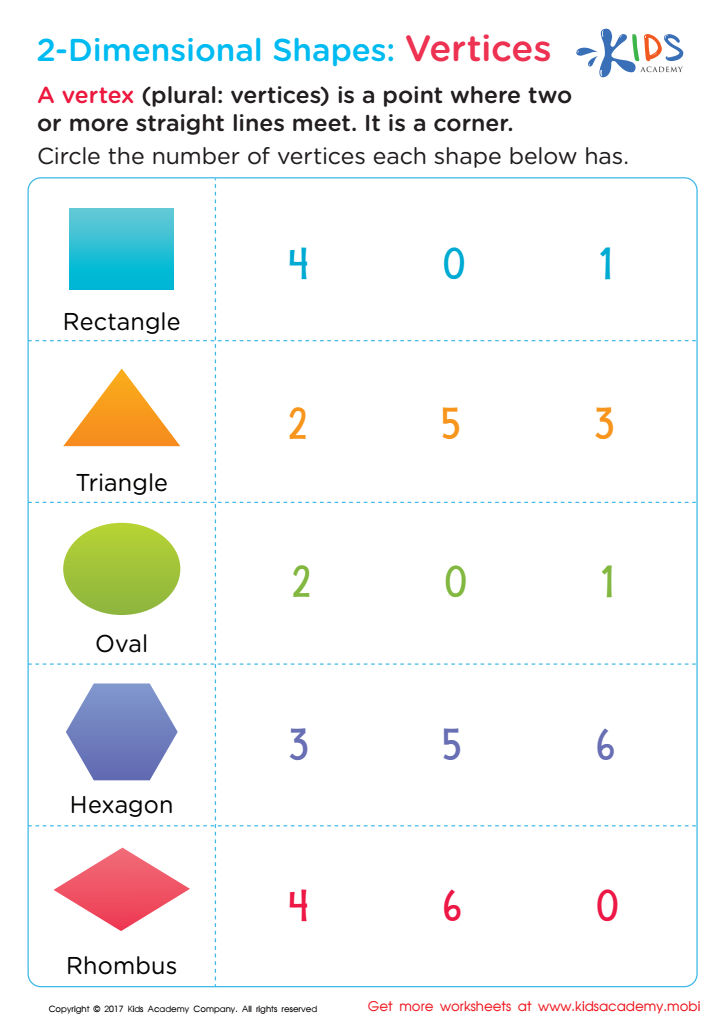
Two–Dimensional Shapes: Vertices Printable
 Assign to My Students
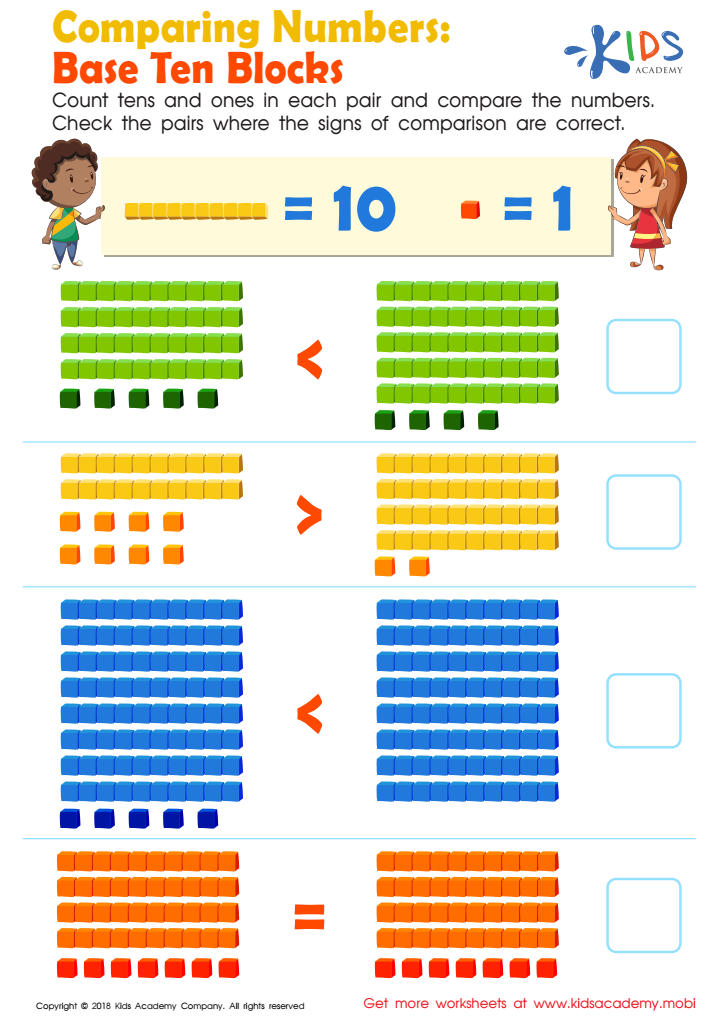
Comparing Numbers: Base Ten Blocks Worksheet








Counting skills are foundational for young learners and play a crucial role in their overall mathematical development. For children aged 5-8, improving counting skills is essential, as it sets the groundwork for more advanced mathematical concepts such as addition, subtraction, and problem-solving. When children become confident in counting, they develop a sense of number sense, which helps them understand relationships between numbers and quantities.
Parents and teachers should care about counting skills improvement because these skills are not only vital for academic achievement but also promote cognitive development. Strong counting abilities enhance critical thinking, boost confidence in handling numbers, and foster mathematical curiosity. Moreover, mastery of counting aids in everyday activities, from simple tasks like sharing snacks to more complex budgeting skills later in life.
Additionally, early intervention can prevent math anxiety, ensuring that children do not struggle as they progress in their education. By actively engaging children in counting activities—like using tools, games, and real-life scenarios—adults can facilitate a supportive learning environment. Such encouragement cultivates a positive attitude towards math, helping children develop a robust foundation that will benefit them throughout their education and beyond. Investing time in counting skills now prepares the way for future success in science, technology, engineering, and mathematics (STEM) fields.








