
Reading rulers Math Worksheets for Ages 5-8
3 filtered results
Difficulty Level
Grade
Age
-
From - To
Subject
Activity
Standards
Enhance your child’s measurement skills with our Reading Rulers Math Worksheets specifically designed for ages 5-8. These engaging and educational printables from Kids Academy ensure that young learners grasp the concept of using rulers to measure objects accurately. Each worksheet combines colorful illustrations with simple instructions, making it fun and easy for kids to understand lengths in both inches and centimeters. Ideal for use at home or in the classroom, these worksheets develop essential math skills while fostering a love of learning. Help your child master measurement with our carefully crafted Reading Rulers Math Worksheets.
Favorites
With answer key
Interactive
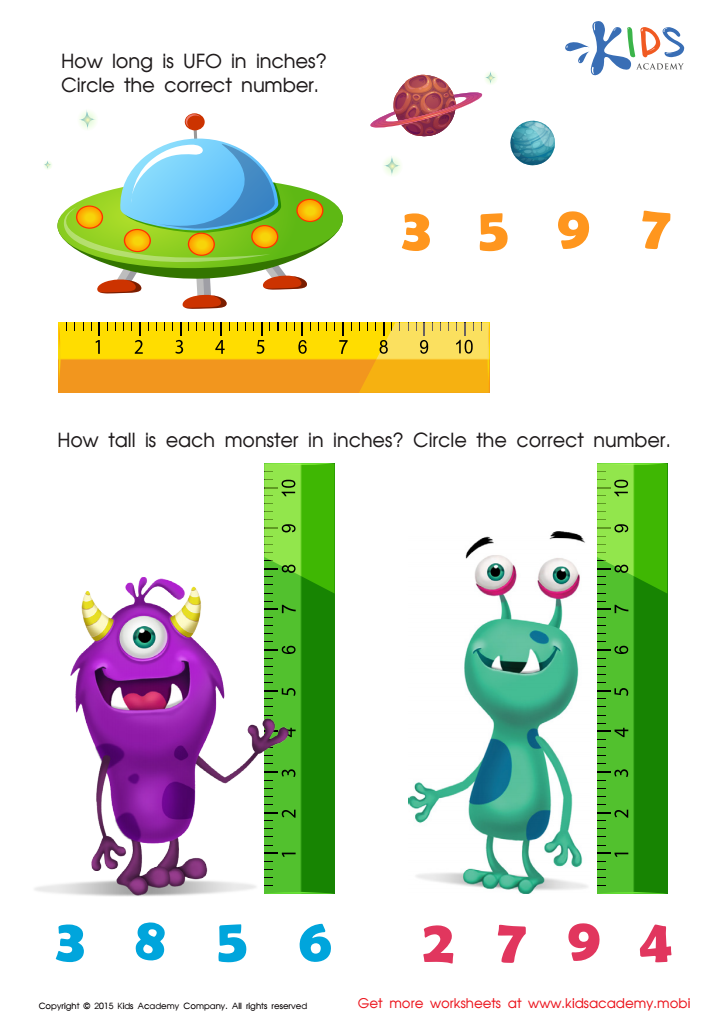
Measuring in Inches Worksheet
Look at the picture, can you measure the UFO & monsters? Write down how long each is. Which is tallest? Circle it. Get more free printable math worksheets for kindergarten at our website.
 Assign to My Students
Measuring in Inches Worksheet
Worksheet
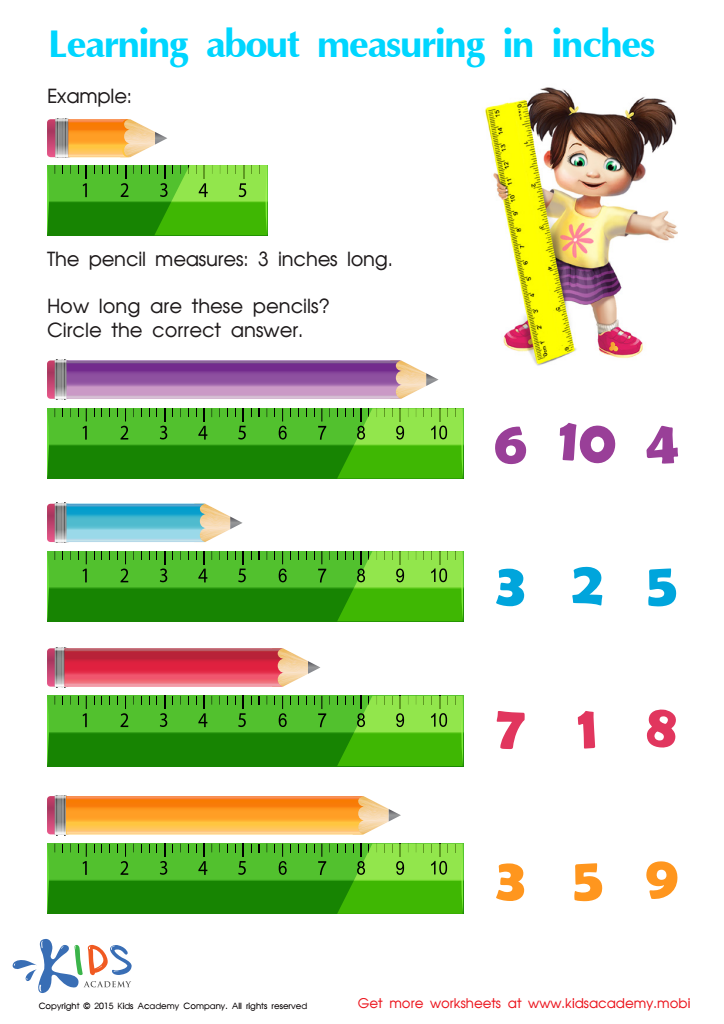
Learning About Measuring In Inches Printable
Print this free worksheet and measure pencils together with kids. See who finds the longest and the shortest! Enjoy learning math with your kids.
Learning About Measuring In Inches Printable
Worksheet
Join Kids Academy for Free
Who is primarily going to use this learning content?







Reading rulers for mathematics can be an incredibly valuable tool for children ages 5-8 as they embark on their educational journey. During these formative years, children are not only learning numbers and basic arithmetic but also developing key cognitive skills, such as spatial awareness, fine motor skills, and the ability to follow instructions.
Parents and teachers should care about reading rulers because they provide visual and tactile reinforcement of mathematical concepts. For young learners, abstract numerical concepts become more concrete when they can physically measure, compare, and manipulate numbers. This hands-on approach supports different learning styles and can be particularly beneficial for children who might struggle with traditional methods of instruction.
Reading rulers also help children improve their concentration and precision. Measuring activities necessitate focus and careful observation, which in turn can enhance a child's attention span and patience—skills that are critical across all subjects. These rulers cater to developmental needs by contextualizing learning in a playful yet structured manner, fostering a love for math in an engaging way.
Moreover, using reading rulers encourages collaborative learning. Group activities involving these tools can foster teamwork, communication, and shared problem-solving strategies among peers. Understanding the importance of these seemingly simple tools can lead to more effective early education and long-lasting academic success.








