Mental math skills Mixed Times Tables Worksheets for Ages 5-8
3 filtered results
-
From - To
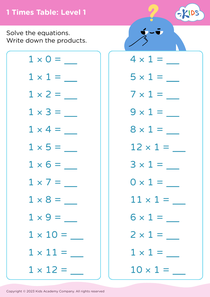
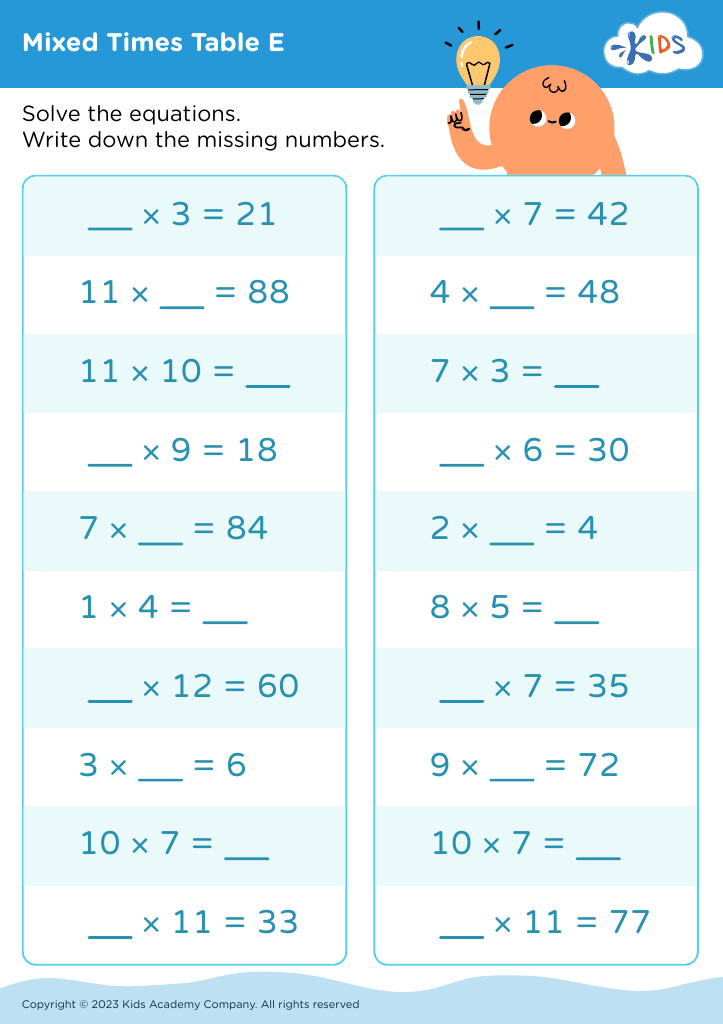
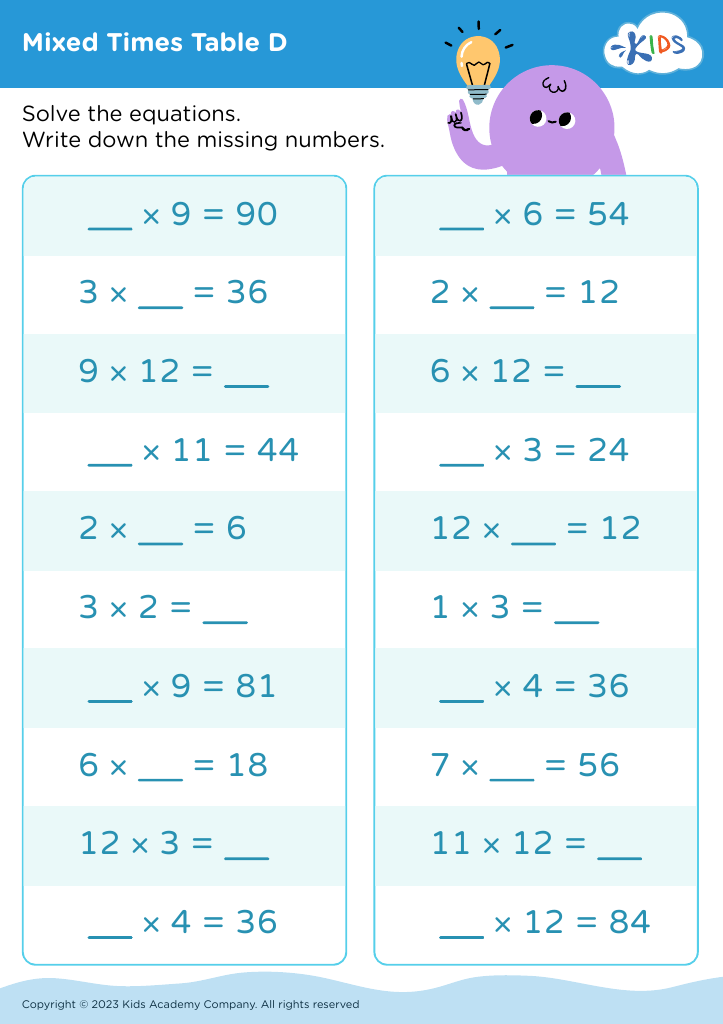
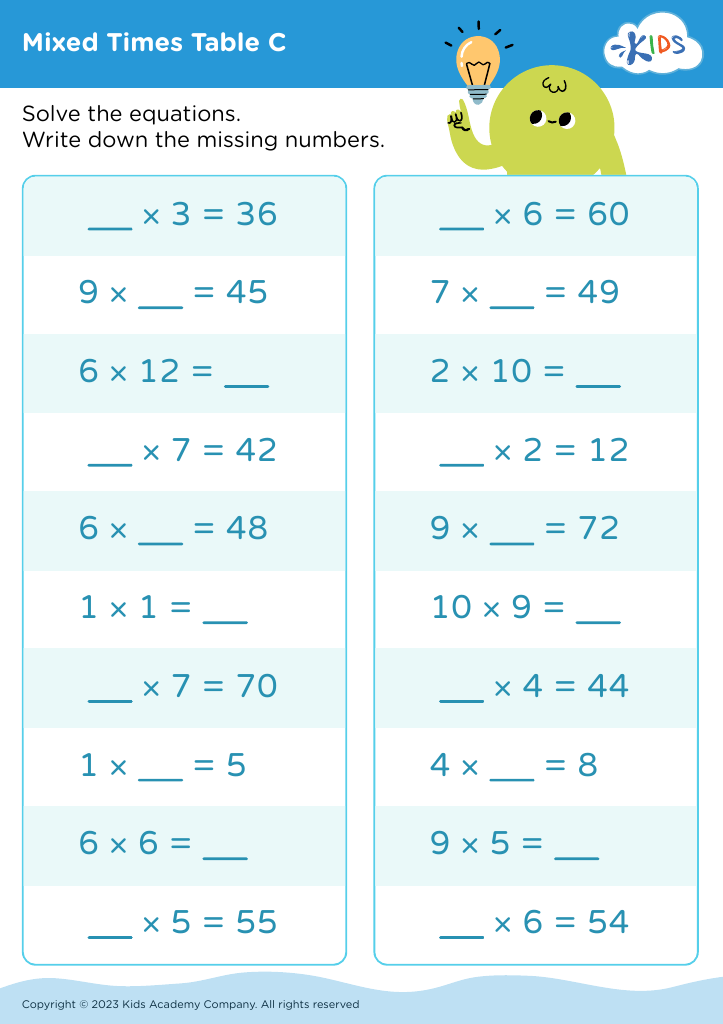
Enhance your child's mental math skills with our Mixed Times Tables Worksheets, specifically designed for ages 5-8! These engaging worksheets aim to develop quick recall of multiplication facts through fun and interactive exercises. Our carefully crafted activities help young learners build confidence in their math abilities while improving their agility with numbers. Perfect for use at home or in the classroom, these worksheets are suited for all learning styles. Enjoy a variety of formats that make practicing multiplication exciting and enjoyable. Download our worksheets today and watch your child's math skills flourish with each session of effective practice!


Mental math skills, particularly in mastering mixed times tables, play a crucial role in the development of a child's early mathematical abilities. For children ages 5-8, it is essential to build a strong foundation in arithmetic that fosters confidence and problem-solving skills. Developing mental math skills through mixed times tables enhances a child’s number sense, allowing them to recognize patterns, make connections, and understand multiplication in a deeper way.
Parents and teachers should care about encouraging these skills because they promote resilience and adaptability in young learners. Being proficient in mental math helps children tackle more complex math problems in the future and aids in everyday situations, such as budgeting or cooking. Additionally, mental calculations engage the brain actively, enhancing cognitive functions, such as memory and attention.
Furthermore, mastering mixed times tables can lead to improved academic performance, reducing math anxiety and building a positive attitude toward mathematics. By emphasizing these skills, parents and educators nurture a generation of confident learners, equipped to take mathematical challenges in their stride. This early investment in mental math not only lays the groundwork for future math success but also supports overall academic achievements across various subjects.