Number ordering Worksheets for Ages 5-9
3 filtered results
-
From - To
Number Ordering Worksheets for Ages 5-9 provide engaging and educational activities designed to enhance your child’s numerical skills. Tailored for young learners, our worksheets offer a variety of exercises to practice ordering numbers, filling in missing numbers, and understanding number sequences. These activities are not only fun but also crucial in developing a child's mathematical foundation. Perfect for both classroom and home use, our resources cater to different levels of learning, ensuring an enriching experience for every child. Enhance your child's confidence and proficiency in math with our well-structured and user-friendly worksheets. Dive into number ordering now!
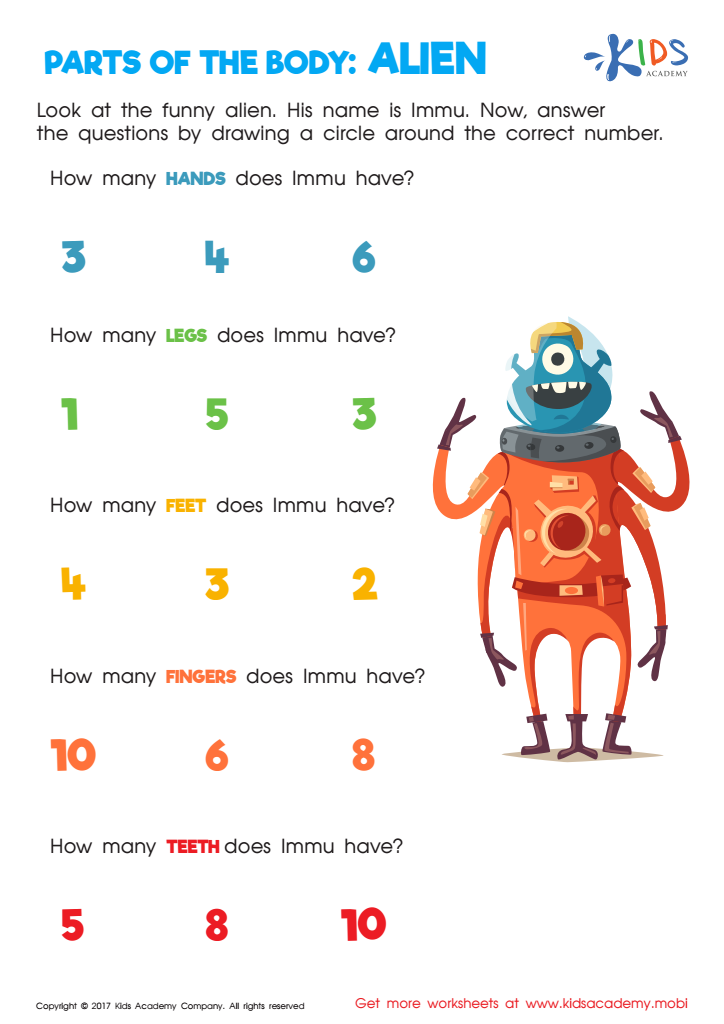
Alien Worksheet
 Assign to My Students







Number ordering is a foundational skill in early mathematics education, critical for children aged 5-9, and is important for both parents and teachers to emphasize. At this stage, children are developing their understanding of numerical relationships, which are fundamental for more advanced mathematical concepts.
Firstly, learning to order numbers enhances a child's number sense, enabling them to recognize patterns and sequences in everyday life. This skill underpins their ability to perform operations such as addition, subtraction, and comparison, which are vital for problem-solving.
Secondly, understanding number ordering helps children grasp the concept of magnitude and place value, which are essential for their future progression in math. For instance, discerning that 15 is greater than 12 but less than 18 helps in both simple counting and more complex operations like multiplication and division.
Additionally, early mastery of number ordering promotes confidence and reduces math anxiety. Children who are adept at recognizing and ordering numbers develop a positive attitude towards learning and become more proactive in tackling math challenges.
For teachers and parents, engaging children in activities that involve sorting, sequencing, and placing numbers in order as part of daily routines can reinforce this skill. Games, puzzles, and hands-on activities make the learning process enjoyable and effective. Hence, prioritizing number ordering in early education sets a solid mathematical foundation that benefits children’s academic development and everyday life problem-solving skills.








