Sorting and categorizing Worksheets for Ages 5-9
3 filtered results
-
From - To
Enhance your child's cognitive skills with our specially designed Sorting and Categorizing Worksheets for ages 5-9. At Kids Academy, we believe in making learning fun and engaging. Our worksheets are crafted to help young learners sort items by different attributes such as color, shape, size, and more. These activities not only boost their critical thinking but also improve their ability to classify and organize information. Perfect for classroom use and homeschooling, each worksheet aligns with educational standards to ensure effective learning. Unlock the potential of your young scholar today with our comprehensive collection!
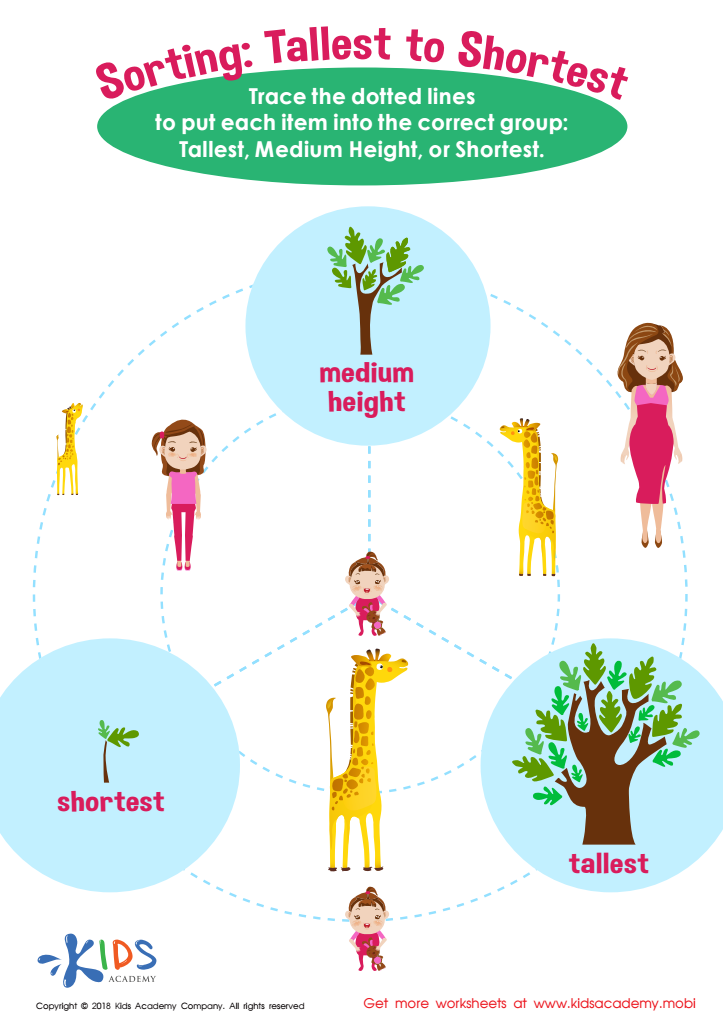
Sorting: Tallest to Shortest Worksheet
 Assign to My Students






Sorting and categorizing are foundational cognitive skills that significantly benefit children aged 5-9. For parents and teachers, these activities play an essential role in developing critical thinking and organizational skills. When kids sort and categorize objects, they learn to observe attributes, recognize patterns, and differentiate between similarities and differences. These skills are fundamental in mathematics, science, and literacy.
Engaging in sorting activities helps improve problem-solving abilities and enhances a child's capacity for logical reasoning. For instance, when children categorize shapes, colors, or sizes, they must decide on classification rules and rationalize their choices. This practice trains their brains to think systematically and approach problems methodically.
Moreover, sorting aids language development. As children discuss their sorting criteria, they learn new vocabulary and linguistic structures, strengthening their communication skills. Early introduction to categorization also fosters a more organized mindset. An organized approach benefits children academically by enabling them to arrange their thoughts logically and manage their tasks more efficiently.
In social scenarios, sorting and categorizing support cooperative play and shared learning experiences, thereby building social skills and teamwork. Overall, nurturing these skills lays a robust foundation for lifelong learning, making it imperative for parents and teachers to incorporate sorting and categorizing activities into children's daily routines.








