Telling time Worksheets for Ages 5-9
4 filtered results
-
From - To
Welcome to our Telling Time Worksheets for Ages 5-9, designed to make learning how to tell time fun and engaging! Our printable worksheets feature colorful graphics and interactive activities tailored for young learners. Through various exercises, kids can practice reading analog and digital clocks, understanding time concepts like hours and minutes, and solving practical time-related problems. These resources help reinforce essential skills while encouraging kids to build confidence in their time-telling abilities. Perfect for classrooms or home learning, our worksheets cater to diverse learning styles, ensuring every child can master this crucial skill with ease. Explore and start your time-telling journey today!
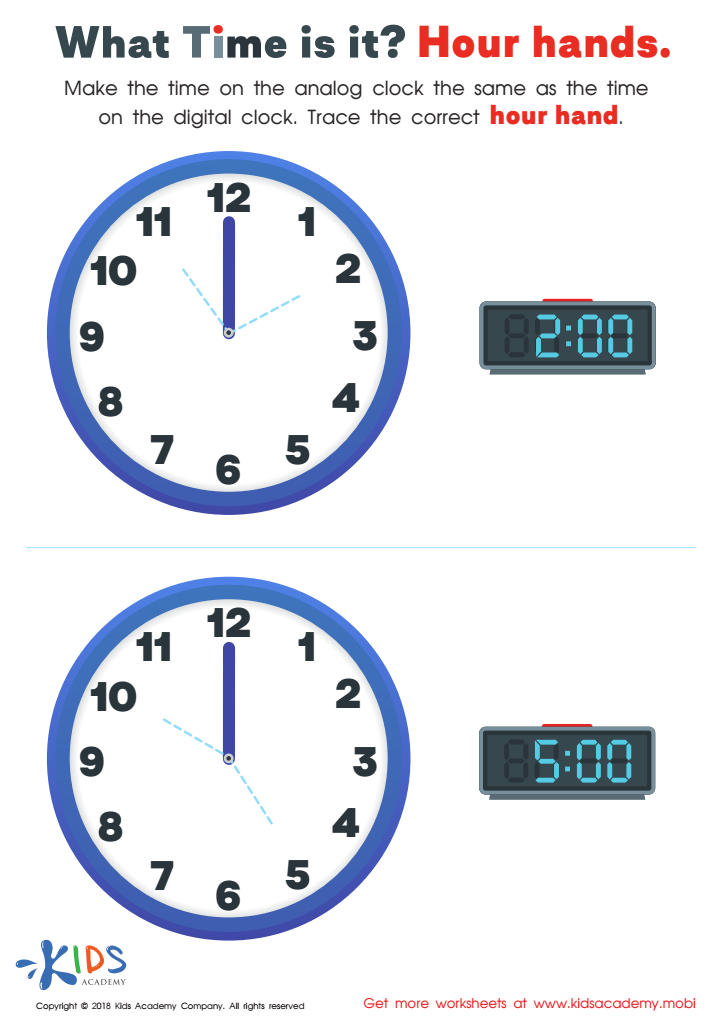
What Time Is it? Hour Hands Worksheet
 Assign to My Students








Teaching children ages 5-9 how to tell time is an essential skill that extends far beyond simply reading a clock. First, understanding time encourages independence, as children gain the ability to manage their daily schedules—such as knowing when to start their homework, prepare for bed, or arrive at school. By being aware of time, children can better organize their tasks and responsibilities, fostering essential life skills like planning and prioritization.
Moreover, learning to tell time aids cognitive development. It enhances spatial awareness through the understanding of clocks and time measurement concepts. It also introduces mathematical concepts and skills, such as counting by fives or understanding fractions when learning about hours and minutes.
In social contexts, being able to tell time allows children to participate fully in group activities and understand the importance of punctuality, thereby enhancing their social skills. Furthermore, time-telling sparks curiosity about the world and helps children relate it to personal events, routines, and learning experiences, ultimately preparing them for a more structured and time-conscious societal environment.
Thus, parents and teachers should prioritize teaching time-telling as a crucial step in a child's development, laying foundations for self-sufficiency and facilitating better interactions with others.








