
Vowel differentiation Worksheets for Ages 5-9
3 filtered results
Difficulty Level
Grade
Age
-
From - To
Subject
Activity
Standards
Welcome to our Vowel Differentiation Worksheets for Ages 5-9! Designed to enhance young learners' reading and writing skills, these engaging worksheets focus on helping children identify and differentiate between short and long vowels. With interactive activities that combine fun with learning, your child will build essential phonemic awareness. Our resources support classroom and home learning, providing a variety of exercises tailored to different learning styles. Watch your child's confidence grow as they master vowel sounds, laying a strong foundation for future literacy. Explore our collection of worksheets to make learning vowels an enjoyable adventure for your child today!
Favorites
With answer key
Interactive
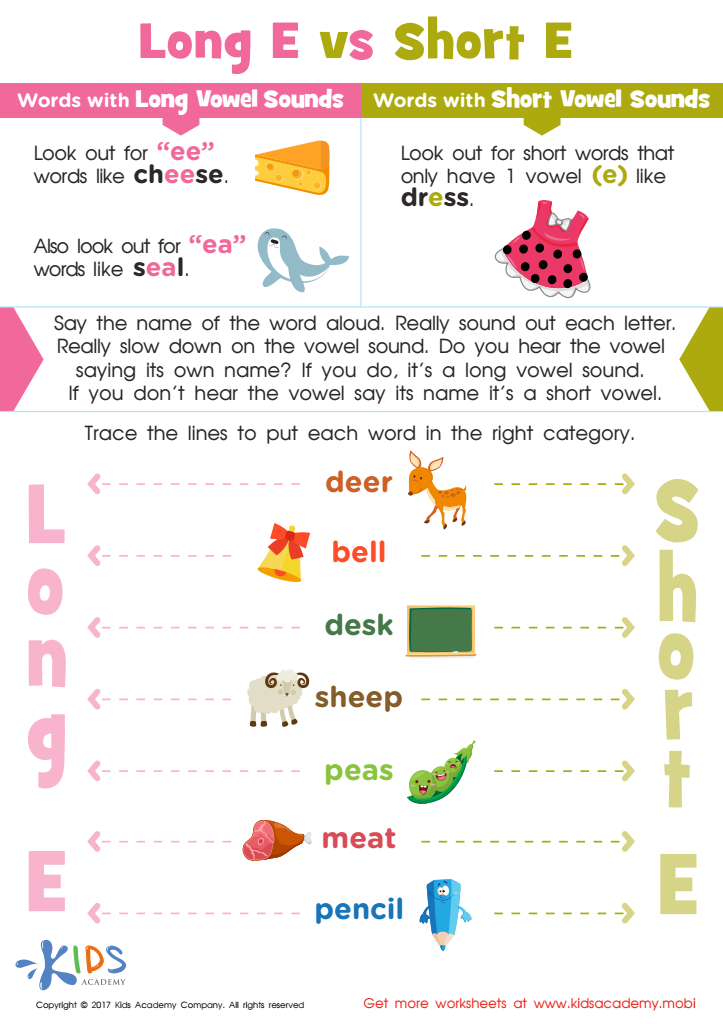
Long and Short Vowel E Spelling Worksheet
This worksheet helps kids master spelling with the letter "E". They read about long and short vowel sounds, view examples and sound out words to complete it. Two vowels distinguish long "E" sounds from its short vowel counterparts with just one.
Long and Short Vowel E Spelling Worksheet
Worksheet
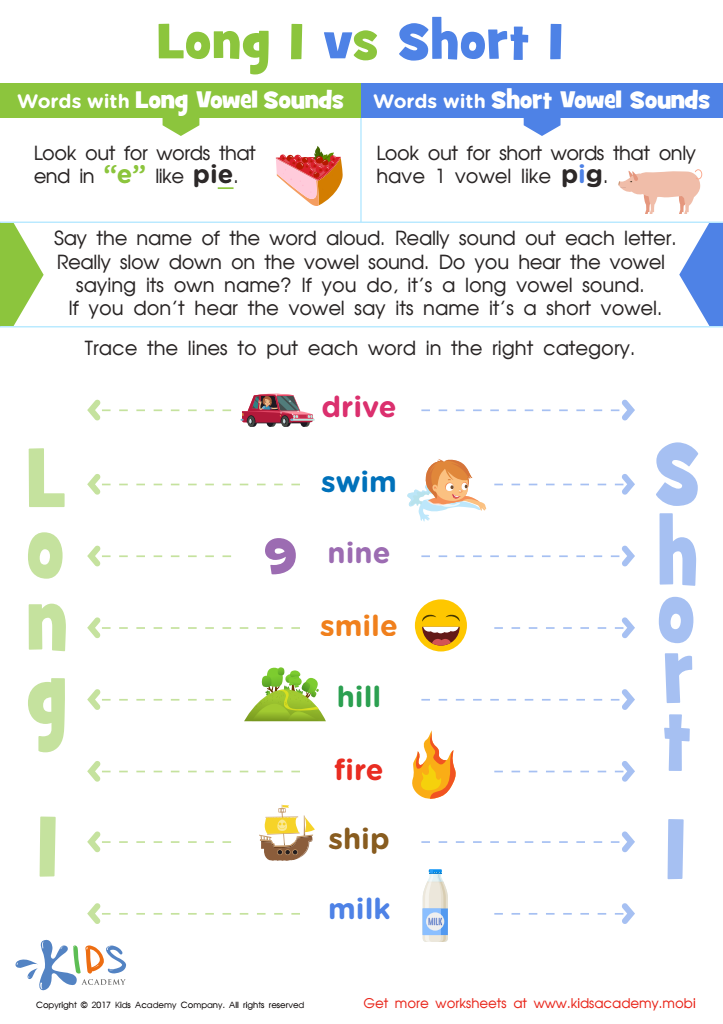
Long and Short Vowel I Spelling Worksheet
When it comes to long "I" sounds, kids should look out for the letter "E" at the end. With examples and sounding out words, kids will improve spelling skills with this long/short "I" worksheet!
Long and Short Vowel I Spelling Worksheet
Worksheet

Long and Short E Worksheet
This fun printout makes learning phonics enjoyable for Grade 3 students. Get them to read the words “tree” and “bed” to recognize the different sounds of the letter “E”. After hearing the words they can color the words and the pictures to understand differences between long and short vowels.
Download (PDF)
 Assign to My Students
Assign to My Students
Long and Short E Worksheet
Worksheet
Join Kids Academy for Free
Who is primarily going to use this learning content?







Vowel differentiation is a crucial element of early literacy development for children aged 5-9. Understanding the distinct sounds that different vowels make—both in isolation and within words—helps young learners decode and spell effectively. Mastering vowel phonetics lays the foundation for reading fluency, which is vital for overall academic success.
Parents and teachers should prioritize vowel differentiation because it enhances a child's language skills, enriching their vocabulary and comprehension. As children learn to identify and manipulate vowel sounds, they become more proficient in sounding out new words, leading to increased confidence and motivation in reading. This process supports the development of critical thinking and problem-solving skills as children learn to analyze word structures.
Additionally, vowel differentiation is key to preventing common reading difficulties, such as dyslexia, by equipping children with the phonemic awareness necessary to navigate language. By fostering an understanding of vowel sounds early on, educators and parents can provide children with tools that will benefit them across all subjects, improving communication skills and promoting lifelong learning. Supporting vowel differentiation not only strengthens literacy but also nurtures a child’s love for reading, encouraging curiosity and imagination that are vital during these formative years.








