
Developing critical thinking Addition & Subtraction Worksheets for Ages 5-9
3 filtered results
Difficulty Level
Grade
Age
-
From - To
Subject
Activity
Standards
Explore our engaging "Developing Critical Thinking Addition & Subtraction Worksheets" designed specifically for children ages 5-9. These worksheets aim to enhance mathematical skills while fostering critical thinking abilities. Each activity encourages young learners to analyze, evaluate, and solve problems using addition and subtraction in innovative ways. With colorful visuals and interactive content, kids will enjoy tackling real-life scenarios that require thoughtful reasoning. Perfect for homeschooling or classroom use, these worksheets will help students build a solid math foundation while promoting creativity and logical thinking. Start developing essential skills today and watch your child's confidence in math soar!
Favorites
With answer key
Interactive
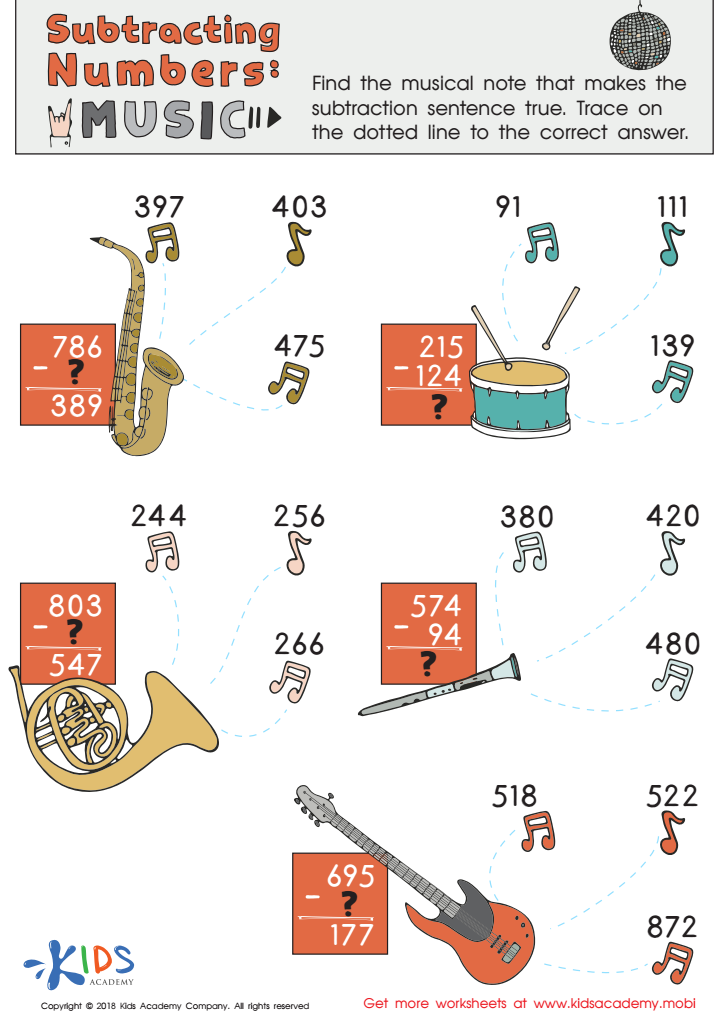
Subtracting Numbers: Music Worksheet
Enroll your kids in a music class and let them express their feelings via music! This worksheet challenges them to identify the musical note that makes the subtraction sentence true. Help them solve the problem and trace the dotted line to the correct answer. Let their appreciation for music grow!
 Assign to My Students
Subtracting Numbers: Music Worksheet
Worksheet
Learning Skills
Join Kids Academy for Free
Who is primarily going to use this learning content?








Developing critical thinking in addition and subtraction for children aged 5-9 is essential for several reasons. First, this foundational skill supports broader cognitive development. As children engage in problem-solving and logical reasoning, they learn to analyze information, make decisions, and understand consequences—skills that are crucial throughout life.
Secondly, promoting critical thinking in math encourages a deeper understanding of numbers rather than rote memorization. When children learn to ask "why" or "how," they grasp concepts like grouping and patterns, which enhance their overall math proficiency and boost their confidence in tackling more complex problems later on.
Additionally, fostering critical thinking in early math lays the groundwork for a positive attitude towards learning. When kids discover ways to approach addition and subtraction creatively, they cultivate curiosity and resilience, essential traits in an ever-evolving world.
Lastly, strong critical thinking skills intersect with other academic areas and life scenarios. They promote collaboration, effective communication, and ethical reasoning, preparing children not only for academic success but also for their future roles as thoughtful citizens. By nurturing these skills early, parents and teachers can significantly contribute to a child’s holistic development and lifelong learning journey.








