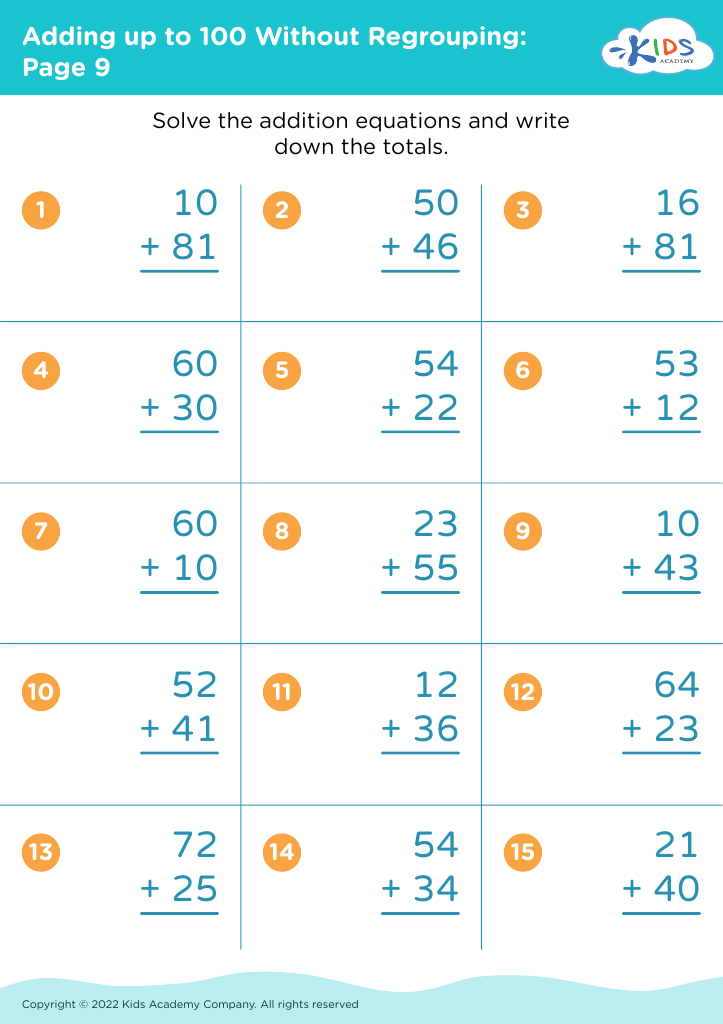








Mathematical reasoning, especially with addition, for ages 5-9 lays a crucial foundation for children's cognitive development, analytical thinking, and problem-solving skills. At this age, children are developing their ability to think logically and systematically, and addition serves as a fundamental building block for understanding more complex mathematical concepts later on. Learning addition helps children to understand numbers, quantity, and the relationship between them, which is essential for everyday tasks such as shopping, cooking, and managing time.
When young children grasp addition, they gain confidence in handling numerical information, which nurtures a positive attitude towards math as a whole. This enthusiasm and confidence can carry over into other subjects and learning experiences, enhancing their overall academic performance.
Moreover, early mastery of addition fosters children's ability to break problems down into manageable steps, an essential skill across all areas of learning and life. When children learn to approach problems methodically, they develop resilience and perseverance, traits that serve them well beyond the classroom.
Thus, by prioritizing mathematical reasoning and addition for young children, parents and teachers equip them with essential life skills, fostering a generation of critical thinkers and capable problem-solvers. Investing in this aspect of education sets the stage for lifelong learning and success.








