
Pattern identification Addition Worksheets for Ages 5-9
3 filtered results
Difficulty Level
Grade
Age
-
From - To
Subject
Activity
Standards
Enhance your child's math skills with our engaging Pattern Identification Addition Worksheets designed for ages 5-9! These worksheets help young learners recognize patterns while improving their addition abilities. Each activity has been thoughtfully created to encourage critical thinking and problem-solving skills, making math both fun and educational. Children will enjoy vibrant illustrations and age-appropriate exercises that promote recognition of numerical relationships and sequences. With a variety of formats, including puzzles and visual aids, these worksheets cater to different learning styles. Dive into the world of patterns and numbers today, and watch your child's confidence in math grow! Perfect for homework, classwork, or extra practice!
Favorites
With answer key
Interactive
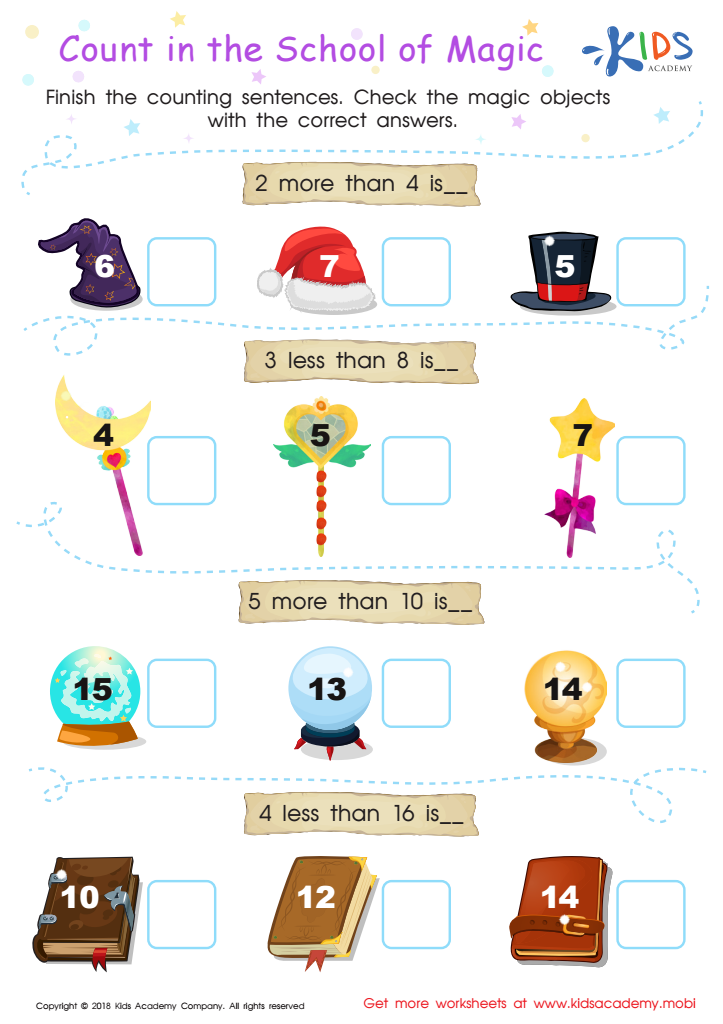
Count in the School of Magic Worksheet
Your math learners can explore the School of Magic with this worksheet. They'll read equations with addition and subtraction numbers under 20, count back and forth to find the answer, then complete the counting sentences. Fun pictures and easy accuracy make it an enjoyable and successful learning experience.
 Assign to My Students
Count in the School of Magic Worksheet
Worksheet
Join Kids Academy for Free
Who is primarily going to use this learning content?








Pattern identification in addition is a crucial skill for children aged 5-9, as it lays the foundation for not only arithmetic but also broader mathematical concepts. When parents and teachers encourage the recognition of patterns in addition—such as recognizing that adding 1 to a number can yield the next consecutive number—they help foster a deeper understanding of how numbers work together. This comprehension enhances children's problem-solving abilities and boosts their confidence in tackling more complex math tasks.
Additionally, identifying patterns allows children to make connections between different mathematical concepts, aiding in their transition to more advanced topics like multiplication and algebra. Engaging with patterns cultivates critical thinking skills, as students learn to predict outcomes and find solutions using logical reasoning.
Moreover, these foundational skills are essential for future success; they help prevent math anxiety and create a positive attitude towards learning math. In a world increasingly dominated by data and technology, strong mathematics skills developed through pattern identification are invaluable. As such, both parents and teachers play a pivotal role in nurturing these abilities, ensuring children can navigate their academic journeys with competence and confidence.








