
Visual discrimination Addition Worksheets for Ages 5-9
5 filtered results
Difficulty Level
Grade
Age
-
From - To
Subject
Activity
Standards
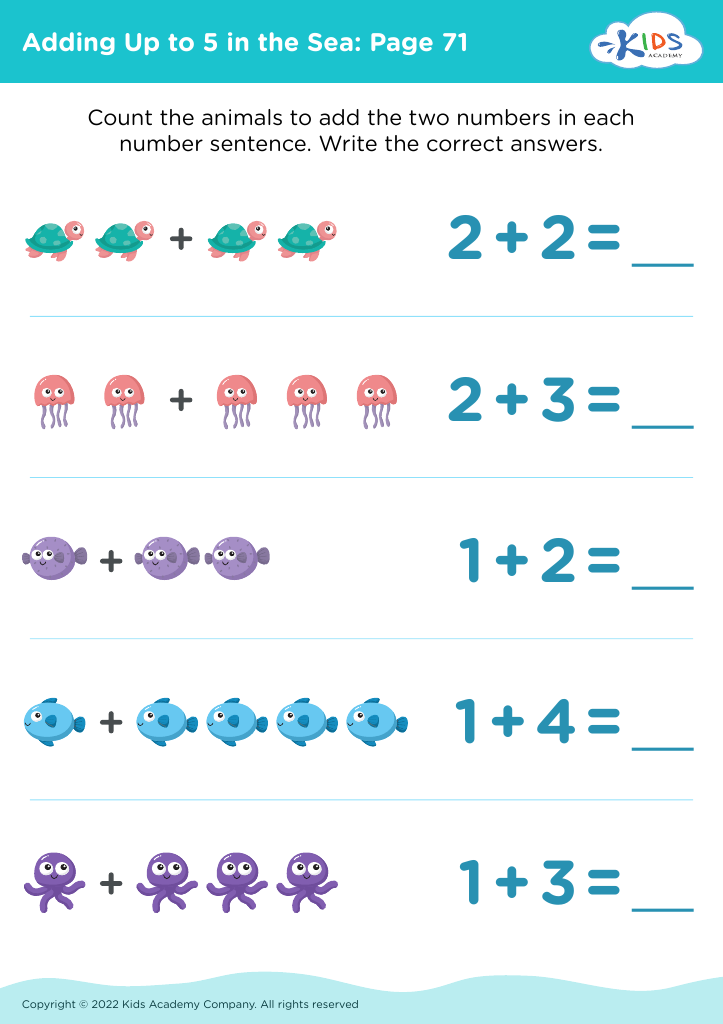
Discover our engaging Visual Discrimination Addition Worksheets designed specifically for children aged 5-9. These worksheets combine fun activities with educational content to help young learners enhance their visual discrimination and addition skills. Each printable worksheet offers vibrant visuals and interactive exercises that captivate kids’ attention while reinforcing essential math concepts. Perfect for use at home or in the classroom, our collection supports learners in developing keen observation abilities and strong numerical foundations. Encourage your child's learning journey with Kids Academy’s expertly crafted addition worksheets, ensuring they build confidence and excel in math effortlessly. Download now for endless learning fun!
Favorites
With answer key
Interactive
Join Kids Academy for Free
Who is primarily going to use this learning content?








Visual discrimination skills are vital for the cognitive development of children ages 5-9, and they significantly impact a child's success in academics, particularly in subjects like math. Visual discrimination in addition involves the ability to recognize and differentiate between numbers, symbols, and patterns—a crucial competency when learning basic arithmetic.
Parents and teachers should prioritize developing these skills because they form the foundation for more advanced mathematical thinking. When children can visually distinguish between different numerals and symbols, they are better equipped to understand and solve addition problems accurately. This proficiency minimizes errors and promotes confidence in their mathematical abilities.
Moreover, children with strong visual discrimination skills can more easily grasp the relationship between numbers, which is essential for understanding addition concepts. For instance, understanding that different quantities can combine to form a larger number becomes more intuitive. These skills also help with reading and writing math problems correctly, enabling smoother transitions across various learning activities.
In essence, by fostering visual discrimination skills through engaging activities and focused instruction, parents and teachers can create a supportive environment that enhances a child's overall mathematical understanding and academic performance. This proactive approach is crucial for laying a robust groundwork for future learning.








