
Counting skills Coins Worksheets for Ages 5-9
4 filtered results
Difficulty Level
Grade
Age
-
From - To
Subject
Activity
Standards
Enhance your child's math abilities with our "Counting Skills Coins Worksheets for Ages 5-9." Our expertly designed worksheets make learning to count money a fun and engaging experience. Each worksheet features a variety of coins, helping kids identify, count, and total different denominations. These activities build essential skills in addition and value recognition, providing a solid foundation for practical financial literacy. Perfect for young learners, our worksheets support classroom learning or homeschooling, catering to individual progress and fostering confidence in math. Jumpstart your child's counting skills today with these interactive and educational resources!
Favorites
With answer key
Interactive
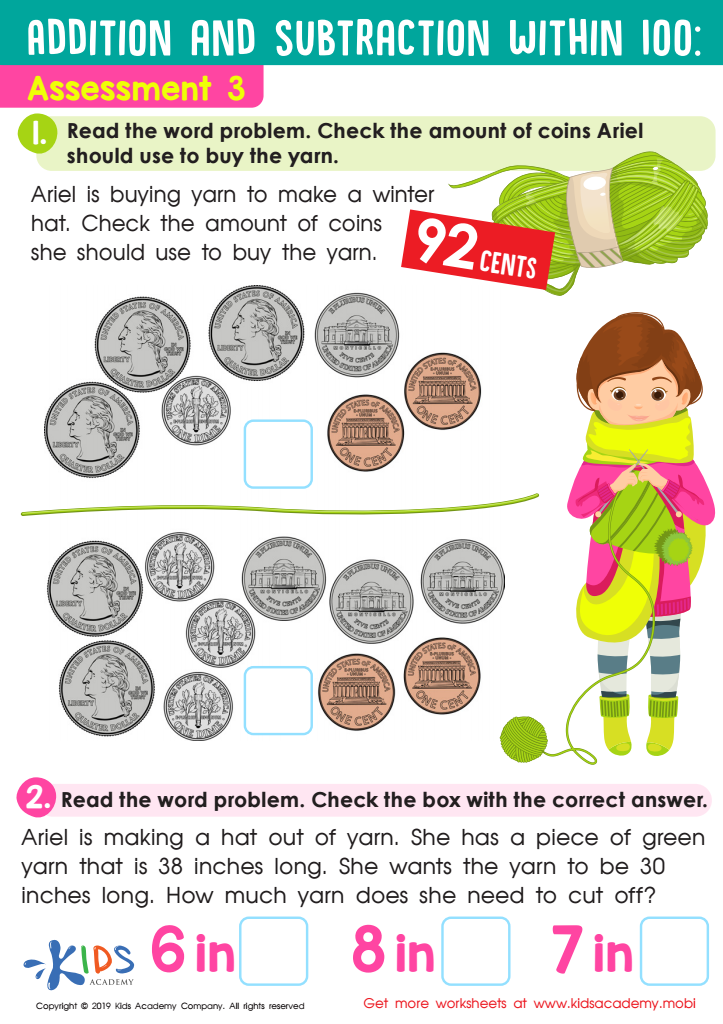
Assessment 3 Math Worksheet
Ariel needs to buy yarn. Do your kids know what yarn is? If they've seen you knit, they will. Help them solve the two word problems to figure out how many coins Ariel needs to buy it.
 Assign to My Students
Assessment 3 Math Worksheet
Worksheet
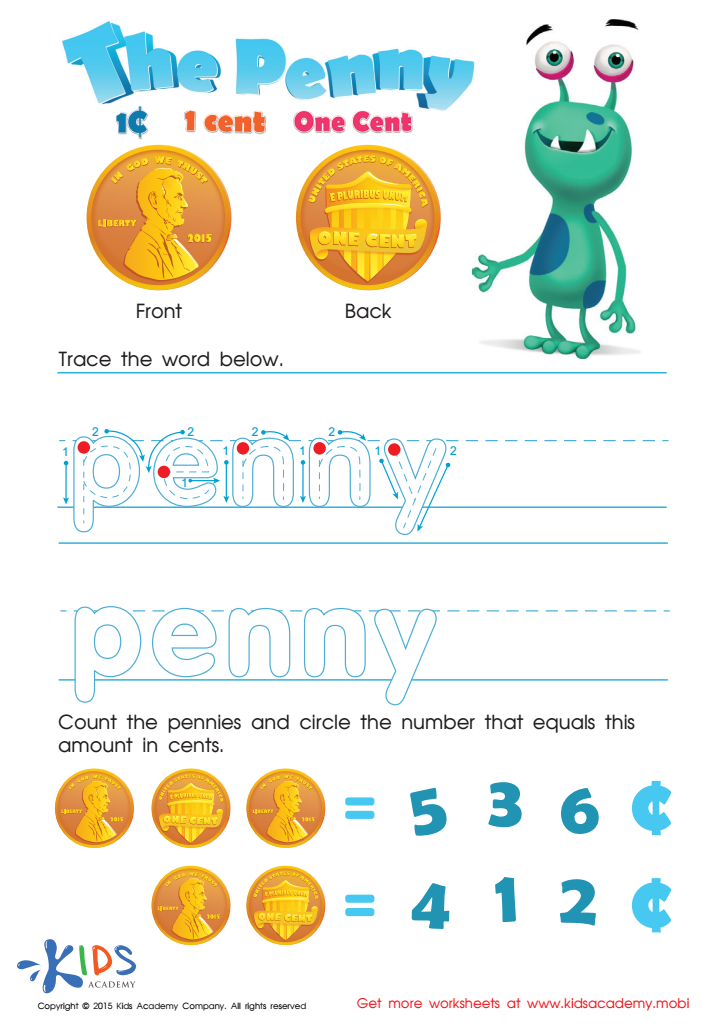
One Cent or the Penny Money Worksheet
Counting money made easy with Kids Academy's new collection of worksheets! Start with the one cent coin, or "Penny": trace it and count the pennies to work out the total. Visit our site for more free, printable money worksheets.
One Cent or the Penny Money Worksheet
Worksheet
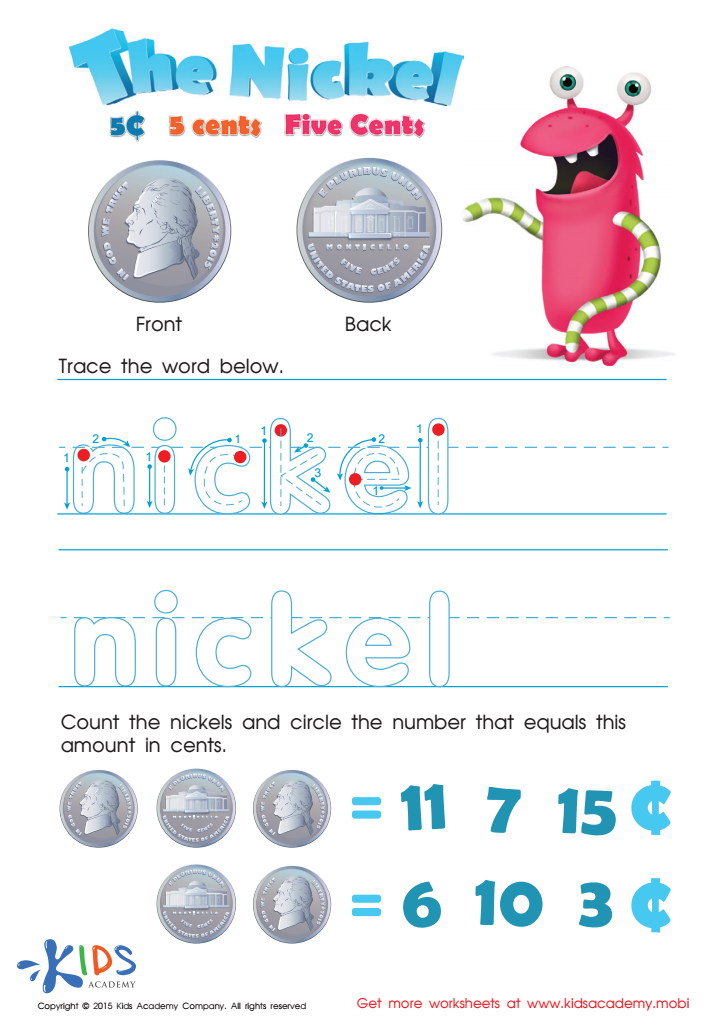
Five Cents or the Nickel Money Worksheet
Counting money games help kids make learning money fun and easy. Next up: the 5 cent coin, or nickel. Look at both sides and remember them. Then, trace the word "nickel" to help you remember. Finally, count the nickels and work out amounts in cents. Let's do this! Kids Academy helps make money learning easy and fun!
Five Cents or the Nickel Money Worksheet
Worksheet
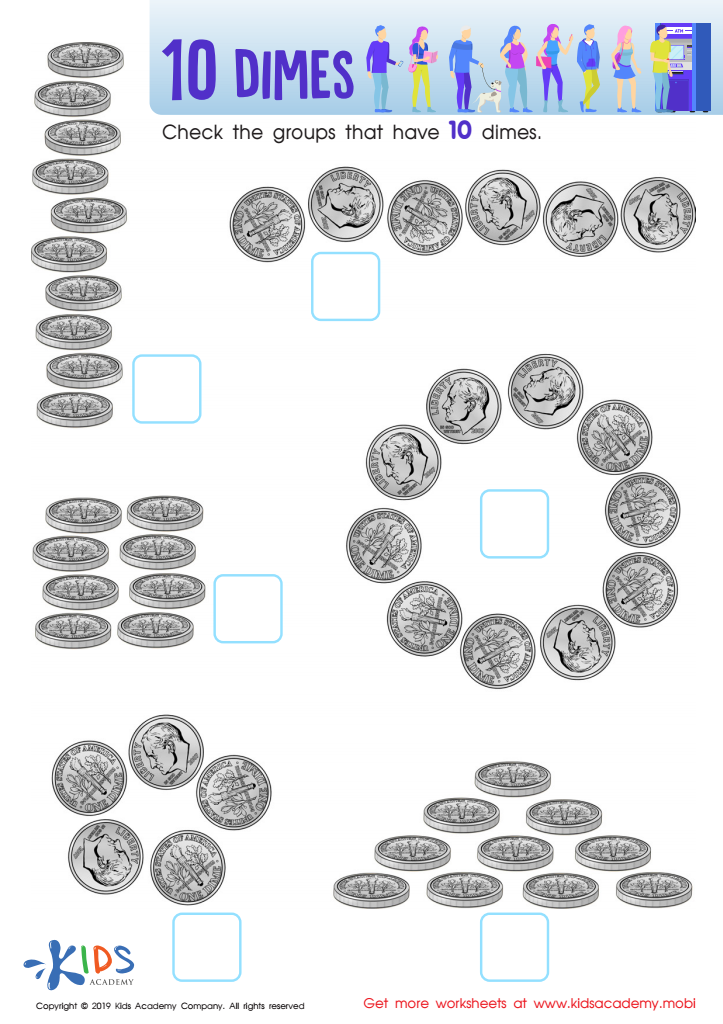
10 Dimes Worksheet
Get your students ready for the task by asking them to count as high as they can. Familiar objects are stacked in groups. Look at the picture and help them count the dimes. Circle the groups of 10. This worksheet will help kindergartners practice counting up to and recognizing 10 dimes.
10 Dimes Worksheet
Worksheet
Join Kids Academy for Free
Who is primarily going to use this learning content?








Counting skills, especially using coins, are essential for children aged 5-9 as they lay the foundation for broader numerical understanding and practical life skills. At this influential age, kids are highly receptive to learning through hands-on activities and real-world examples. Handling coins helps young learners improve number recognition, addition, subtraction, and the concept of value.
Teaching children to count using coins integrates both mathematical concepts and daily-life scenarios. This dual approach helps solidify their comprehension by providing tangible examples of why math matters. For instance, when children count pennies, nickels, dimes, and quarters, they gain a deeper understanding of place value, decimals, and the basics of money management.
Additionally, these activities promote critical thinking and problem-solving. For example, when tasked with making a specific amount using various coins, children must analyze, experiment, and find solutions, fostering cognitive development.
Furthermore, counting coins can enhance fine motor skills as kids handle small objects, improving their dexterity and hand-eye coordination. Most importantly, these skills build confidence in everyday tasks, laying a strong foundation for financial literacy—a crucial life skill.
In short, parents and teachers should prioritize coin counting skills to enrich children’s mathematical foundation, enhance practical problem-solving, and prepare them for real-world financial interactions.








