
Understanding measurement units Measurement Worksheets for Ages 5-9
3 filtered results
Difficulty Level
Grade
Age
-
From - To
Subject
Activity
Standards
Discover fun and engaging "Understanding Measurement Units" worksheets suitable for children ages 5-9. Our carefully crafted printable resources aim to strengthen your child's grasp of essential measurement concepts—including length, weight, and capacity. Through a variety of enjoyable exercises, kids will learn to efficiently compare and measure using both standard and non-standard units. These worksheets not only align with key learning objectives but also foster practical problem-solving skills and confidence in math. Perfect for both classroom activities and home practice, our worksheets make mastering measurement units a fun adventure! Visit Kids Academy to explore and download today.
Favorites
With answer key
Interactive
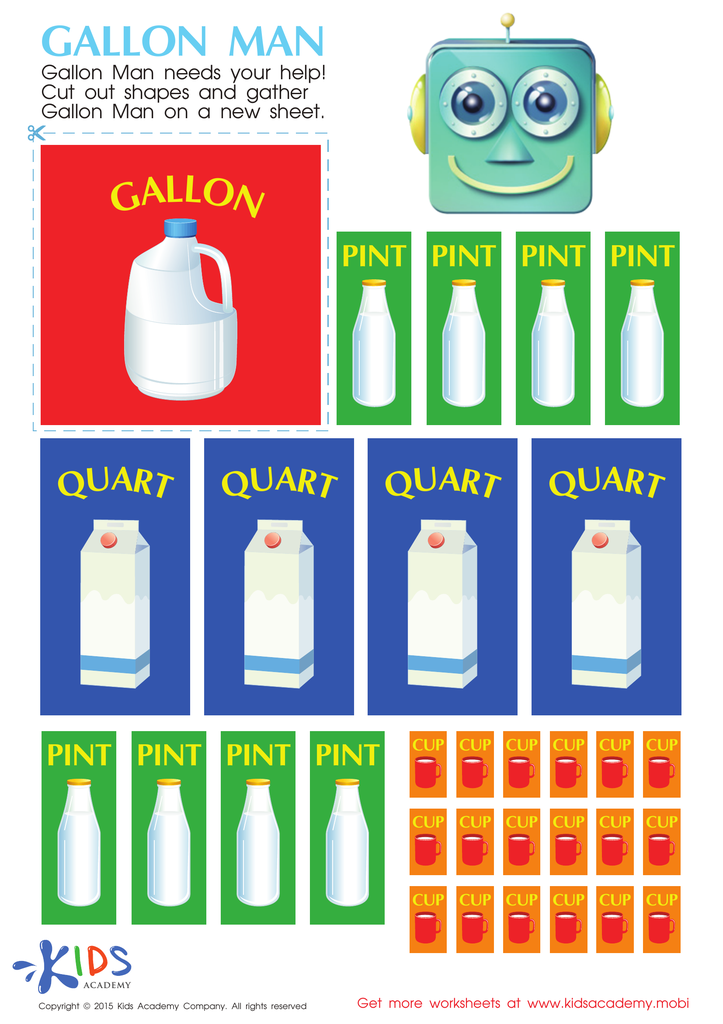
Cups, Pints and Quarts With Gallon Man Worksheet
Measurement in cups, pints, quarts and gallons has never been this fun!
Cups, Pints and Quarts With Gallon Man Worksheet
Worksheet
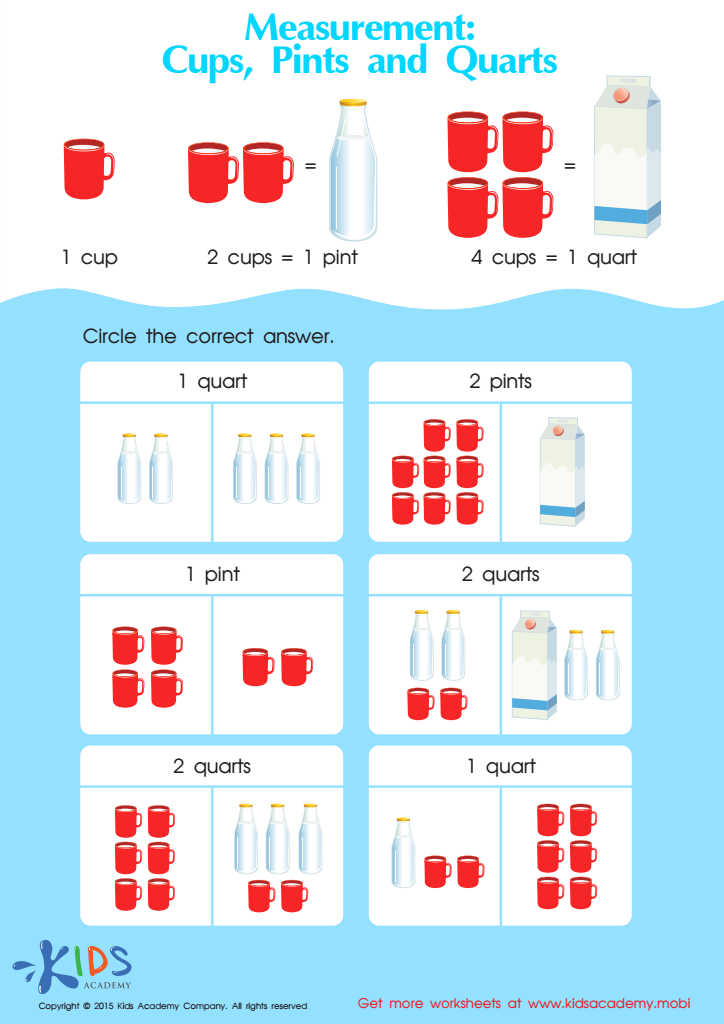
Cups, Pints and Quarts Worksheet
Let your kids explore the world of math with our worksheet! Have them count cups, pints and quarts in pictures and circle the right answer. Get even more free printable math worksheets for kindergarten on our website. Come on, join the adventure!
 Assign to My Students
Cups, Pints and Quarts Worksheet
Worksheet
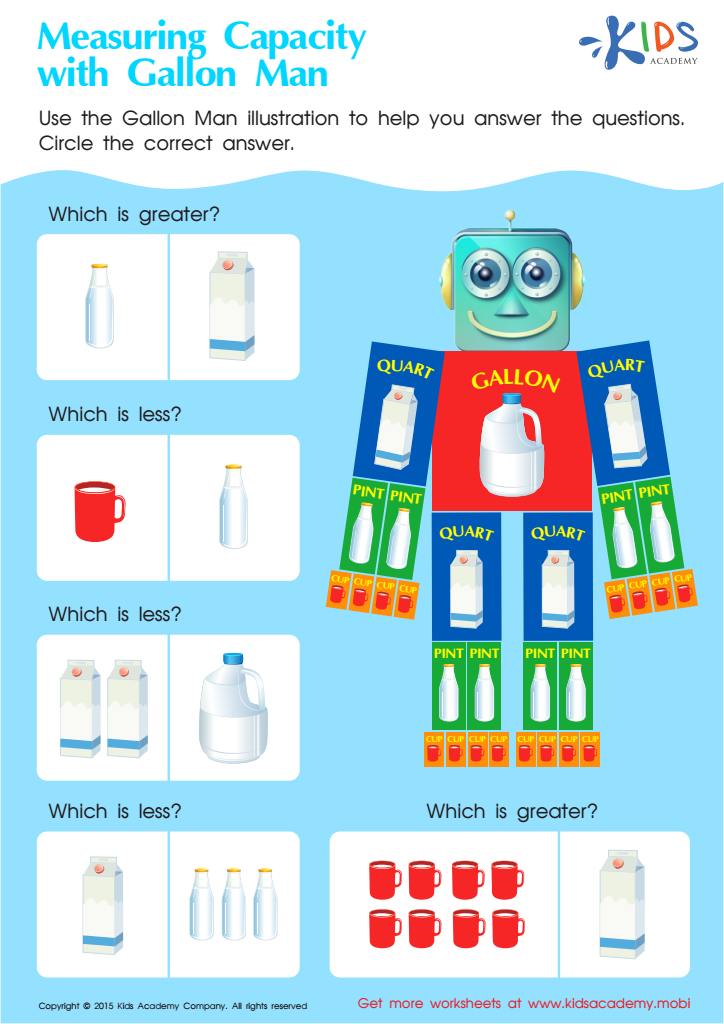
Measurement: Measuring Capacity with Gallon Man Worksheet
Check out Gallon Man to practice measuring capacity with cups, pints, quarts, and gallons. Our worksheet has questions with answers checked against Gallon Man. For more practice, visit our site for free printable math worksheets for kindergarten and learn math with fun!
Measurement: Measuring Capacity with Gallon Man Worksheet
Worksheet
Join Kids Academy for Free
Who is primarily going to use this learning content?








Understanding measurement units is essential for children ages 5-9 because it lays the foundation for early math skills and everyday problem-solving. At this age, kids are naturally curious about their surroundings, and comprehending measurement units helps them make sense of the world.
First, measurement concepts like length, weight, and volume are integral parts of the math curriculum. Familiarity with these units aids children in grasping more advanced math topics in later grades, ensuring they build a strong mathematical foundation. For instance, understanding that inches, feet, or centimeters measure length promotes accuracy and competence in both academic and real-life situations.
Second, measurement skills are constantly applied in daily life. Whether they are baking and need to measure ingredients, checking their height on a growth chart, or understanding time to follow a daily routine, having a handle on measurement units enhances their ability to function independently and confidently.
Furthermore, learning about measurement promotes critical thinking and problem-solving. It encourages children to make comparisons and estimations, developing their observational skills and reasoning capabilities.
In conclusion, educators and parents should prioritize teaching measurement units to children aged 5-9 to support their academic growth, self-reliance, and analytical thinking. This foundational knowledge is a vital life skill with broad implications for future learning and everyday tasks.








