
Fraction comparison Building Vocabulary Worksheets for Ages 5-9
13 filtered results
Difficulty Level
Grade
Age
-
From - To
Subject
Activity
Standards
Discover our engaging Fraction Comparison Building Vocabulary Worksheets, specifically designed for kids aged 5–9! These worksheets provide an interactive and fun approach to mastering fundamental concepts of fraction comparison. Perfect for early learners, they enhance mathematical vocabulary while challenging students to think critically about sizes, values, and relationships between fractions. With colorful illustrations and age-appropriate activities, children will gain confidence in their math skills and develop a deeper understanding of fractions. Our resource caters to various learning styles, making it an ideal supplement for your teaching toolkit. Empower young minds by fostering a love for math and vocabulary building today!
Favorites
With answer key
Interactive
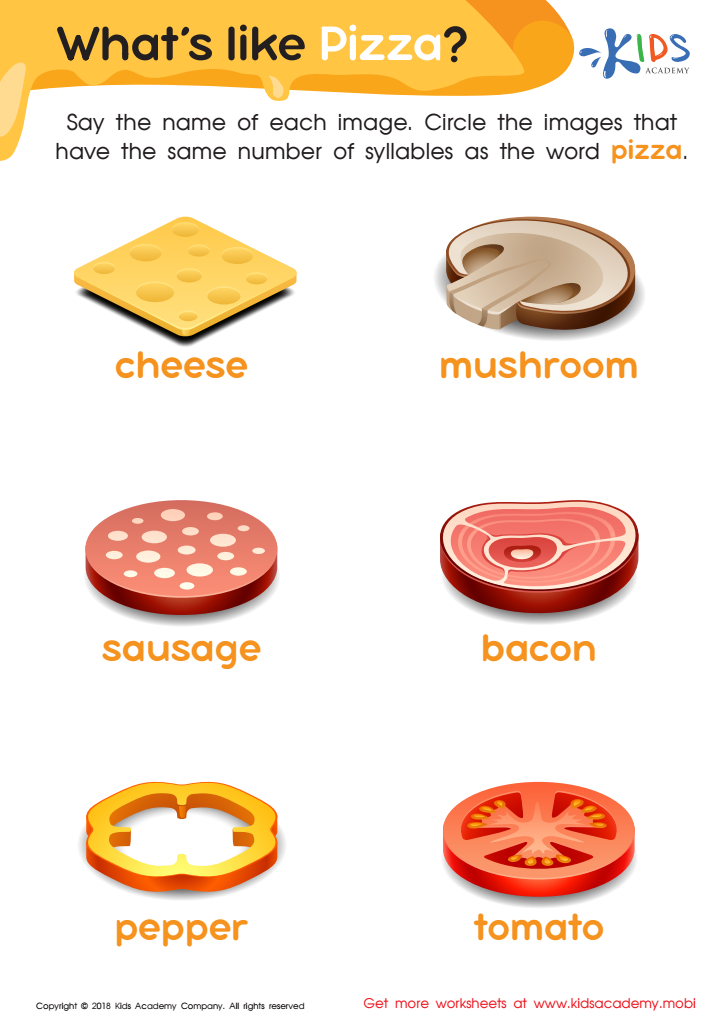
What's Like Pizza? Worksheet
Encourage your kids to exercise their minds with this pizza worksheet! Ask them to name the ingredients they like on their favourite pizzas. Then, help them circle the images that have the same number of syllables as 'pizza'. They'll have fun while learning too!
 Assign to My Students
What's Like Pizza? Worksheet
Worksheet











Join Kids Academy for Free
Who is primarily going to use this learning content?




.jpg)



Parents and teachers should prioritize fraction comparison vocabulary for children aged 5-9 because it lays a crucial foundation for mathematical understanding and problem-solving skills. Early comprehension of fractions is essential, as it is a precursor to more complex mathematical concepts encountered in later grades. Introducing specific vocabulary related to fraction comparison, such as "greater than," "less than," "equal to," "half," and "whole," helps children articulate their thought processes and understand relationships between numbers.
Furthermore, building vocabulary in this area boosts children's confidence in mathematics. When children can communicate their reasoning using the appropriate terms, they become more engaged and willing to participate in discussions about math. This engagement fosters a positive attitude toward learning and encourages them to explore concepts independently.
Moreover, strong vocabulary skills translate to better reading comprehension when encountering word problems and instructional texts in math. Clear understanding and language proficiency enable children to interpret problems and express solutions effectively.
In essence, investing time in developing fraction comparison vocabulary is significant for cultivating mathematical literacy, supporting cognitive development, fostering confidence, and equipping children with essential problem-solving skills that will serve them throughout their academic journey.








