
Basic arithmetic understanding Worksheets for 5-Year-Olds
4 filtered results
Difficulty Level
Grade
Age
-
From - To
Subject
Activity
Standards
Explore our engaging "Basic Arithmetic Understanding Worksheets" designed specifically for 5-year-olds! These worksheets provide a fun and interactive way for young learners to develop foundational math skills. Through colorful illustrations and creative activities, children will practice essential concepts such as addition and subtraction, number recognition, and basic problem-solving. Tailored to cater to the developmental needs of preschoolers, these worksheets foster cognitive growth while enhancing fine motor skills. Perfect for home or classroom use, our worksheets not only make learning enjoyable but also help build confidence in young mathematicians. Start your child's arithmetic journey today with our comprehensive collection!
Favorites
With answer key
Interactive
 Assign to My Students
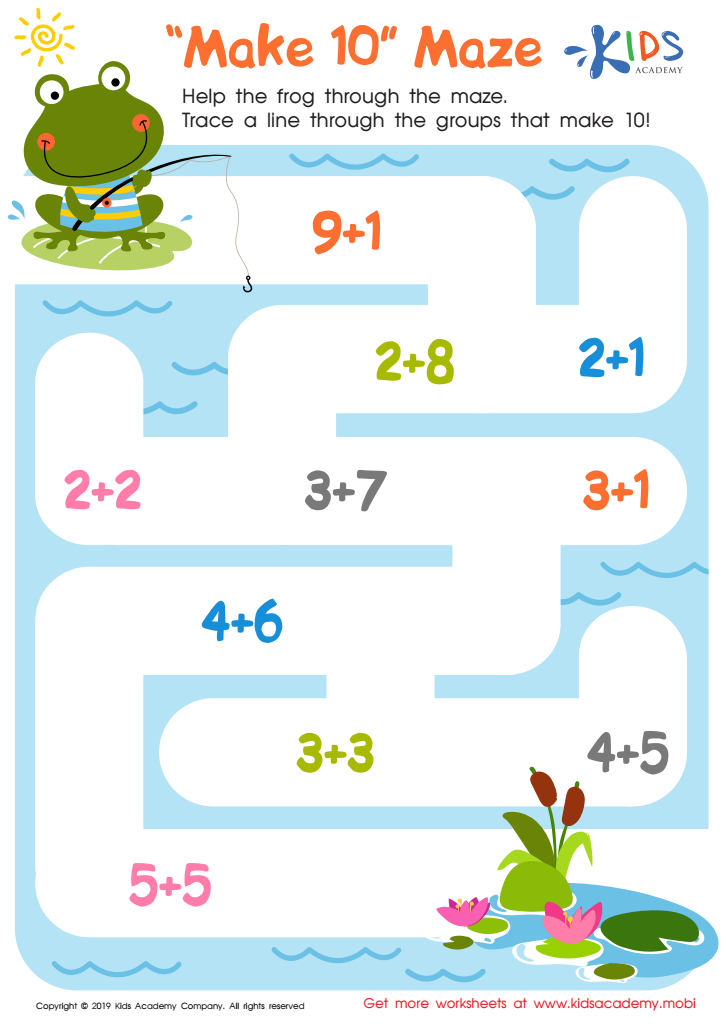
Make 10 Maze Worksheet
Help your child's frog friend make its way out of the maze! Mazes are an enjoyable way to get your kids to learn and can be a challenge. Have your kids take a look at this tracing sheet and help the frog make its way through the maze by tracing a line through the groups of equations that make 10. It’ll be a fun time for everyone!
Make 10 Maze Worksheet
Worksheet
Join Kids Academy for Free
Who is primarily going to use this learning content?






Understanding basic arithmetic is crucial for 5-year-olds as it lays the foundation for their future math skills and overall cognitive development. At this age, children are naturally curious and eager to learn, making it an ideal time to introduce fundamental concepts like addition, subtraction, and number recognition. Mastering these basic skills enhances problem-solving abilities, critical thinking, and logical reasoning—capabilities that benefit not only mathematics but all areas of learning.
Furthermore, arithmetic fosters a sense of confidence and accomplishment in young learners. As they grasp these concepts, they become more motivated to explore math-related activities, leading to a positive attitude toward future mathematical challenges. Early exposure also helps address potential learning gaps, ensuring that children progress in line with their peers. This proactive approach can prevent feelings of frustration as they encounter more complex math in later grades.
In a broader context, basic arithmetic is not only vital for academic success but is also essential in daily life, from practical situations like counting objects to managing money. By prioritizing early arithmetic understanding, parents and teachers empower children with skills that promote lifelong learning and adaptability in an increasingly complex world.








