
Understanding number patterns Worksheets for 5-Year-Olds
3 filtered results
Difficulty Level
Grade
Age
-
From - To
Subject
Activity
Standards
Help your little one master early math skills with our "Understanding Number Patterns" worksheets designed for 5-year-olds. These fun and engaging printable activities show children exciting ways to recognize and complete number sequences. Each worksheet uses colorful illustrations and simple patterns to keep young learners motivated. Children will learn basic concepts such as counting by 2s, 5s, and discovering numeric order. Ideal for both classroom and at-home learning, these resources will develop your child's critical thinking and foundational math skills. Prepare your child for future math success with these delightful and educational worksheets.
Favorites
With answer key
Interactive
 Assign to My Students
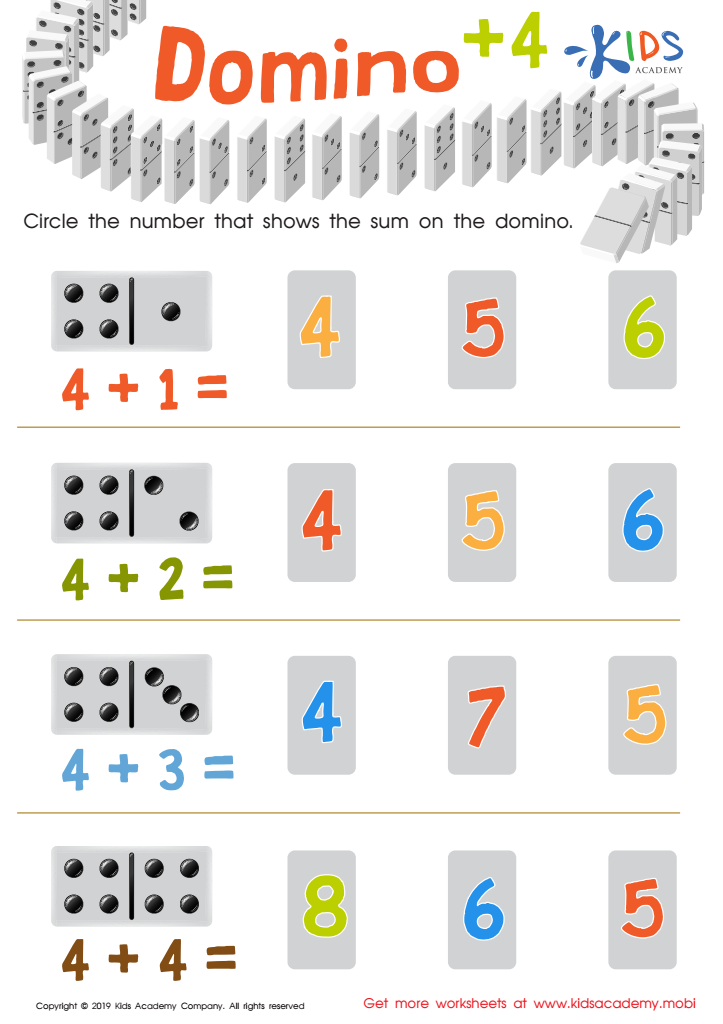
Domino +4 Worksheet
Ask your kids if they know what a domino is. Explain, then move on to solving the four simple equations on this printout, adding a number to 4. Help them find the sum and circle the number.
Domino +4 Worksheet
Worksheet
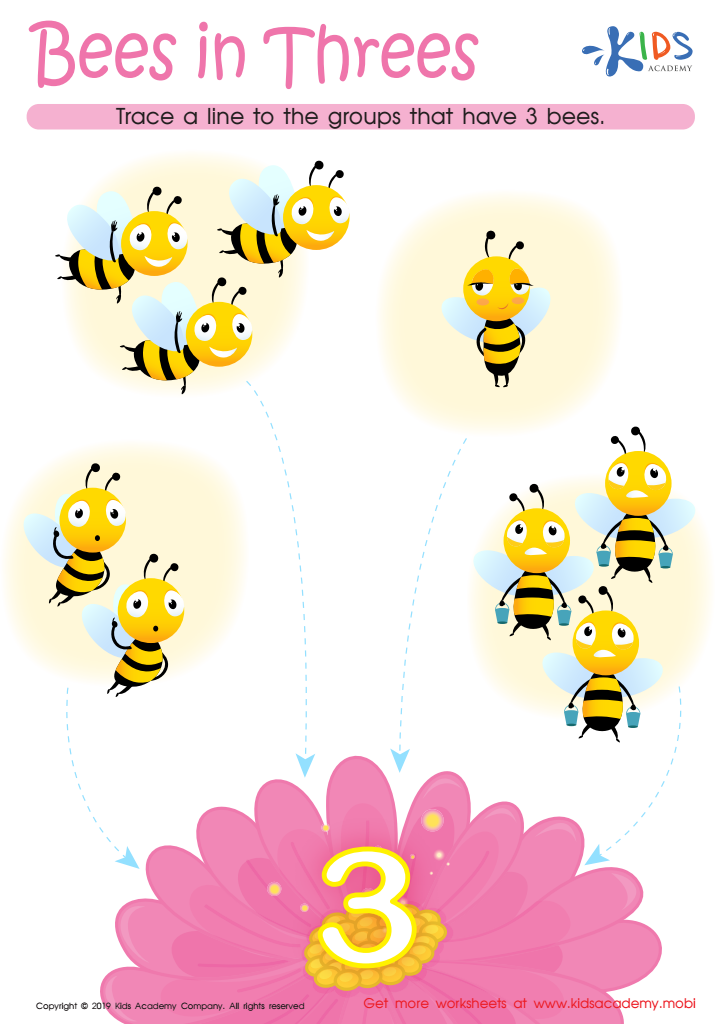
Bees in Threes Worksheet
Kids love learning numbers, especially 1, 2, 3! Counting bees with this fun worksheet? It's the bee's knees! They'll practice number recognition and counting skills while connecting groups of three to the number three. It's a great way to make math fun at home or school!
Bees in Threes Worksheet
Worksheet
Join Kids Academy for Free
Who is primarily going to use this learning content?







Understanding number patterns is fundamental for 5-year-olds, as it lays the groundwork for essential math skills and critical thinking. For parents and teachers, fostering this early concept is vital because it nurtures a child's natural curiosity about numbers and order. Patterns help children recognize sequences, predict future events, and establish a sense of stability and order, which is crucial in their formative years.
Number patterns also enhance problem-solving skills. By identifying and working with patterns, children learn to observe, hypothesize, and test their predictions—key steps in the scientific method. These abilities are essential for success in math and other academic subjects as they progress through school.
Additionally, early exposure to number patterns supports cognitive development. It builds a strong understanding of mathematical concepts such as counting, addition, and subtraction. When children grasp number sequences like even numbers, odd numbers, or skip counting, they develop a sense of how numbers relate to one another, fostering numeracy skills that benefit reading comprehension and logical reasoning.
Moreover, recognizing patterns boosts confidence. As children master these concepts, they become more confident in their abilities, motivating them to tackle more complex challenges with enthusiasm. Therefore, parents and teachers should prioritize understanding number patterns because it fortifies the cornerstones of learning, preparing children for a lifetime of academic and real-world success.








