Spatial awareness Chess Worksheets for Ages 6-7
3 filtered results
Difficulty Level
Grade
Age
-
From - To
Subject
Activity
Standards
Enhance your child's spatial awareness with our engaging Chess Worksheets specially designed for ages 6-7. These worksheets blend fun and learning, introducing young minds to essential geometric concepts through the stimulating game of chess. Activities focus on recognizing patterns, understanding positional relationships, and developing problem-solving skills, all while promoting critical thinking and concentration. Ideal for both classroom and at-home learning, our spatial awareness worksheets provide a playful approach to mastering key cognitive skills. Encourage your child's love for chess and nurturance of their intellectual development today with our printable, easy-to-use resources designed for early learners!
Favorites
With answer key
Interactive
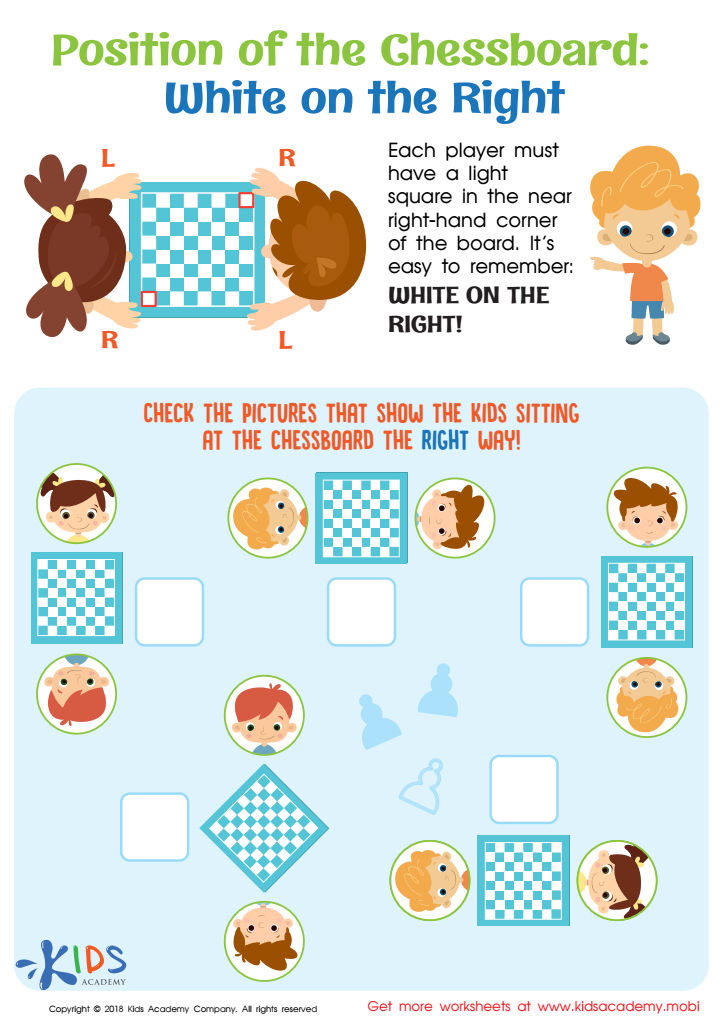
Position of the Chessboard: White on the Right Worksheet
Proper positioning of the chessboard and players is key. Before the game, make sure the white square is in the right-hand corner. A simple rhyme can help: "White on the right". Check pictures of kids at the chessboard to ensure correct positioning.
 Assign to My Students
Position of the Chessboard: White on the Right Worksheet
Worksheet
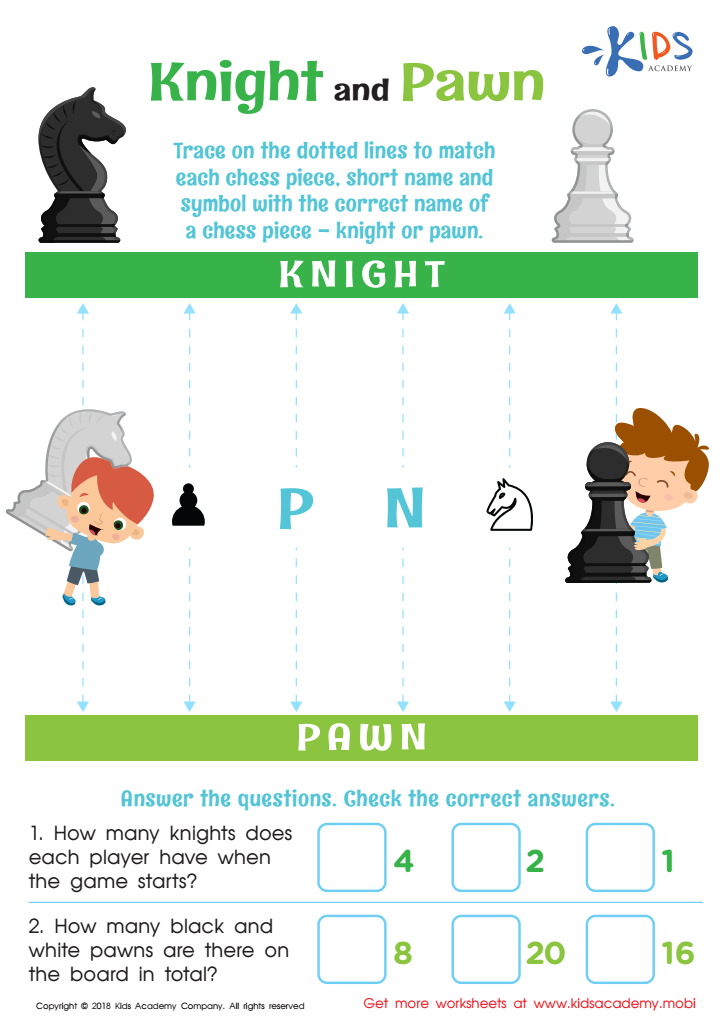
Knight and Pawn Worksheet
This tracing worksheet teaches kids about chess. They trace the dotted lines to match pieces, names and symbols to the correct chess piece. Questions at the bottom test their understanding. It's a simple exercise for a fun way to learn.
Knight and Pawn Worksheet
Worksheet
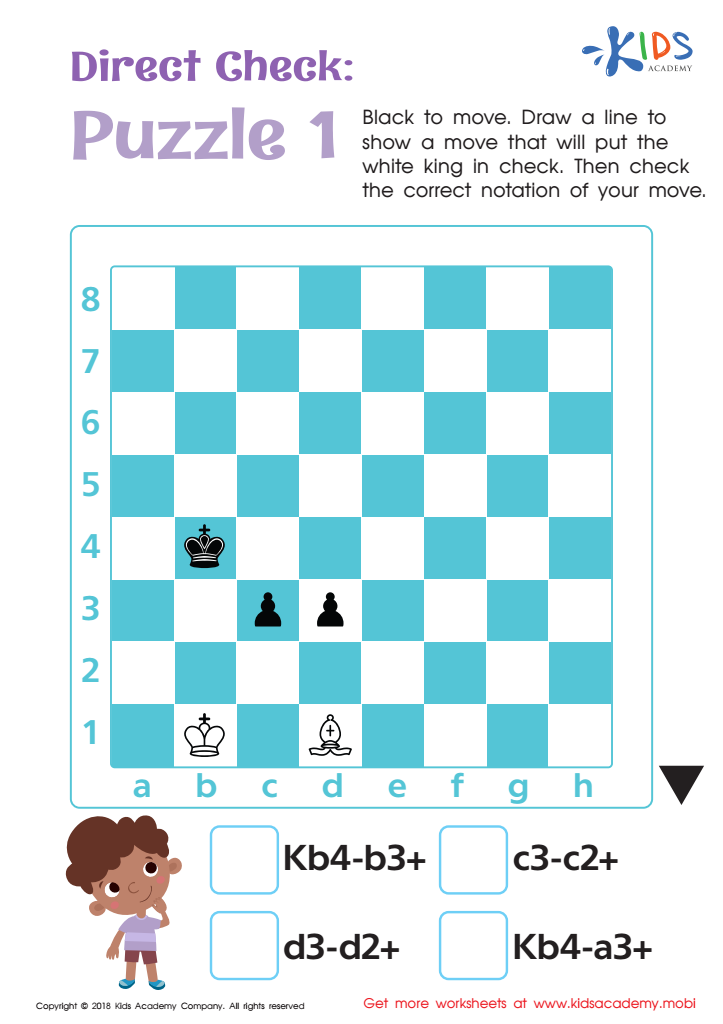
Direct Check: Puzzle 1 Worksheet
Your child can test their chess knowledge with this worksheet. If they've been taking lessons or playing regularly, they'll enjoy connecting the dots to put the white king in checkmate, then checking the correct notation. Challenge their chess skills!
Direct Check: Puzzle 1 Worksheet
Worksheet
Join Kids Academy for Free
Who is primarily going to use this learning content?








Spatial awareness is a crucial cognitive skill that develops a child’s ability to understand and navigate the world around them. In the context of chess, particularly for children ages 6-7, enhancing spatial awareness can lead to significant developmental benefits.
Playing chess helps children visualize how pieces move on the board, encouraging them to improve their ability to perceive distances and relationships between objects. This skill is not only vital for strategic gameplay, but it also lays the foundation for critical thinking, problem-solving, and mathematical reasoning. As children learn to anticipate an opponent’s moves, they begin to think several steps ahead, fostering creativity and planning skills.
Moreover, chess promotes patience and concentration, which are essential for young learners. As they engage in this tactical game, children practice staying focused for extended periods, enhancing their attention span. Teachers and parents who emphasize the importance of spatial awareness through chess are investing in their child’s overall cognitive development. Providing opportunities for children to play chess can be a fun, engaging way to develop these skills in a supportive environment, potentially benefiting their performance in other academic areas while fostering a love for learning.