
Money identification Worksheets for Ages 6-7
5 filtered results
Difficulty Level
Grade
Age
-
From - To
Subject
Activity
Standards
Discover engaging money identification worksheets designed for children ages 6-7 at Kids Academy! Our printable worksheets feature fun activities that help young learners recognize coins and bills, understand their values, and develop essential math skills. Each worksheet is crafted to captivate children's interest with vibrant illustrations and interactive tasks, promoting hands-on learning. Perfect for classroom or at-home use, these resources build a strong foundation in financial literacy. Enable your child to confidently identify money and exercise smart spending from an early age with our expertly designed money identification worksheets. Visit Kids Academy to explore our collection today!
Favorites
With answer key
Interactive
Money: Coins Dollars Printable
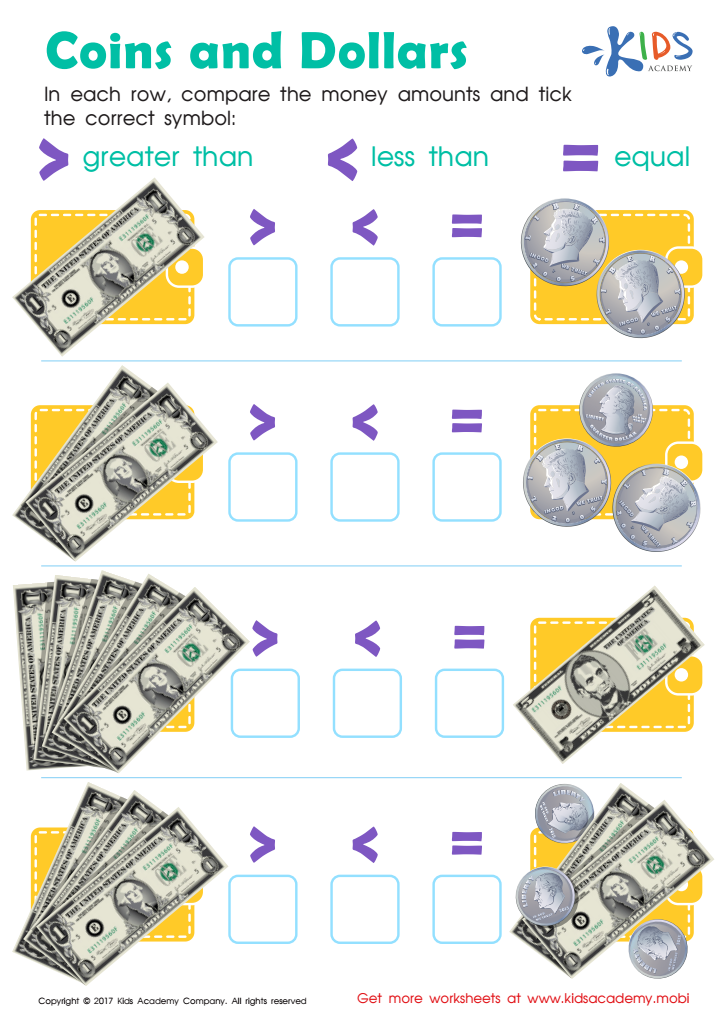
Motivate your kid to learn and practise essential math skills, like 'greater than' and 'less than', by introducing the importance of money! The money worksheet "Coins and Dollars" will give them a hands-on experience of counting coins and dollars, making math symbols more memorable.
 Assign to My Students
Money: Coins Dollars Printable
Worksheet
Picking the Coins You Need Money Worksheet
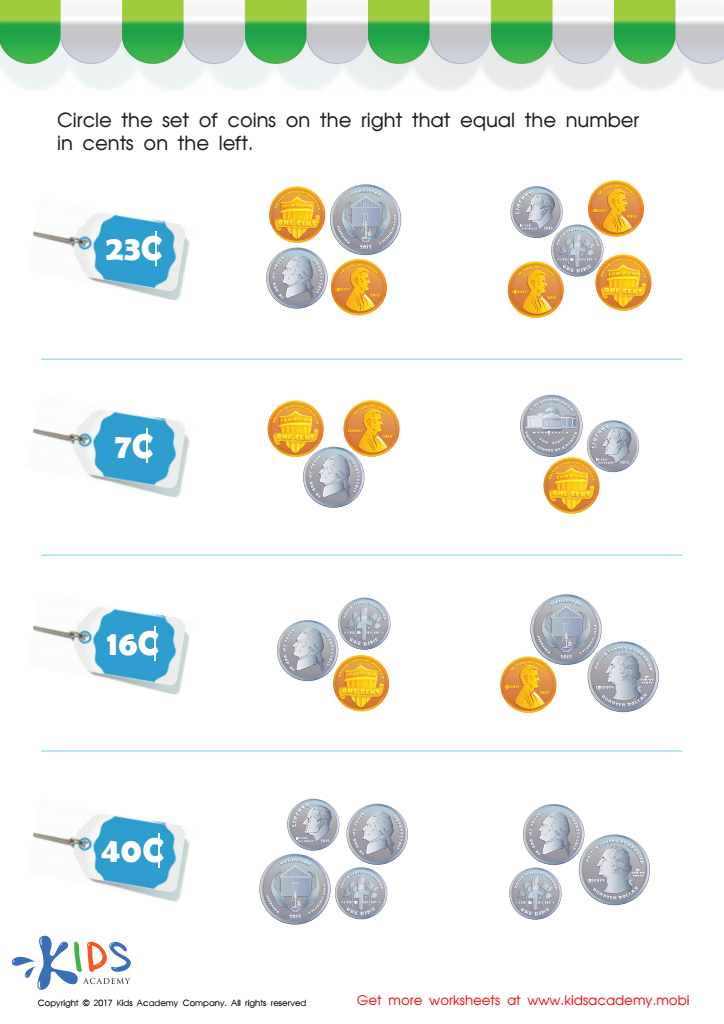
Let's learn to count money with Parents and Kids Academy! Investigate a real shop together: buy a globe, pencils, books, and a school bag using coins. Then, circle the coins you'll need. Visit our website for more free and fun money games for kids!
Picking the Coins You Need Money Worksheet
Worksheet
Join Kids Academy for Free
Who is primarily going to use this learning content?





Money identification for ages 6-7 is a fundamental skill that sets the foundation for a child's future financial literacy. At this early age, children are highly receptive to learning new concepts, and understanding money helps them develop essential mathematical and cognitive skills. Recognizing coins and bills, knowing their values, and understanding how they combine to make purchases are practical abilities that children will use throughout their lives.
For parents, teaching kids about money helps instill a sense of responsibility and the basics of budgeting. It’s a way to introduce them to the concept of saving, spending, and even the importance of choice and prioritization. For example, explaining that pennies, nickels, dimes, and quarters can add up to a dollar gives them a clear, practical illustration of addition and multiplication, reinforcing their math skills in a real-world context.
Teachers play an equally important role in facilitating structured learning experiences around money. Engaging lessons that involve money identification can be interactive and hands-on, using play money, games, and activities to make learning fun and relevant. Plus, these lessons tie into broader curricular areas, like social studies, by showing the role money plays in society.
In essence, early exposure to money identification equips children with the practical skills and knowledge they need for real-world applications while bolstering their academic growth.








