Understand number relationships Worksheets for Ages 6-7
4 filtered results
-
From - To
Explore our engaging "Understand Number Relationships Worksheets" designed for children aged 6-7! These interactive resources help young learners grasp foundational math concepts, such as comparing, ordering, and relating numbers. Each worksheet features fun, age-appropriate activities that promote critical thinking and build confidence in math skills. With colorful visuals and varied exercises, kids will enjoy practicing essential number relationships in a playful way. Perfect for homeschooling or reinforcing classroom learning, our worksheets are aligned with educational standards to ensure your child is on the right track. Start your child's math journey today and watch them thrive with numbers!
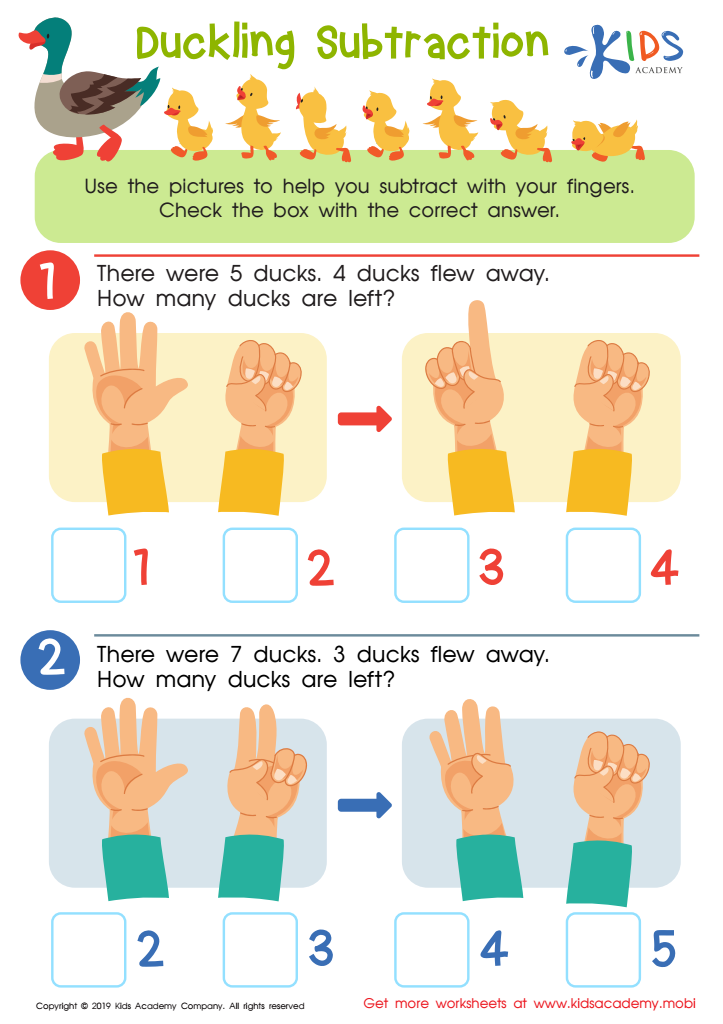
Duckling Subtraction Worksheet
 Assign to My Students




.jpg)


Understanding number relationships is essential for children aged 6-7 as it forms the foundation for their mathematical reasoning and problem-solving skills. At this stage, children start to explore deeper concepts beyond basic counting, such as addition, subtraction, and the idea of numerical value. By grasping these relationships, students learn how numbers interact with one another—realizing, for instance, that 6 is greater than 4 or that adding two numbers can lead to different sums.
This understanding promotes a more significant mathematical competence, encouraging children to see patterns and relationships that are foundational for advanced math concepts like multiplication, division, and even fractions in later grades. Moreover, it aids in developing critical thinking skills. Children equipped with a solid grasp of number relationships are better prepared to tackle real-world problems, engage in successful reasoning, and succeed in STEM fields.
Parents and teachers play a crucial role in facilitating this understanding. They can provide supportive learning environments, offer relatable examples, and engage children in hands-on activities that illuminate these relationships. By prioritizing this foundational skill, they ensure that children build confidence in their mathematical abilities, setting the stage for future academic achievement.








