Basic Addition Skills Adding up to 100 with Regrouping Worksheets for Ages 6-7
3 filtered results
-
From - To
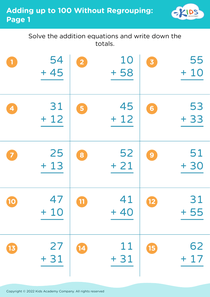
Welcome to our "Basic Addition Skills: Adding Up to 100 with Regrouping" worksheets designed for children ages 6-7. These engaging and interactive resources provide young learners with essential addition practice, focusing on skills like regrouping and carrying over numbers to solve problems accurately. Suitable for both classroom and home use, these worksheets aim to build confidence and proficiency in basic math concepts. With fun illustrations and varied exercises, our materials help make learning enjoyable while reinforcing foundational skills. Perfect for helping students master addition up to 100, our worksheets cater to different learning styles and ensure kids are well-prepared for future math challenges!
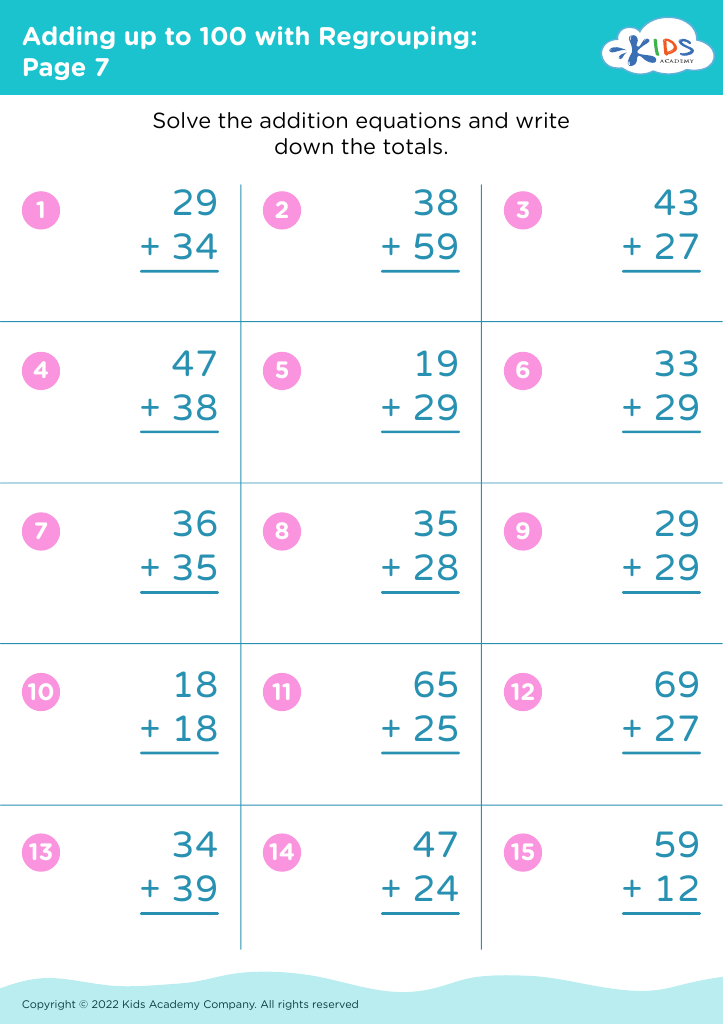
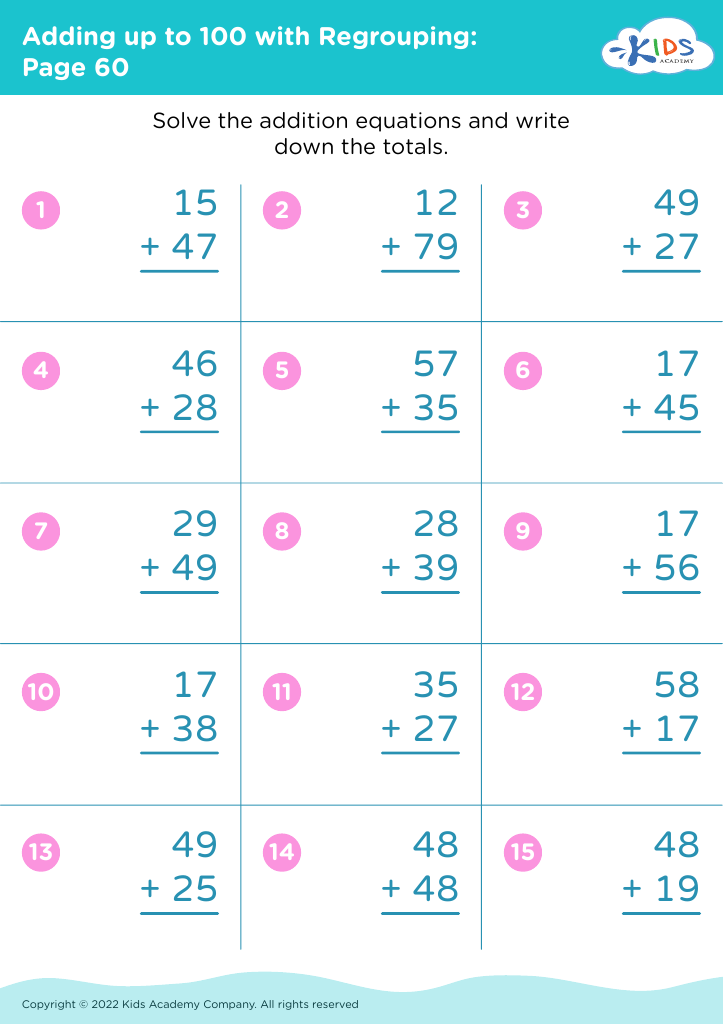
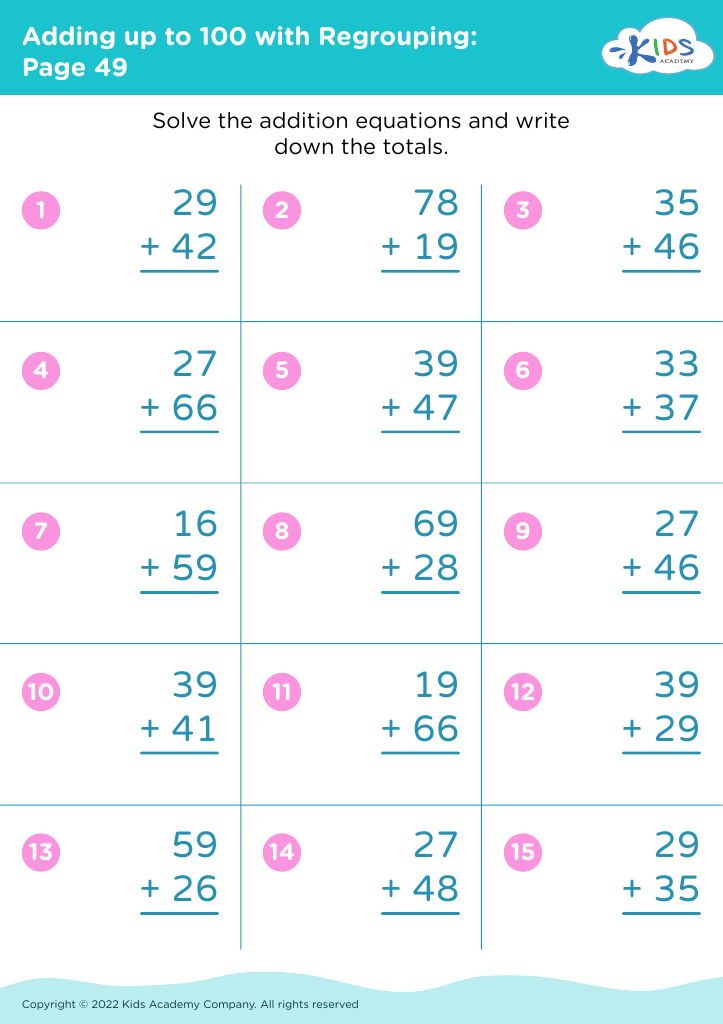




Basic addition skills, particularly adding up to 100 with regrouping, are essential for children aged 6-7 as they lay the foundation for future mathematical understanding and problem-solving abilities. Mastering these skills enhances a child’s confidence and autonomy when handling number operations, fostering a positive attitude towards math.
Early mastery of addition with regrouping teaches students the importance of place value, as they learn to discern units from tens and the significance of carrying over. This not only aids in basic arithmetic but also prepares them for more complex mathematical concepts in later years, such as subtraction, multiplication, and division.
Additionally, these skills encourage critical thinking and cognitive development, nurturing logical reasoning that can be applied outside the classroom. Children are better equipped to tackle real-world problems, like budgeting or time management, through their mathematical knowledge.
Furthermore, developing strong addition skills supports overall academic performance, not just in math but in subjects requiring analytical thinking. By prioritizing these foundational skills, parents and teachers can set children on a pathway to mathematical proficiency, lifelong learning, and success in various disciplines.