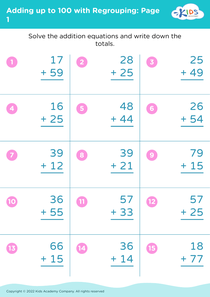
Mathematical reasoning Adding up to 100 Without Regrouping Worksheets for Ages 6-7
3 filtered results
-
From - To
Our "Mathematical Reasoning Adding up to 100 Without Regrouping Worksheets for Ages 6-7" are perfect for young learners developing their addition skills. These worksheets offer a variety of problems designed to help children add numbers up to 100 without needing to regroup. By working through these exercises, students will enhance their mathematical reasoning, improve their number sense, and gain confidence in their arithmetic abilities. Ideal for classroom practice or at-home learning, these engaging printable worksheets provide a fun and effective way to master essential math skills. Help your child succeed with our expertly crafted educational resources.
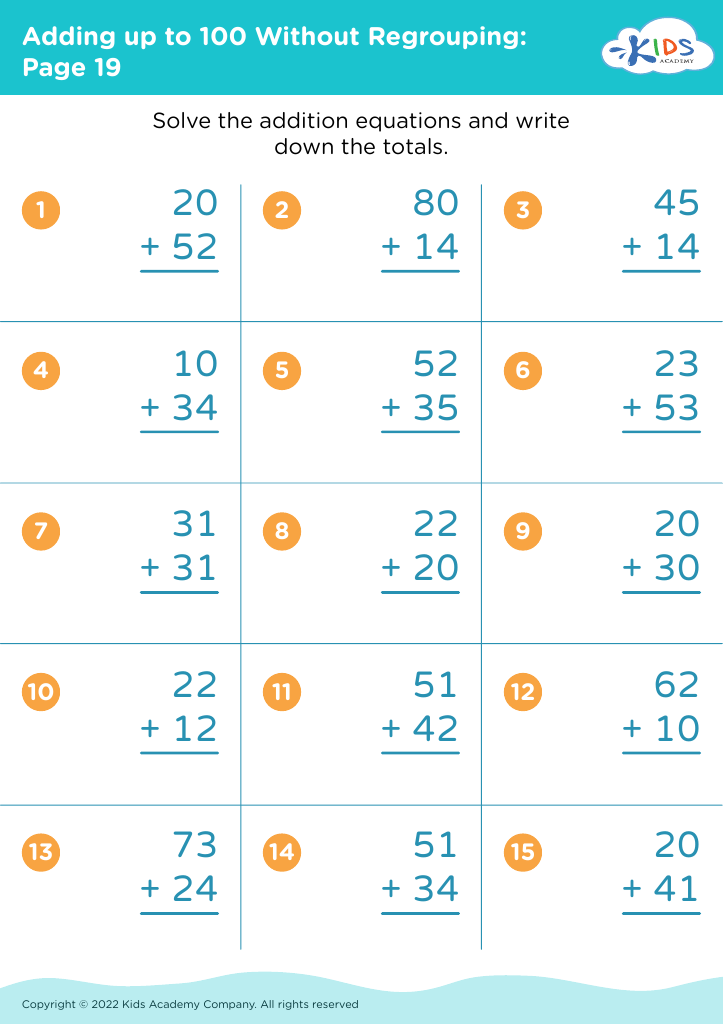
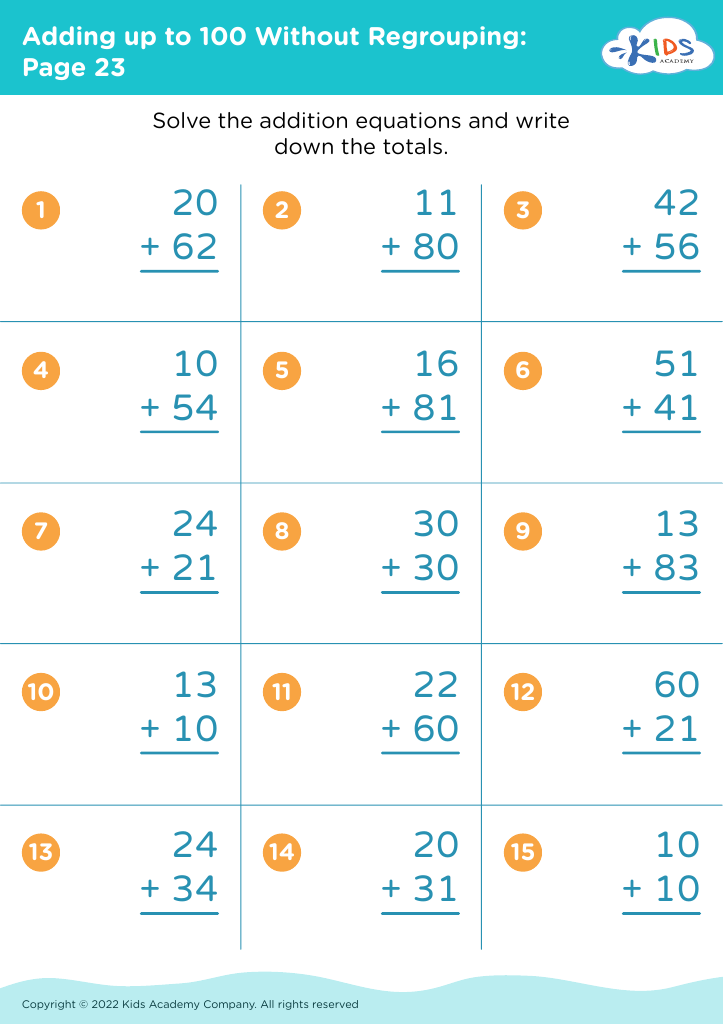
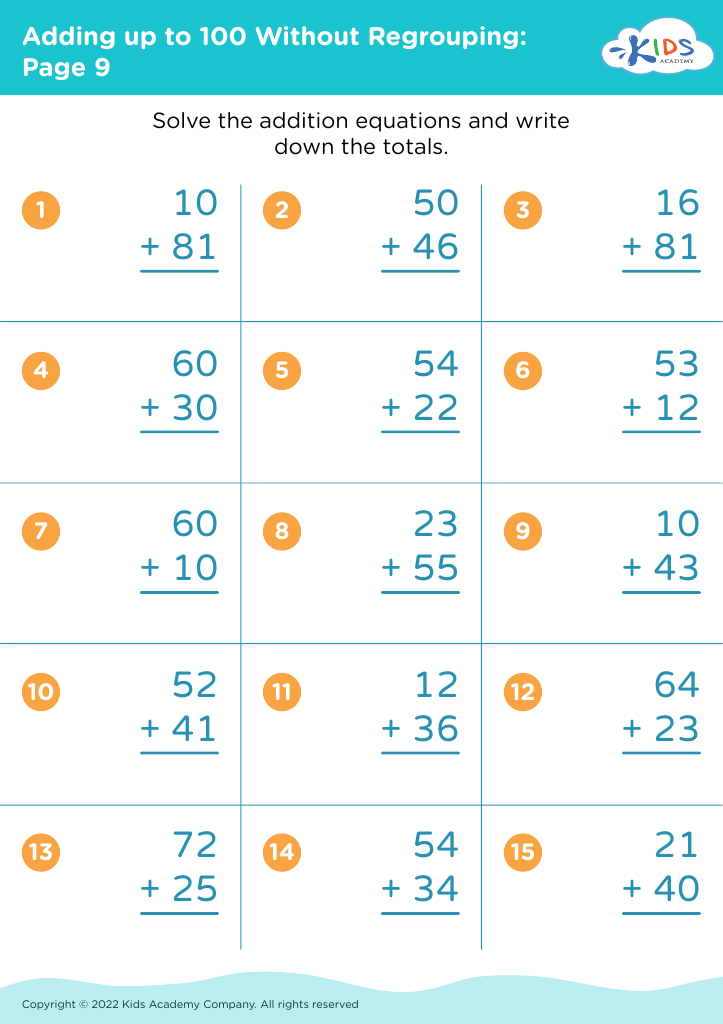




Mathematical reasoning and the ability to add up to 100 without regrouping are vital for children aged 6-7 as they form the cornerstone of more advanced math skills. This developmental stage is crucial since it builds the foundation for arithmetic operations they will encounter in later grades. Teaching children to add numbers up to 100 without regrouping improves their numerical fluency, ensuring they grasp basic principles such as place value and the sequential nature of numbers.
Parents and teachers should prioritize this skill because it enhances cognitive abilities like problem-solving, critical thinking, and logical reasoning. When children practice adding up to 100 without regrouping, they strengthen their memory and concentration. This also sets the stage for understanding more complex mathematical concepts such as carrying over in addition and borrowing in subtraction.
Moreover, achieving proficiency in this area can greatly boost a child’s confidence in their mathematical abilities, translating into a more positive attitude towards the subject overall. Given that math is a cumulative discipline, a strong grasp of early arithmetic operations facilitates smoother academic progress and less frustration in future learning experiences. Thus, focusing on this skill prepares children not only for future math challenges but for everyday tasks that require basic calculations.