
Pattern identification Addition & Subtraction Worksheets for Ages 6-7
3 filtered results
Difficulty Level
Grade
Age
-
From - To
Subject
Activity
Standards
Unlock the magic of math with our "Pattern Identification Addition & Subtraction Worksheets" for ages 6-7! Tailored to boost young minds, these engaging worksheets help first graders master addition and subtraction through fun pattern exercises. By recognizing numerical patterns, students enhance their cognitive skills and build a solid mathematical foundation. Ideal for both classroom use and homeschooling, our resources are designed to make learning interactive and enjoyable. Watch your child confidently solve math problems while developing critical thinking and problem-solving abilities. Set the stage for math success with our expertly crafted worksheets!
Favorites
With answer key
Interactive
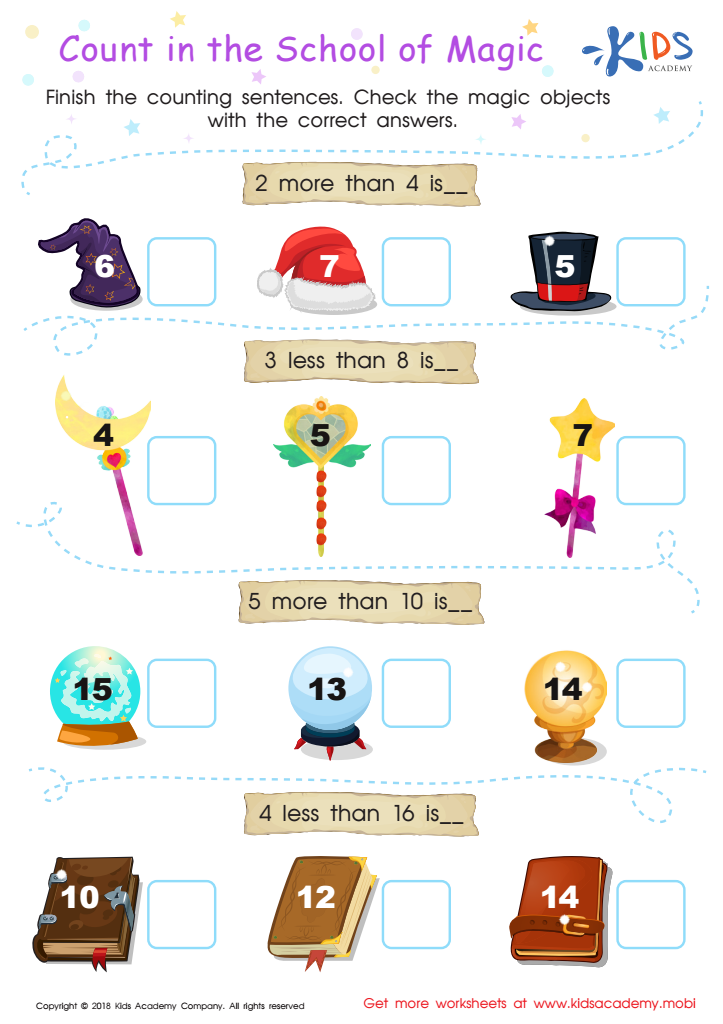
Count in the School of Magic Worksheet
Your math learners can explore the School of Magic with this worksheet. They'll read equations with addition and subtraction numbers under 20, count back and forth to find the answer, then complete the counting sentences. Fun pictures and easy accuracy make it an enjoyable and successful learning experience.
 Assign to My Students
Count in the School of Magic Worksheet
Worksheet
Join Kids Academy for Free
Who is primarily going to use this learning content?








Pattern identification and basic arithmetic skills such as addition and subtraction are crucial for children ages 6-7 for several core reasons. Firstly, these foundational skills form the bedrock of more advanced mathematical concepts they will encounter later in their education. Recognizing patterns helps children understand and predict mathematical relationships and sequences, fostering critical thinking and problem-solving skills.
Secondly, mastering addition and subtraction enhances cognitive development by improving memory, attention to detail, and logical reasoning. At this age, young learners transition from concrete to more abstract thinking; grasping these basic operations builds their confidence and prepares them for higher-level math challenges.
Additionally, pattern recognition and arithmetic operations are skills that extend beyond the classroom and into daily life. They help children develop an intuitive understanding of numbers, crucial for tasks like time management, budgeting, and decision-making.
For parents and teachers, supporting children in these areas means encouraging a growth mindset and a positive attitude towards learning. By creating engaging, hands-on experiences with patterns and basic arithmetic, adults can make math interesting, relatable, and less intimidating. This sets children on a path to academic success and lifelong learning, equipping them with essential skills that are pivotal for their future.








