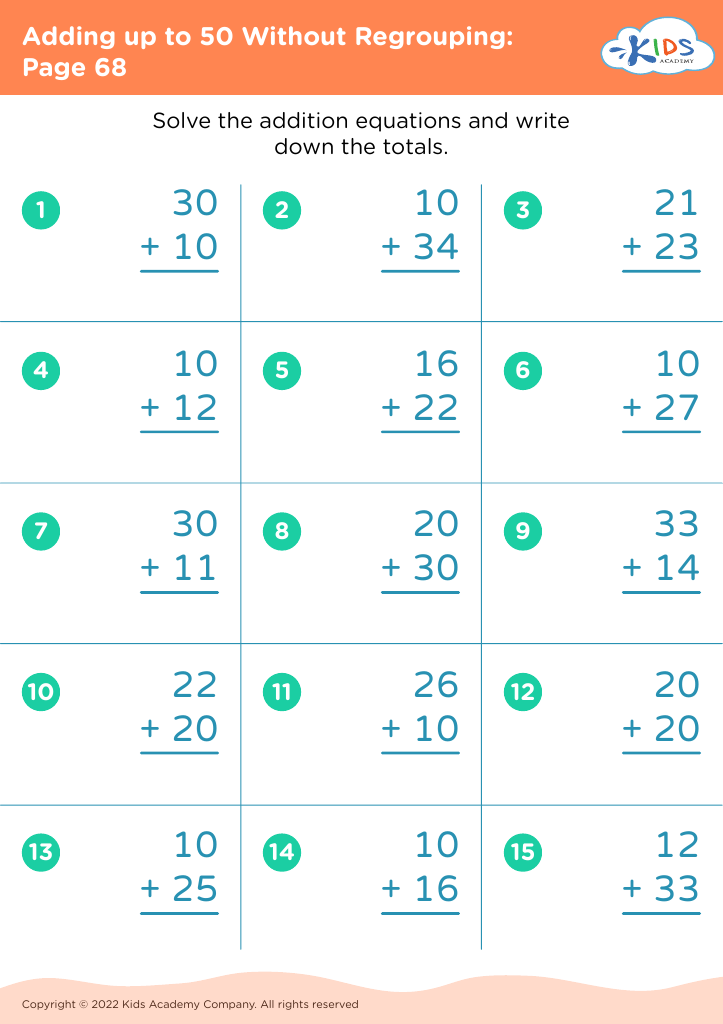








Basic addition skills for ages 6-7 form the foundation of a child's mathematical development and have lasting implications for their academic success. At this critical stage, children are not merely learning numbers; they're also developing essential cognitive skills such as problem-solving, critical thinking, and logical reasoning. Effective addition skills bolster a child's confidence in mathematics, making them more likely to engage and persevere in future mathematical learning.
Early mastery of addition helps children transition smoothly into more complex arithmetic topics, including subtraction, multiplication, and even division later on. Additionally, these skills are pivotal in fostering a love for math, as children who grasp foundational concepts are more inclined to enjoy and succeed in the subject. Moreover, good addition skills can aid in practical life situations, such as shopping or cooking, thereby connecting classroom learning to real life.
Teachers and parents play a crucial role in nurturing these skills through interactive play, engaging activities, and supportive reinforcement. Monitoring a child's progress in addition ensures that they don’t fall behind, aiding in early intervention if needed. In essence, prioritizing basic addition skills sets the stage for a brighter academic future and lays the groundwork for all future learning in mathematics.








