
Comparison Skills Addition Worksheets for Ages 6-7
4 filtered results
Difficulty Level
Grade
Age
-
From - To
Subject
Activity
Standards
Enhance your child's mathematical understanding with our "Comparison Skills Addition Worksheets" designed specifically for ages 6-7. These engaging worksheets help children develop critical comparison skills while they practice addition. Through diverse and interactive exercises, kids will learn to compare numbers, grasp the concepts of greater than and less than, and strengthen their overall arithmetic abilities. Our worksheets make math fun and accessible, promoting confidence in young learners. Perfect for reinforcing classroom teachings or supplementing home study, these resources are ideal for fostering a solid foundation in mathematics. Empower your child with essential skills today!
Favorites
With answer key
Interactive
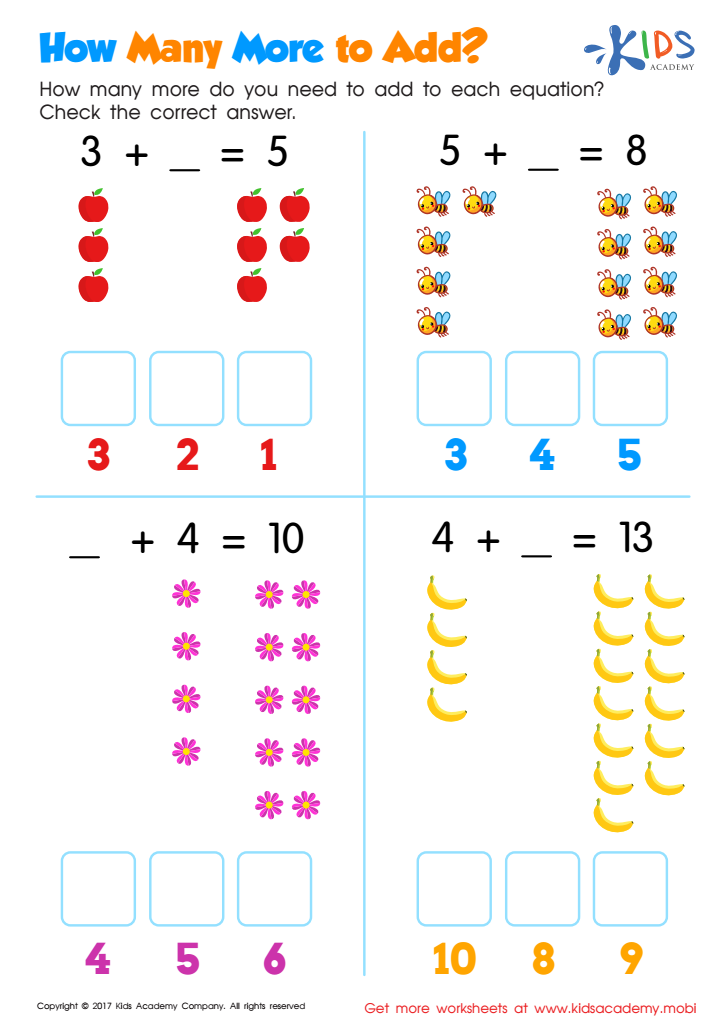
How Many More to Add Worksheet
Sharpen your child's math skills with this pdf worksheet. Help them figure out how many apples, bees, flowers and bananas are needed to reach the answer given. The possible answers are provided at the bottom of the boxes. Have some fun doing some addition and subtraction magic together and get those math skills sharpened!
 Assign to My Students
How Many More to Add Worksheet
Worksheet
Join Kids Academy for Free
Who is primarily going to use this learning content?








Comparison skills in addition for children aged 6 to 7 are crucial for several reasons. At this developmental stage, students are learning to not only perform basic addition but also to understand the relationships between numbers. Learning to compare sums helps them grasp concepts of quantity, size, and value, which are foundational to mathematical understanding.
Encouraging comparison skills fosters critical thinking by prompting students to analyze different sums and determine which is greater or lesser. This supports not only addition but also future topics such as ordering numbers and understanding place value. Additionally, comparison skills are essential in real-life scenarios, such as shopping or cooking, where children make decisions based on numerical information.
Moreover, these skills enhance cognitive development and help improve problem-solving abilities. Engaging students in comparison activities allows teachers and parents to assess their understanding and identify any gaps in their knowledge. By nurturing these skills through games, discussions, and hands-on activities, adults can create a positive learning environment that makes math engaging and relevant. Ultimately, fostering comparison skills lays the groundwork for a child's confidence in mathematics and builds a lifelong appreciation for the subject.








