
Logical thinking Addition Worksheets for Ages 6-7
9 filtered results
Difficulty Level
Grade
Age
-
From - To
Subject
Activity
Standards
Discover our engaging Logical Thinking Addition Worksheets designed specifically for children ages 6-7! These worksheets help young learners develop essential math skills by encouraging logical reasoning alongside addition practice. Featuring a variety of fun problems and visually stimulating exercises, children will enhance their critical thinking skills while mastering basic addition concepts. Our resources are perfect for both classroom use and home learning, promoting independence and boosting confidence in math. Help your child build a strong foundation in mathematics with our thoughtfully-designed worksheets that make learning enjoyable and effective. Explore the collection today and support your child’s logical thinking and number skills!
Favorites
With answer key
Interactive
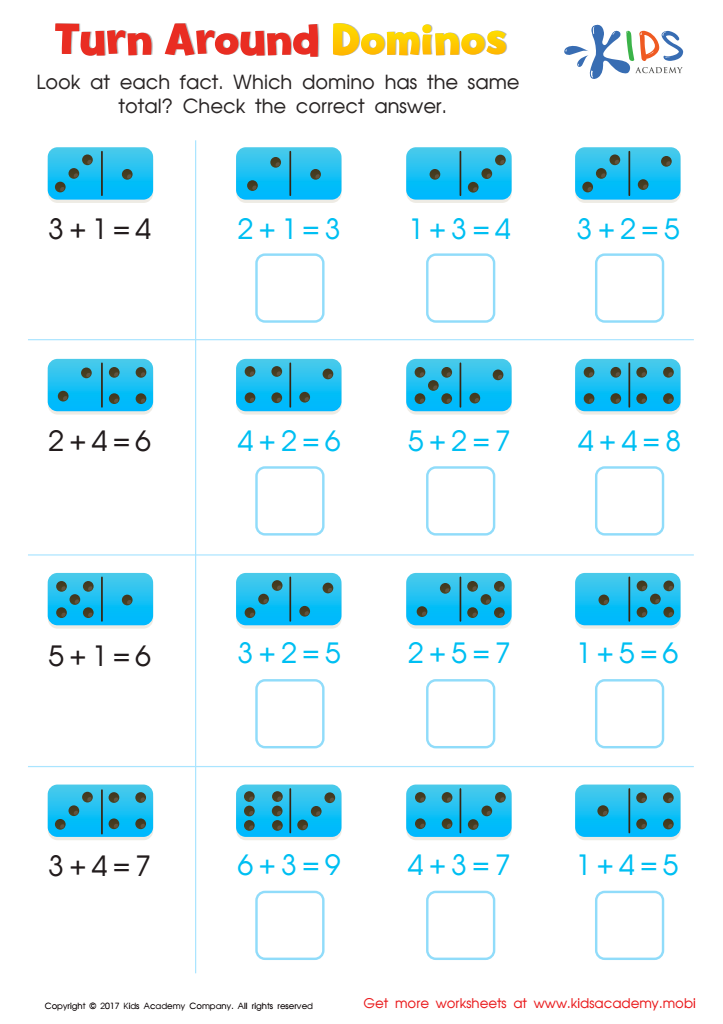
Turn Around Dominos Worksheet
Encourage your child to flex their mental muscles with this math worksheet. Look through the left side's dominos and their values and then check the three boxes on the right. Ask your child if any of the right box's dominos are similar. This requires focus and careful observation.
 Assign to My Students
Turn Around Dominos Worksheet
Worksheet
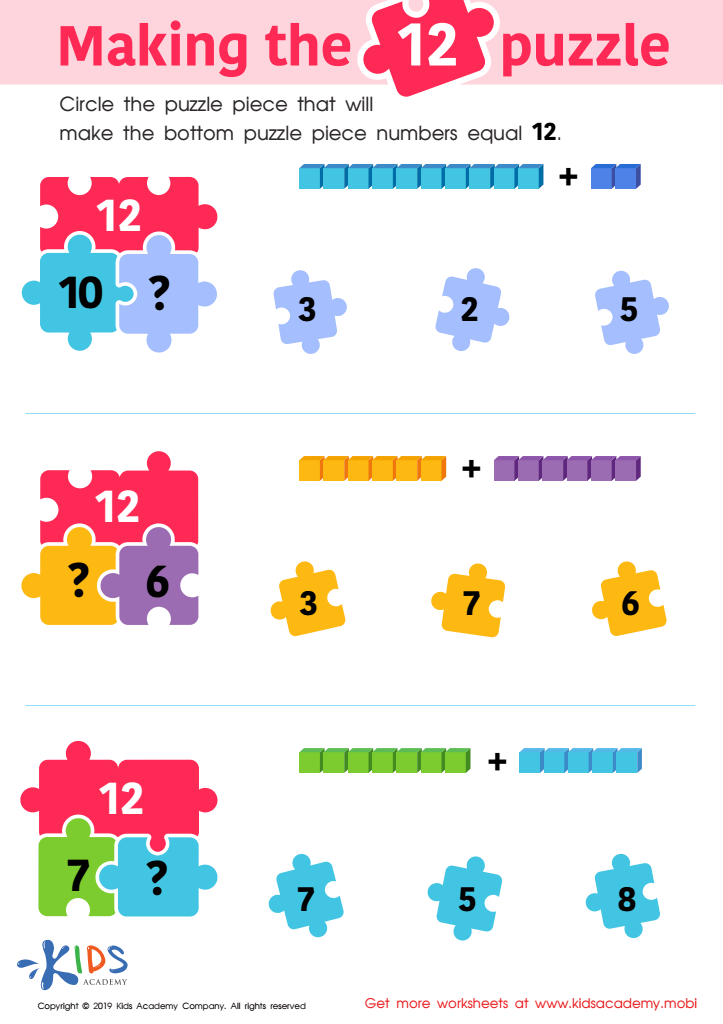
Making the 12 Puzzle Worksheet
Engage preschoolers in learning with this fun and colorful worksheet. Ask them to look at the picture and identify the missing equation on each puzzle piece; then help them solve the problems. When all the puzzle pieces make the bottom numbers equal 12, have them circle it. This is a great way to combine learning and fun!
Making the 12 Puzzle Worksheet
Worksheet
Join Kids Academy for Free
Who is primarily going to use this learning content?








Parents and teachers should prioritize logical thinking addition for children ages 6-7 as it lays the foundational skills necessary for both math proficiency and critical thinking. At this age, children are developing their cognitive structures, making it an ideal time to cultivate their ability to think logically and independently. Logical thinking helps them understand relationships between numbers and enhances their problem-solving skills, which are essential not only in mathematics but across various disciplines.
By focusing on logical thinking addition, educators and parents can promote a deeper understanding of mathematical concepts beyond rote memorization. When children engage in activities that require them to analyze patterns, make predictions, and draw conclusions, they develop a number sense that encourages curiosity and exploration. This approach fosters resilience in facing challenges, as they learn to approach problems systematically and thoughtfully.
Moreover, strong logical thinking and mathematical skills contribute to children's self-confidence, enabling them to tackle more complex concepts in the future. For parents and teachers, investing time and resources in developing these skills ensures that children are well-equipped for academic success, ultimately nurturing a love for learning that will benefit them throughout their lives.








