
Pattern identification Addition Worksheets for Ages 6-7
3 filtered results
Difficulty Level
Grade
Age
-
From - To
Subject
Activity
Standards
Our "Pattern Identification Addition Worksheets for Ages 6-7" are designed to make learning math fun and engaging for young learners. These printable worksheets combine the concepts of addition and pattern recognition, helping children to strengthen their math skills while also enhancing their cognitive abilities. Perfect for teachers and parents, these activities motivate students to learn through colorful illustrations and interactive exercises. As kids solve addition problems and recognize numerical patterns, they build a strong foundation in math that prepares them for future academic success. Ideal for home or classroom use, these worksheets are a valuable educational tool.
Favorites
With answer key
Interactive
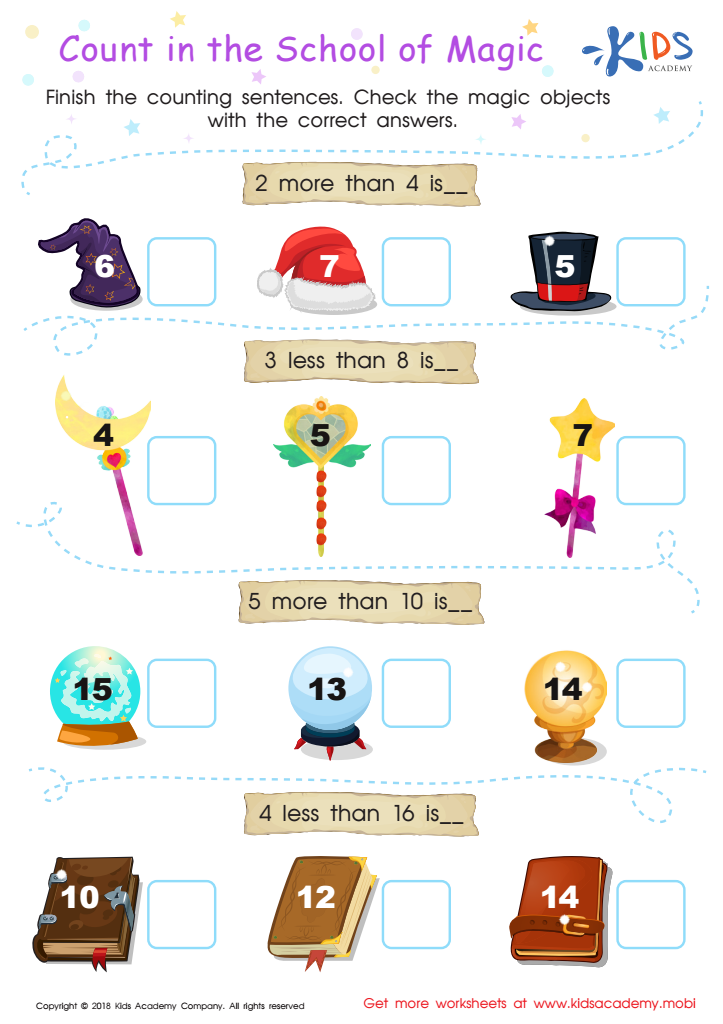
Count in the School of Magic Worksheet
Your math learners can explore the School of Magic with this worksheet. They'll read equations with addition and subtraction numbers under 20, count back and forth to find the answer, then complete the counting sentences. Fun pictures and easy accuracy make it an enjoyable and successful learning experience.
 Assign to My Students
Count in the School of Magic Worksheet
Worksheet
Join Kids Academy for Free
Who is primarily going to use this learning content?








Pattern identification and basic addition are fundamental skills for children aged 6-7, and their importance cannot be overstated for several reasons. Firstly, recognizing patterns helps children develop critical thinking skills and the ability to predict what comes next. This skill is foundational not just in mathematics, but in understanding sequences and systems in subjects like science, technology, and even language arts.
Additionally, proficiency in addition is crucial as it serves as a building block for more advanced mathematical concepts. When children master addition early on, they build the confidence and numerical sense that will aid them in tackling increasingly complex arithmetic, such as subtraction, multiplication, and division.
Teaching these skills engages a child’s natural curiosity and encourages a proactive approach to problem-solving. For educators and parents, early intervention in these areas can help identify any learning difficulties that a child might face, allowing for timely support and resources.
Moreover, early success in these subjects fosters a positive attitude towards learning and school in general. The practical application of patterns and addition in everyday life, such as in games or even while shopping, helps children see the relevance of what they are learning, which can bolster motivation and engagement.
Therefore, both teachers and parents should prioritize pattern identification and addition exercises, knowing they are establishing skills that are vital for academic success and everyday functioning.








