
Practice problem-solving Math Worksheets for Ages 6-7
5 filtered results
Difficulty Level
Grade
Age
-
From - To
Subject
Activity
Standards
Welcome to our Practice Problem-Solving Math Worksheets for Ages 6-7 page! Designed to enhance critical thinking and analytical skills, these engaging worksheets provide a variety of fun, age-appropriate math problems. Perfect for young learners, each worksheet focuses on real-world scenarios that encourage kids to apply their math knowledge creatively. From simple addition and subtraction challenges to more complex word problems, our resources promote independence and confidence in problem-solving. Ideal for homeschoolers, teachers, or additional practice at home, these worksheets offer a fantastic tool to inspire a love for math early on. Start your problem-solving journey today!
Favorites
With answer key
Interactive
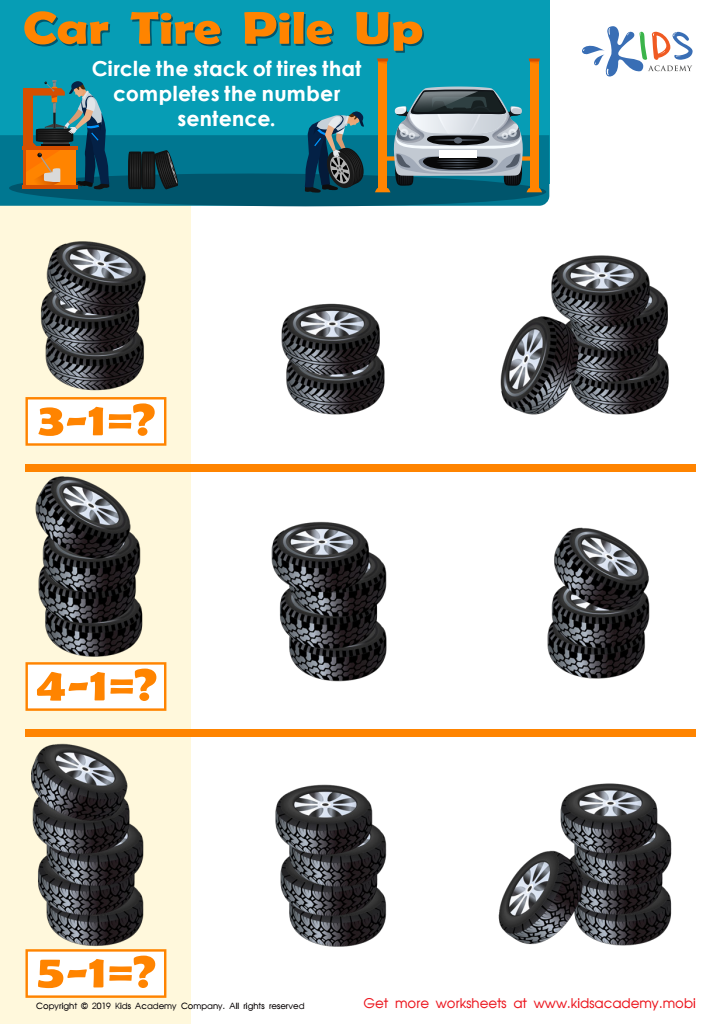
Car Tire Pile Up Worksheet
Examine the pic with your kids. Can they recognize the items piled up? The tires are organized in different quantities. Equations are on the left. Have your children work out the equations, counting the tire stacks to identify the correct answer.
 Assign to My Students
Car Tire Pile Up Worksheet
Worksheet
Join Kids Academy for Free
Who is primarily going to use this learning content?




%20(1).jpg)



Practice problem-solving in math for ages 6-7 is crucial for the developmental growth of children. At this age, children are not just learning numbers but also developing critical thinking skills that are foundational for their future education and everyday life. Engaging in problem-solving activities stimulates cognitive development, allowing children to learn how to approach and dissect problems—a skill that extends beyond math into other subjects and life scenarios.
Moreover, this practice fosters resilience in young learners. When children encounter challenging problems, they learn valuable lessons about perseverance and creativity in finding solutions. This practice also boosts their confidence, helping them to feel competent when faced with difficulties, rather than overwhelmed.
In addition, enhancing problem-solving skills is vital for bridging the gap between concrete experiences and abstract reasoning, which will be carried forward into higher mathematics. It nurtures teamwork and communication skills when solved collaboratively with peers, promoting social interaction.
For parents and teachers, prioritizing problem-solving math cultivates a love for learning, encourages academic success, and equips children with essential life skills, laying a strong educational foundation that will serve them throughout their academic journey and beyond. Investing time in these activities now contributes to a more holistic and resilient approach to education.








