
Reading analog clocks Time Worksheets for Ages 6-7
3 filtered results
Difficulty Level
Grade
Age
-
From - To
Subject
Activity
Standards
Unlock the joy of telling time with our Reading Analog Clocks Time Worksheets for Ages 6-7! Designed to engage young learners, these printable worksheets provide an interactive way for children to master the concepts of hour and minute hand movements. Each activity encourages practice in identifying time to the hour, half-hour, and quarter-hour, making learning fun and effective. With colorful visuals and age-appropriate challenges, your child will build essential time-telling skills while gaining confidence. Perfect for classroom use or at-home practice, these worksheets make learning to read analog clocks a delightful experience. Enhance your child's math journey today!
Favorites
With answer key
Interactive
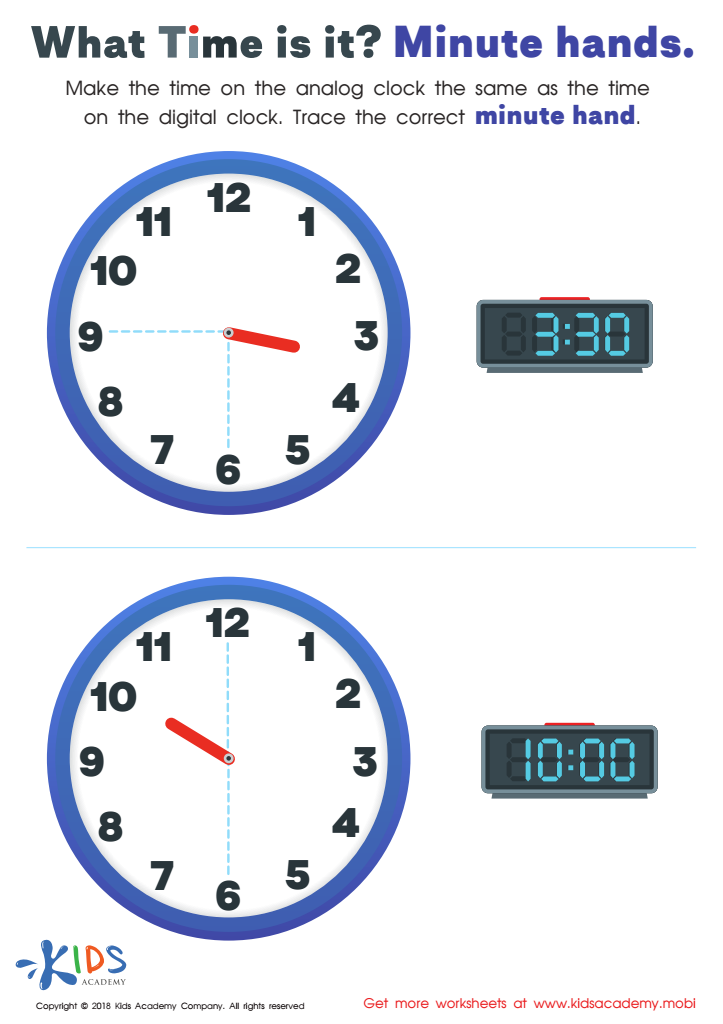
What Time Is it? Minute Hands Worksheet
Help your kids telling time with the minute hand correctly with this tracing sheet. Trace the correct minute hand to make the time on the analog clock the same as the time on the digital clock. Give them a pictured demonstration of how to do it and you'll be all set!
 Assign to My Students
What Time Is it? Minute Hands Worksheet
Worksheet
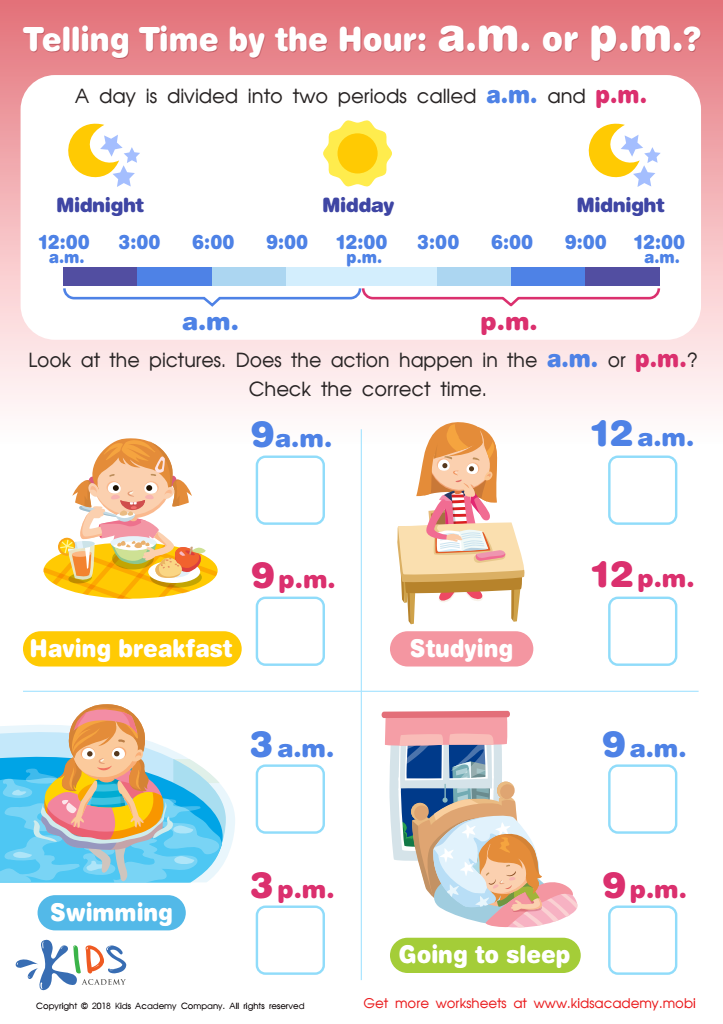
Tilling Time by the Hour: a.m. or p.m.? Worksheet
Can your child tell the time? This worksheet will help them learn. Explain a.m and p.m. and look at the pictures together. Ask your child if the activities happen in the a.m or p.m and help them check the correct time.
Tilling Time by the Hour: a.m. or p.m.? Worksheet
Worksheet
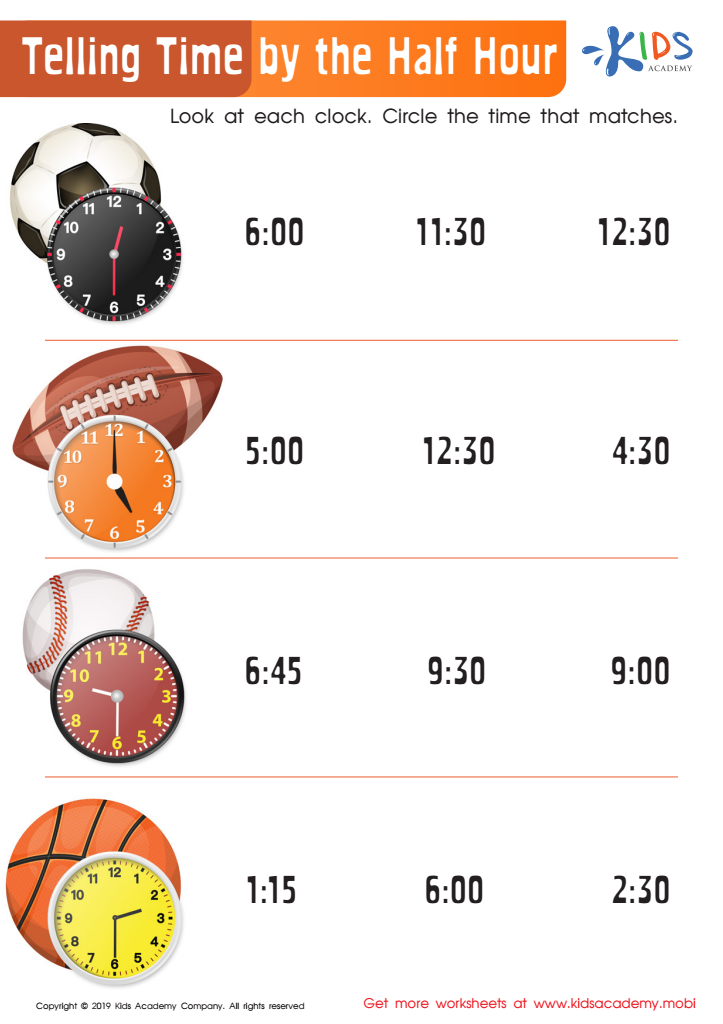
Telling Time by the Half Hour Worksheet
Teach kids to tell time with this worksheet! Four clocks are labeled with different times; help your child circle the right one. It's a great way to teach them to read analog and digital clocks, watches, and written times. Easy and fun learning!
Telling Time by the Half Hour Worksheet
Worksheet
Join Kids Academy for Free
Who is primarily going to use this learning content?






%20(1).jpg)
Understanding how to read an analog clock is a foundational skill in developing time management and mathematical reasoning in children aged 6-7. For parents and teachers, fostering this skill goes beyond merely telling time; it encourages critical thinking and cognitive development.
First, reading an analog clock requires children to grasp the concept of hour and minute hand relationships, which engages their spatial awareness and mathematical understanding. This early exposure to time allows for cognitive connections with fractions as they learn to divide the clock face into segments, aiding their future math skills.
Second, competence in telling time builds children’s independence and confidence. Being able to manage their time helps establish routines and enhances self-discipline, which are essential life skills.
Moreover, analog clocks are still commonly encountered in daily life, including schools and public spaces. Ensuring children can interpret this information empowers them to navigate the world more effectively, reinforcing their adherence to schedules and enhancing punctuality.
Ultimately, teaching children to read analog clocks equips them with lifelong skills, boosts their self-reliance, and provides a deeper understanding of the passage of time, ensuring they are well-prepared for the demands of daily life.








