Identify colors Worksheets for Ages 6-8
3 filtered results
-
From - To
Discover the exciting range of "Identify Colors Worksheets" for ages 6-8 on Kids Academy. These engaging and educational worksheets are designed to help young learners master color recognition and improve their overall cognitive skills. Each worksheet offers a fun and interactive approach to learning, featuring colorful activities that capture your child's imagination. Ideal for both classroom and home use, these printable resources support teachers and parents in guiding children through their colorful learning journey. Give your child a head start in identifying and understanding colors with our expertly crafted worksheets. Visit our website to explore the full collection!
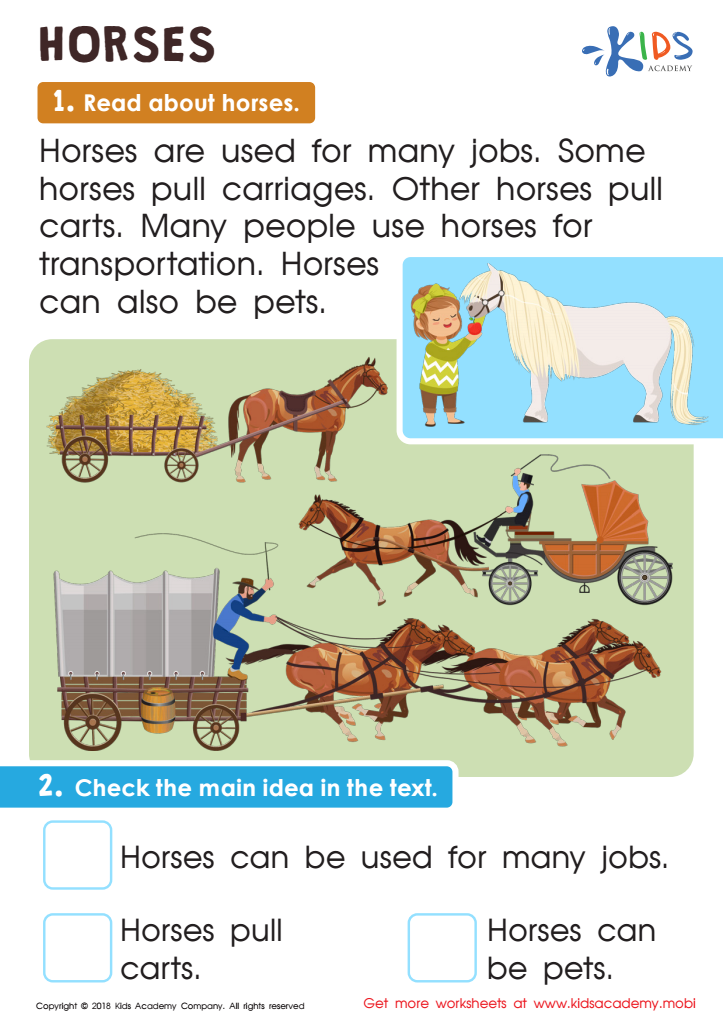
Horses Worksheet
 Assign to My Students








Helping children identify colors at ages 6-8 is crucial for several reasons that extend beyond just recognizing hues. For parents and teachers, color identification plays a vital role in early childhood development across cognitive, emotional, and social domains. At this age, children are navigating complex learning landscapes where color becomes a fundamental tool for understanding their world.
Firstly, recognizing and naming colors enhances cognitive development. It strengthens children's attention to detail and aids memory, which is foundational for learning to read and perform math tasks. For example, sorting objects by color can introduce basic grouping and categorization skills, useful for understanding broader concepts in math and science.
Emotionally, color can be tied to feelings and expressions, helping children articulate their emotions better. Understanding color associations (e.g., red for anger, blue for calm) provides children with a straightforward way to communicate their moods, leading to improved emotional intelligence.
Socially, color activities often involve collaborative tasks, enhancing social interplay and cooperation. When children work together on projects involving color, they learn important social skills, such as sharing, taking turns, and listening to others' ideas.
For these reasons, ensuring that children are proficient in color identification by age 6-8 sets a foundation for holistic development, making it an important focus for both parents and educators.








