Math problem-solving skills Worksheets for Ages 6-8
4 filtered results
-
From - To
Boost your child's critical thinking and analytical abilities with our Math Problem-Solving Skills Worksheets designed for ages 6-8. Tailored to young learners, these engaging worksheets enhance problem-solving competencies, focusing on essential math concepts such as addition, subtraction, multiplication, and division. With a variety of captivating puzzles and word problems, your child will develop a solid mathematical foundation while having fun. Perfect for classroom use or at-home practice, our expertly crafted worksheets ensure math becomes an exciting adventure. Inspire a lifelong love for learning and mastery of math skills today! Visit us at Kids Academy.
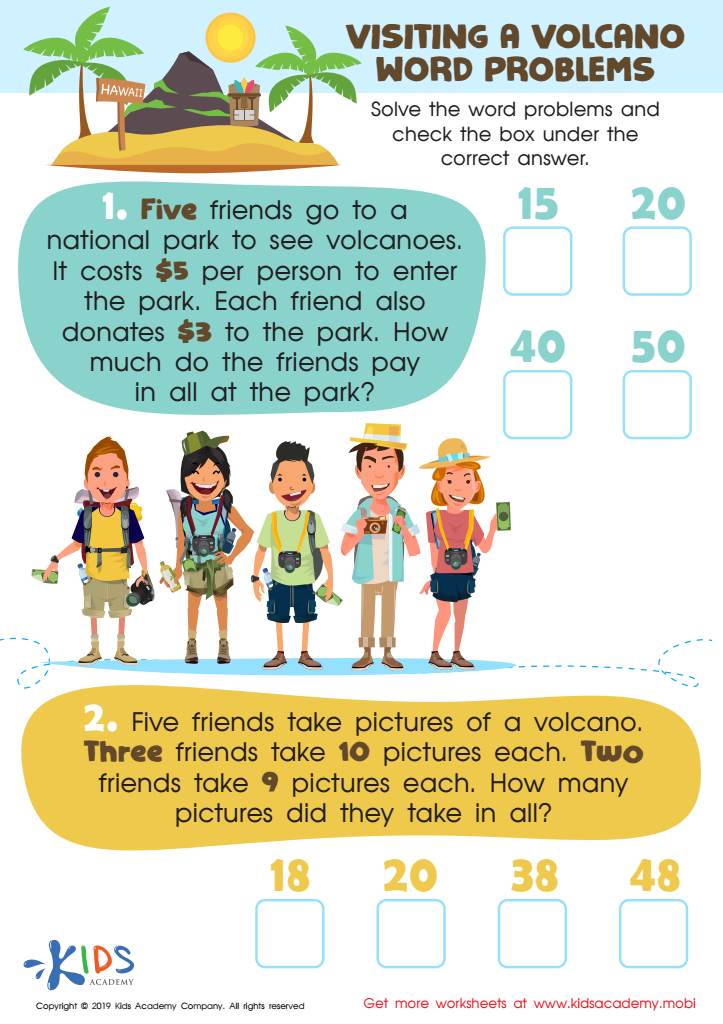
Visiting a Volcano Word Problems Worksheet
 Assign to My Students








Math problem-solving skills are crucial for children ages 6-8, laying the foundation for their future academic and real-world success. During these formative years, children are developing cognitive abilities that help them grasp complex concepts. When parents and teachers focus on nurturing math skills, they are not just preparing children for arithmetic tasks, but also promoting critical thinking and logical reasoning.
Strong problem-solving abilities enable children to approach various challenges methodically and confidently. For instance, learning to solve math problems cultivates patience, persistence, and attention to detail, which are applicable beyond the realm of academia, impacting everyday life situations. Additionally, early success in math builds self-esteem, encouraging a positive attitude towards learning in general.
Problem-solving skills support academic achievement across subjects, as they enhance reading comprehension (understanding math word problems) and even science (interpreting data). Developing these competencies in a collaborative environment, such as through games and group activities, also nurtures social skills and teamwork.
Therefore, investing time and resources in developing mathematical problem-solving abilities during early childhood is essential. It equips children with a toolbox of cognitive skills, fosters a lifelong love of learning, and provides them with the confidence to tackle complex, real-world problems.








