Recognizing equivalent fractions Worksheets for Ages 6-8
6 filtered results
-
From - To
Introduce young learners to the concept of equivalent fractions with our engaging "Recognizing Equivalent Fractions Worksheets for Ages 6-8." Each worksheet is designed to make learning fractions fun and interactive, helping kids understand how different fractions can represent the same value. With visually appealing graphics and age-appropriate exercises, children will develop a solid foundation in fractions through hands-on practice and problem-solving. Ideal for classroom use or at-home learning, our worksheets support both guided instruction and independent exploration. Boost your child's math confidence and mastery of fractions with these fun and educational worksheets. Download now and start learning today!
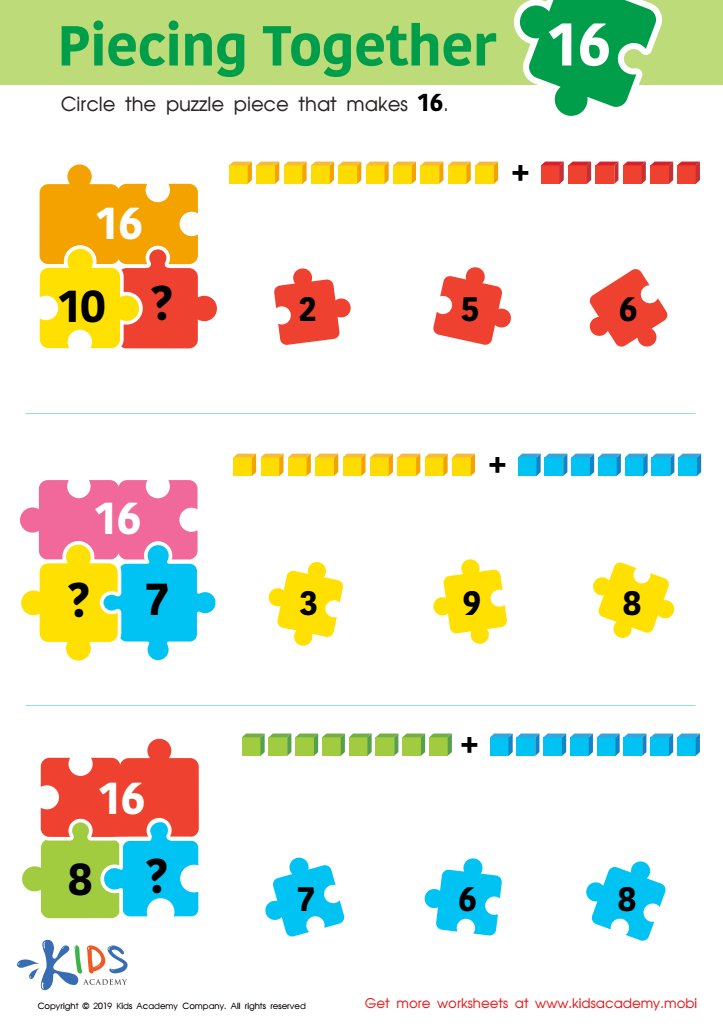
Piecing Together 16 Worksheet
 Assign to My Students





.jpg)
Recognizing equivalent fractions is a crucial skill for young children, especially those aged 6-8, because it lays a strong foundation for their future understanding of mathematics. Understanding equivalent fractions helps students see that different fractions can represent the same portion of a whole, fostering a deeper sense of numeracy and number relationships. For instance, knowing that 1/2 is the same as 2/4 and 4/8 helps children grasp that fractions are just parts of a whole expressed in various ways.
Additionally, grasping this concept at an early age boosts problem-solving skills. It aids in operations involving fractions, like addition and subtraction, where recognizing common denominators becomes essential. This understanding is essential for more advanced math topics they will encounter later, such as algebra.
From an educational perspective, familiarity with equivalent fractions supports the development of logical thinking and spatial reasoning, benefiting areas beyond mathematics, like science and engineering. It also builds confidence and reduces math anxiety since children who have a solid understanding of fundamental concepts are more likely to enjoy and succeed in math.
Furthermore, knowing equivalent fractions in everyday life can aid in practical situations like cooking, dividing materials, or understanding parts of a whole in real-life scenarios. Thus, teachers and parents should emphasize this concept to bridge classroom learning with real-world applications, fostering well-rounded intellectual development.








