Solve word problems Worksheets for Ages 6-8
3 filtered results
-
From - To
Discover engaging Solve Word Problems Worksheets designed for children ages 6-8! These interactive resources help young learners develop critical thinking and problem-solving skills through real-life scenarios. Our carefully crafted worksheets challenge students to read, interpret, and solve problems, enhancing their understanding of mathematics in a fun and practical way. With varied difficulty levels, these worksheets cater to different skill sets, ensuring that every child can confidently tackle word problems. Perfect for classroom use or at-home learning, our worksheets provide the ideal platform for fostering a love for math. Start nurturing your child's mathematical abilities and inspire curiosity today!
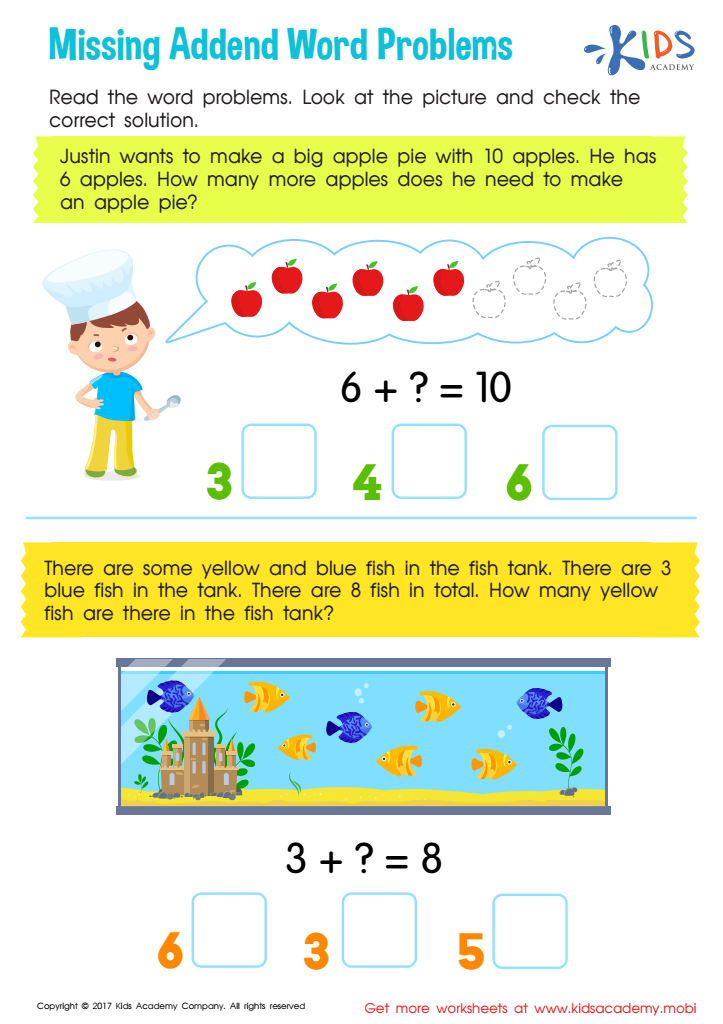
Missing Addend Word Problems Worksheet
 Assign to My Students







Parents and teachers should emphasize solving word problems for children ages 6-8 because it develops essential critical thinking and reasoning skills. At this age, children are transitioning from concrete to more abstract forms of learning. Word problems challenge them to comprehend context, extract relevant information, and apply appropriate mathematical operations, fostering deeper understanding of concepts such as addition, subtraction, and basic multiplication/division.
Furthermore, word problems enhance comprehension and communication skills. Children learn to interpret language, identify keywords, and construct logical arguments, which are valuable not only in mathematics but in overall literacy and cognitive development. Encouraging problem-solving can also foster a positive attitude toward math as it connects learning to real-life situations.
Additionally, tackling word problems enhances perseverance and resilience in children. They learn to navigate challenges, seek alternatives, and arrive at solutions through trial and error. This process fosters a growth mindset, encouraging them to tackle complex problems confidently in the future.
Overall, integrating word problems into early education enriches a child’s academic experience, reinforcing vital skills while making learning engaging and applicable to everyday life. These foundational skills lay the groundwork for their future educational pursuits and lifelong problem-solving abilities.








