Recognizing shapes Adding up to 1000 with Regrouping Worksheets for Ages 6-8
4 filtered results
-
From - To
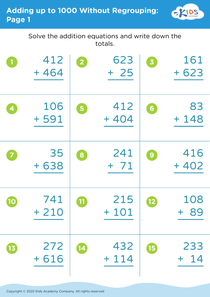
Our "Recognizing Shapes Adding up to 1000 with Regrouping Worksheets for Ages 6-8" combine essential geometry and math skills for young learners. These engaging worksheets help children identify and categorize shapes while mastering addition with regrouping up to 1000. Designed to enhance critical thinking and problem-solving abilities, these exercises offer a balanced approach to learning. Each worksheet is crafted to make math practice both educational and fun, keeping young minds motivated and supported at every step. Ideal for reinforcing classroom learning or providing valuable at-home practice, these materials are a perfect resource for developing foundational math skills.
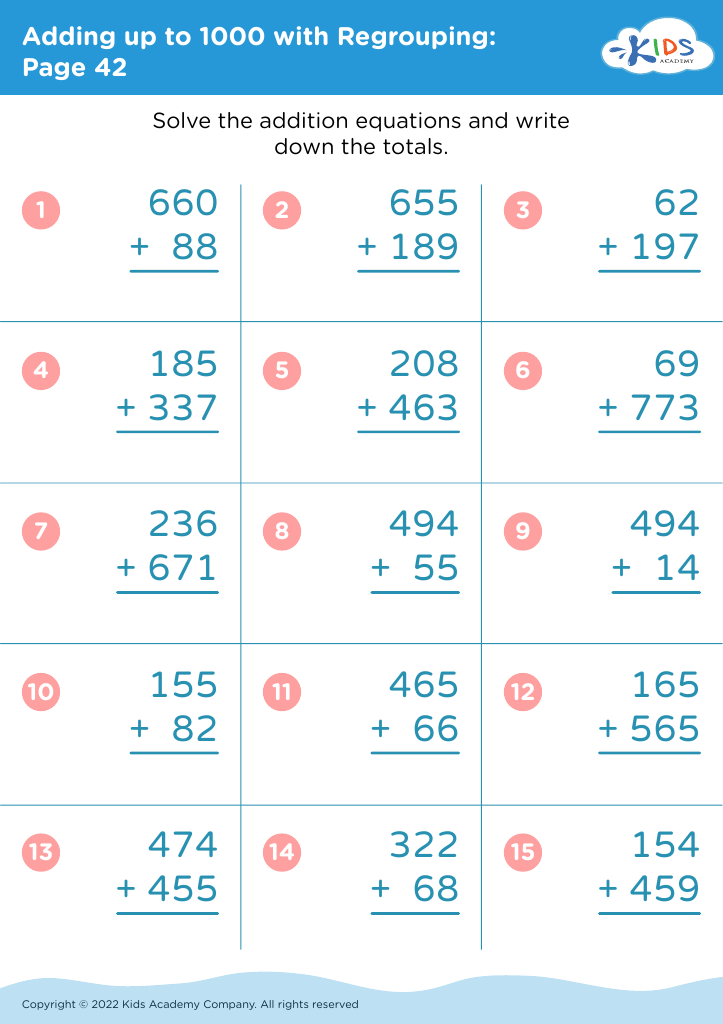
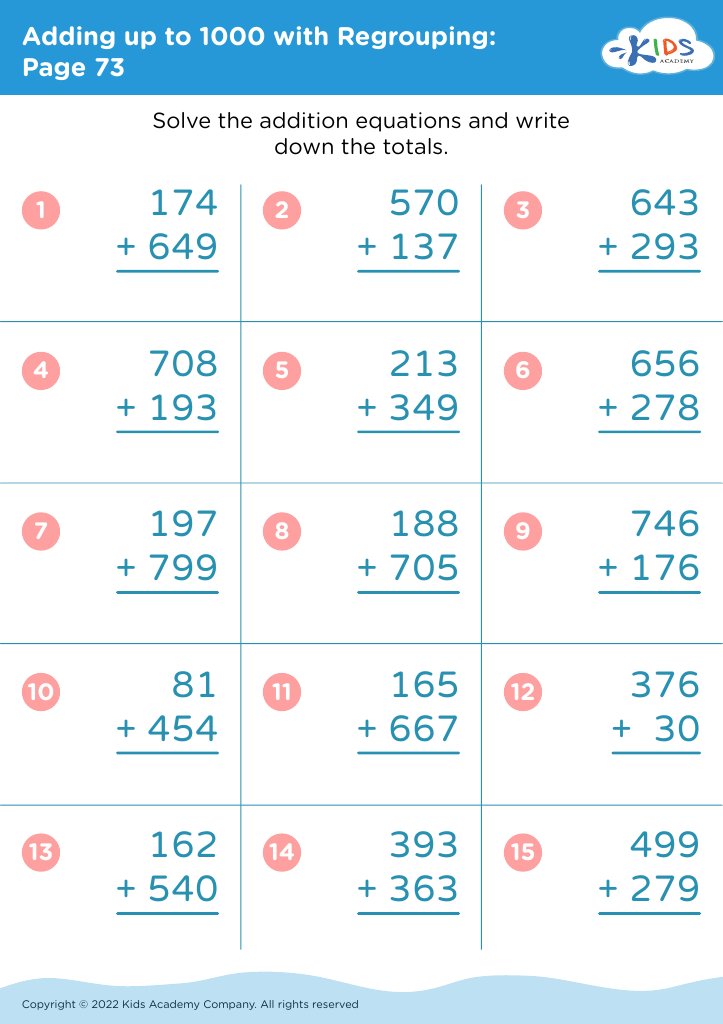
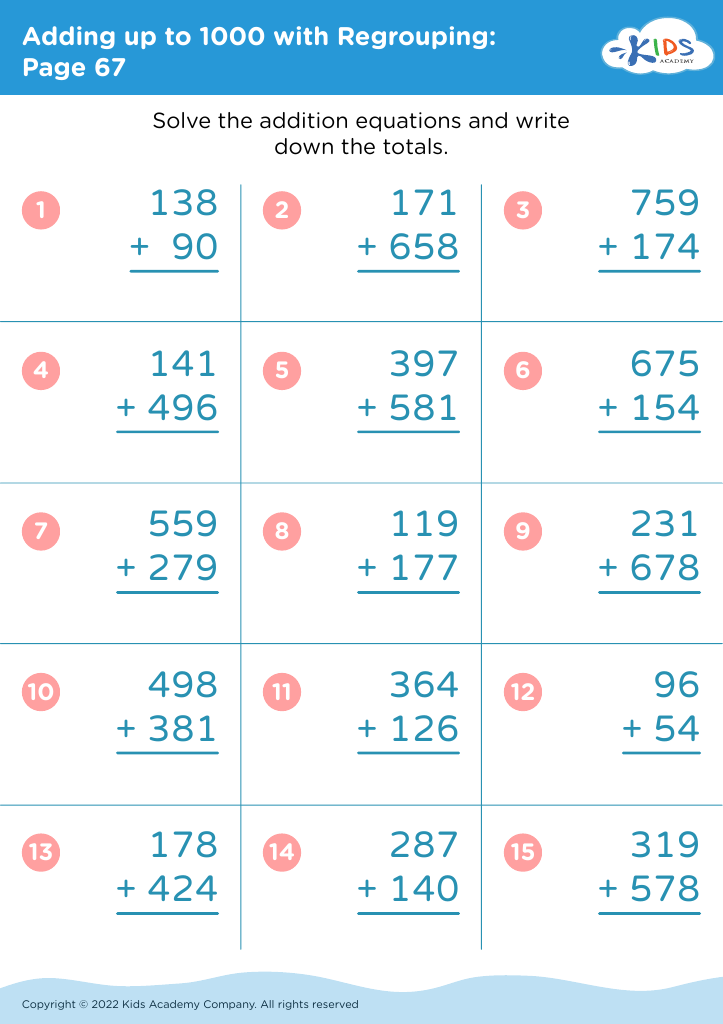
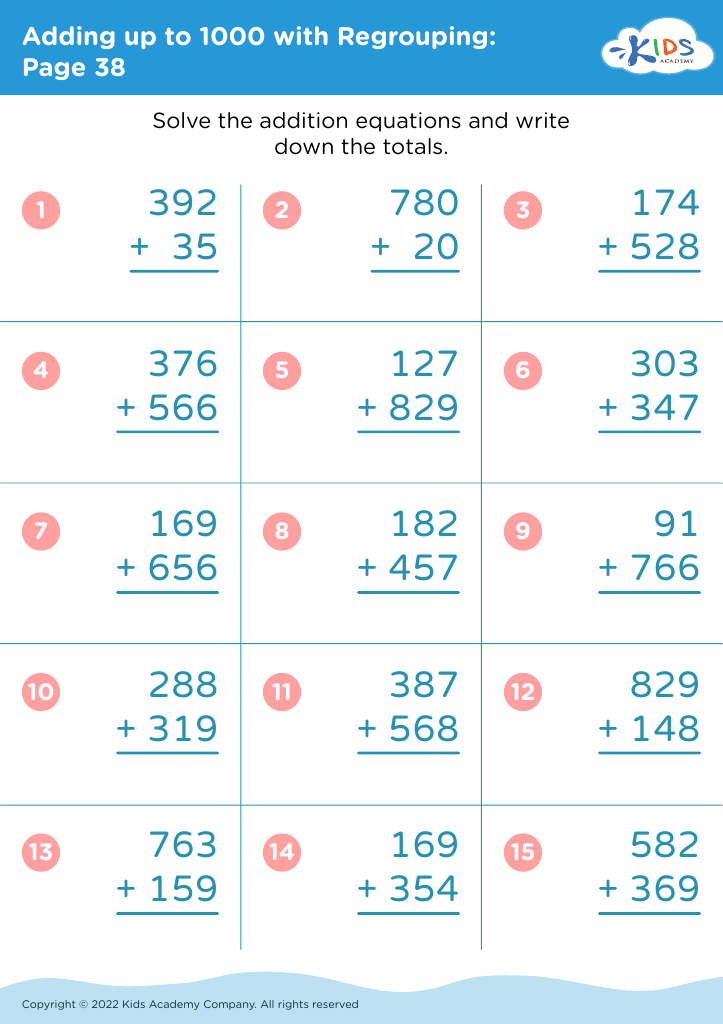


Recognizing shapes and adding up to 1000 with regrouping are fundamental skills for children aged 6-8, forming a foundation for more complex math and critical thinking in later years. Parents and teachers should prioritize these skills for several reasons.
Firstly, recognizing shapes is crucial for developing spatial awareness and geometry understanding. It helps children perceive and interpret the world's structure, fostering problem-solving and logical thinking. Understanding shapes also enhances their ability to categorize and describe objects, essential for effective communication and comprehension in various subjects beyond mathematics, such as art and science.
Secondly, adding up to 1000 with regrouping introduces children to place value and numerical relationships, core concepts in arithmetic that underpin higher-level math skills. Mastery of this skill develops number sense, facilitating mental math and estimation abilities. Regrouping (carrying and borrowing) is fundamental for performing operations like subtraction and multiplication involving large numbers. It teaches perseverance, as children learn that breaking complex problems into smaller, manageable parts can lead to solutions.
Early proficiency in these areas, therefore, leads to greater confidence in mathematics, encouraging a positive attitude toward learning. This foundation not only supports academic success but also prepares children for real-world tasks involving measurement, money, and computer science. Therefore, parents and teachers should actively support and engage children with these essential skills during critical developmental years.