Understanding quantity Adding up to 1000 Worksheets for Ages 6-8
3 filtered results
-
From - To
Enhance your child’s math skills with our “Understanding Quantity: Adding Up to 1000” worksheets tailored for ages 6-8. These engaging activities are designed to solidify fundamental math concepts, helping young learners grasp quantities and efficiently perform addition up to 1000. Utilizing fun problems and visual aids, our worksheets make learning enjoyable, fostering confidence and promoting problem-solving abilities. Perfect for classrooms or at-home practice, these worksheets aim to build a strong numerical foundation, preparing children for more advanced math challenges. Encourage your child's learning journey with our carefully crafted and educationally enriching resources from Kids Academy.
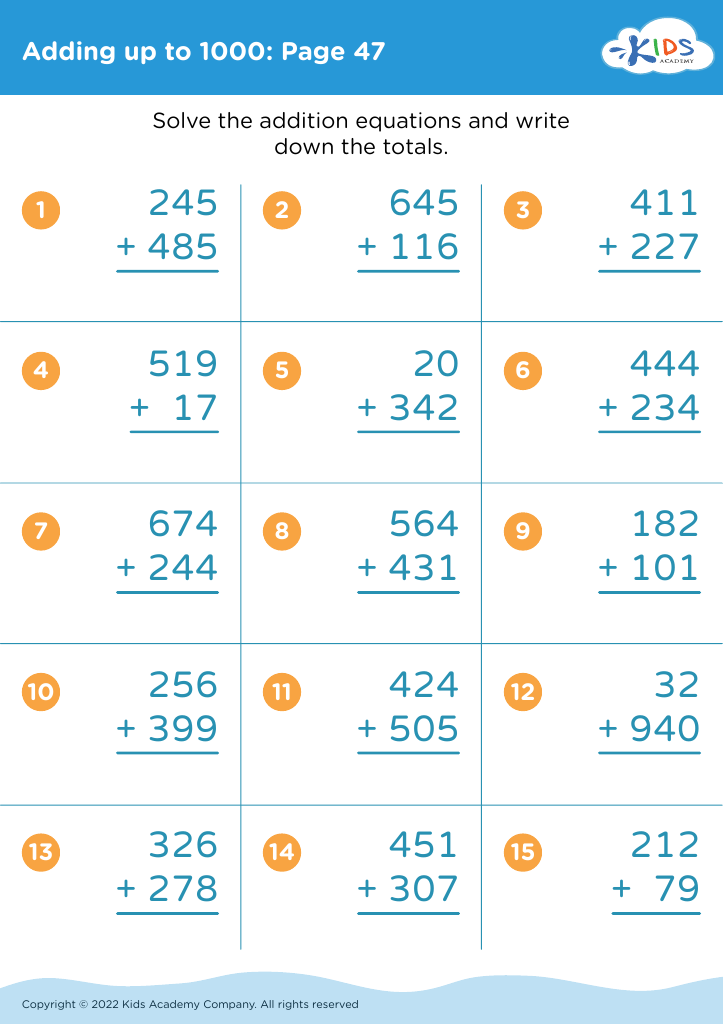
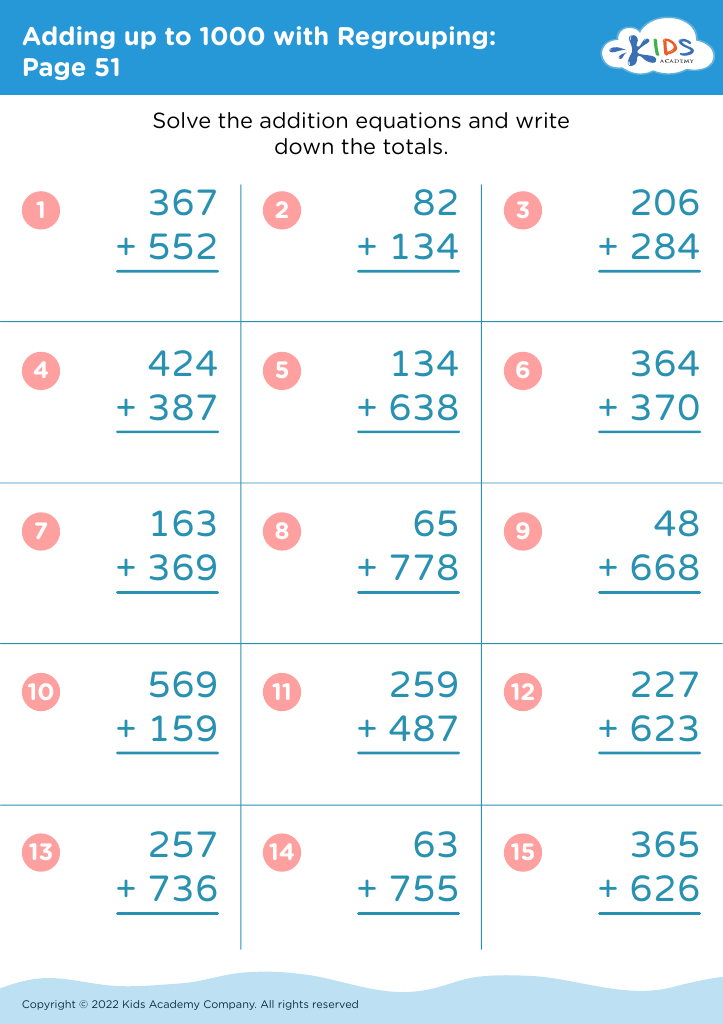
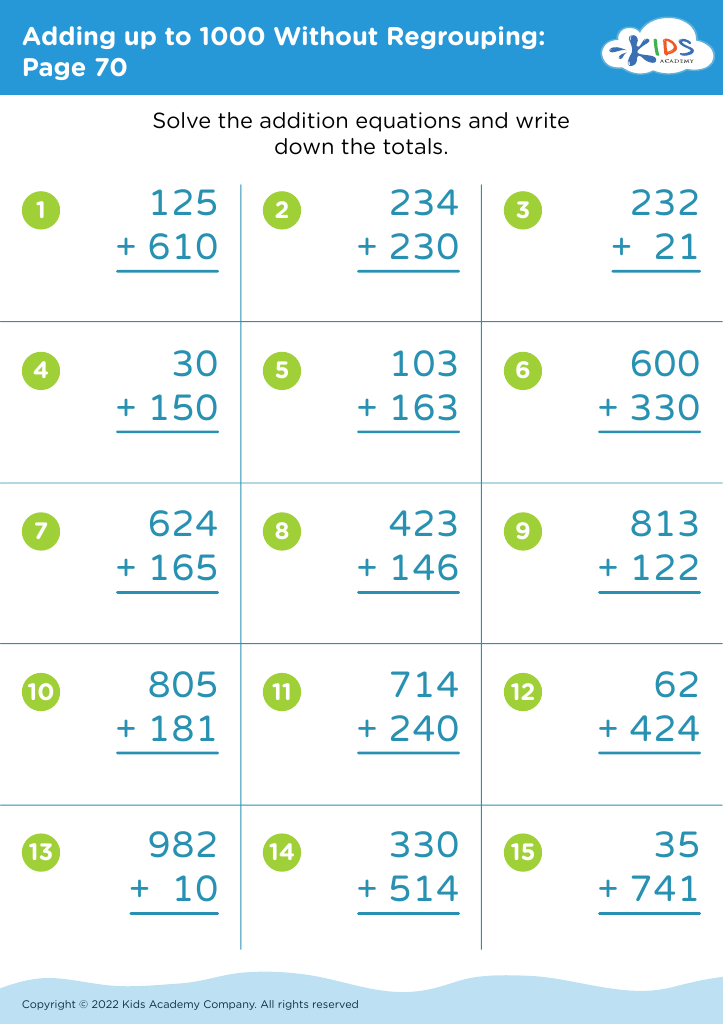



Understanding quantity and being able to add up to 1000 for children aged 6-8 is a crucial foundational math skill that parents and teachers should prioritize for several reasons.
At this stage, grasping large quantities helps solidify the concepts of place value and number sense, which are essential for all future math learning. Kids learn the significance of units, tens, and hundreds, making complex arithmetic operations more intuitive as they grow.
Addition up to 1000 encourages the development of problem-solving and critical thinking skills. These mental processes are not just applicable in math but are broadly transferable to various areas such as reading comprehension, science, and everyday decision-making.
Quantitative understanding also boosts self-confidence in young learners. Children who can handle larger numbers feel more accomplished and are more likely to participate actively in class, fostering a positive attitude towards learning.
Moreover, understanding quantity and addition lays the groundwork for practical life skills. From handling money to measuring ingredients while cooking, these concepts are ever-present in day-to-day activities.
In essence, investing time at this critical age to ensure that children grasp these math skills sets them on a path towards academic success and practical competency throughout life. Parents and teachers should collaborate to make learning engaging, helping kids build a strong numerical foundation.








