
Developing critical thinking Addition & Subtraction Worksheets for Ages 6-8
3 filtered results
Difficulty Level
Grade
Age
-
From - To
Subject
Activity
Standards
Enhance your child's math skills with our "Developing Critical Thinking Addition & Subtraction Worksheets" designed specifically for ages 6-8. Our innovative worksheets go beyond basic calculations, fostering analytical thinking and problem-solving skills through engaging activities and real-life scenarios. Each worksheet encourages children to explore various strategies for addition and subtraction, helping them build a solid understanding of mathematical concepts. With vibrant illustrations and interactive projects, these worksheets capture young learners' attention, making math both fun and educational. Support your child's development in critical thinking while mastering crucial math skills with our thoughtfully crafted resources. Perfect for home or classroom use!
Favorites
With answer key
Interactive
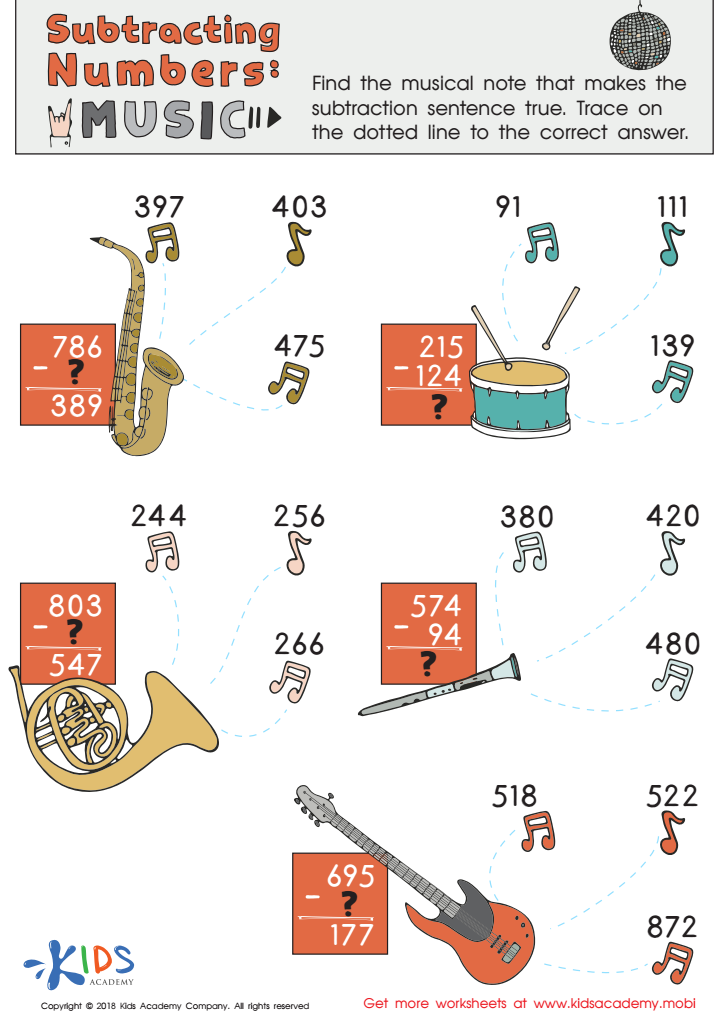
Subtracting Numbers: Music Worksheet
Enroll your kids in a music class and let them express their feelings via music! This worksheet challenges them to identify the musical note that makes the subtraction sentence true. Help them solve the problem and trace the dotted line to the correct answer. Let their appreciation for music grow!
 Assign to My Students
Subtracting Numbers: Music Worksheet
Worksheet
Learning Skills
Join Kids Academy for Free
Who is primarily going to use this learning content?








Developing critical thinking skills in addition and subtraction for children aged 6-8 is vital for several reasons. At this age, children are beginning to grasp basic mathematical concepts, and nurturing critical thinking helps them go beyond rote memorization to understand the “why” behind the numbers. This enhances their problem-solving abilities, allowing them to approach unfamiliar problems with curiosity and confidence.
When children learn to critically analyze mathematical processes, they can discern patterns and apply their knowledge to real-life situations—whether it's counting money, measuring ingredients for a recipe, or understanding time. Critical thinking in math also fosters perseverance and reasoning skills, equipping children to tackle challenges rather than avoiding them.
Moreover, when teachers and parents encourage questioning and exploration, they create an environment where children feel comfortable expressing their thoughts and making mistakes. This practice promotes resilience and a growth mindset, essential qualities for future learning. Ultimately, helping children develop critical thinking in addition and subtraction lays a strong foundation for their overall mathematical understanding, ensuring they are not just passive learners but active participants in their education. Investing in this skill set leads to greater academic success and prepares them for more complex concepts in the future.








