
Mathematical skills Addition & Subtraction Worksheets for Ages 6-8
3 filtered results
Difficulty Level
Grade
Age
-
From - To
Subject
Activity
Standards
Enhance your child's arithmetic prowess with our "Mathematical Skills Addition & Subtraction Worksheets for Ages 6-8." Tailored for young learners, our fun and engaging worksheets build foundational math skills, focusing on the basics of addition and subtraction. With a variety of activities, children practice solving sums, word problems, and math puzzles, designed to complement their learning style and pace. Boost confidence and competence with our educational, age-appropriate resources that make learning math both exciting and effective. Perfect for home and classroom use, transform math practice into an enjoyable experience for your child today.
Favorites
With answer key
Interactive
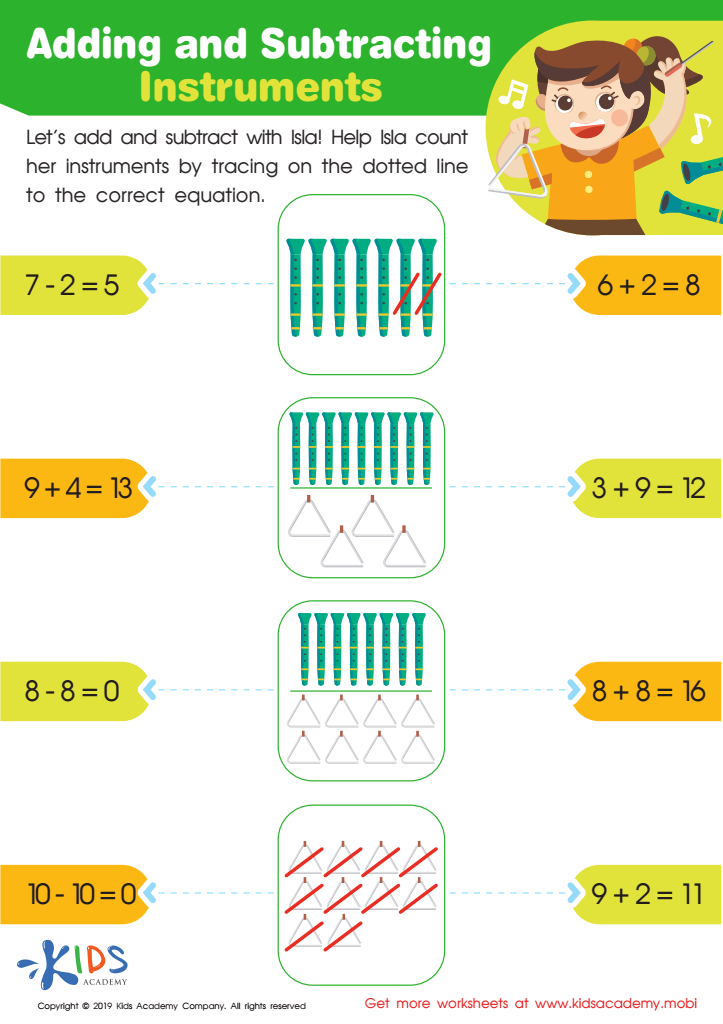
Adding and Subtracting: Instruments Worksheet
Children can help Isla count her musical instruments with this fun worksheet. The downloadable PDF gives them a chance to practice addition and subtraction by connecting pictures to equations. It's also a great way to learn the order of operations.
 Assign to My Students
Adding and Subtracting: Instruments Worksheet
Worksheet
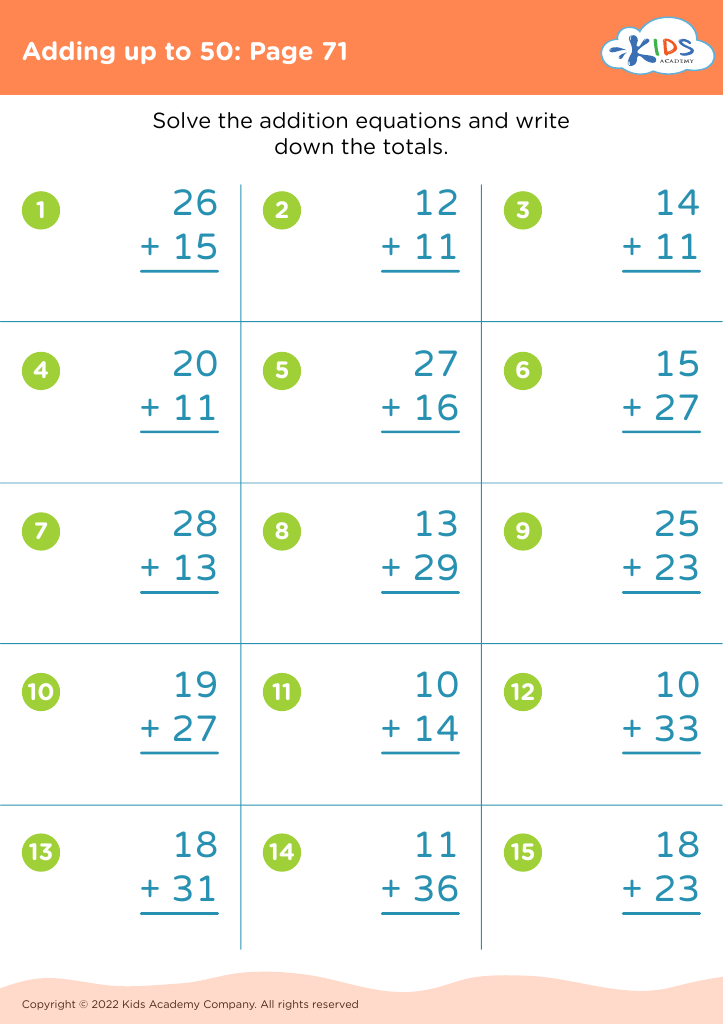
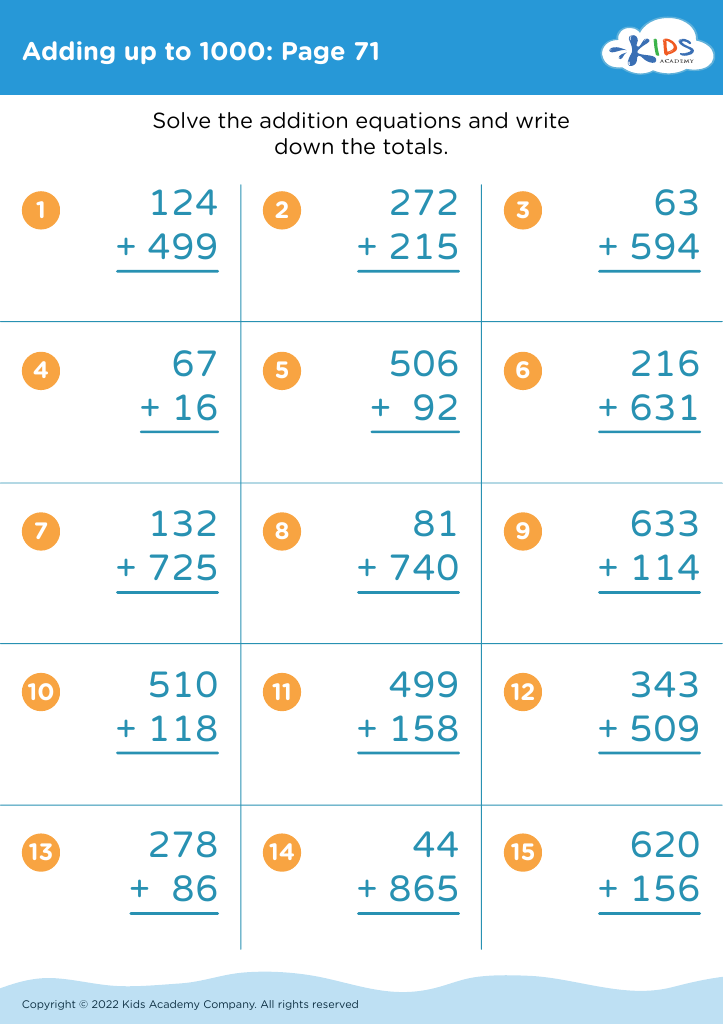
Join Kids Academy for Free
Who is primarily going to use this learning content?








Parents and teachers should prioritize teaching addition and subtraction skills to children aged 6-8 because these foundational operations are critical for their overall mathematical development. At this age, children are typically in the early elementary grades and are beginning to build their basic numeracy skills, which serve as the building blocks for more complex mathematical concepts.
Understanding addition and subtraction helps children to develop critical thinking and problem-solving skills. These operations are not only essential for daily life activities, such as making purchases and managing time, but they also pave the way for financial literacy in the future.
Furthermore, having a strong grasp of addition and subtraction promotes confidence in math, which is crucial during these formative years. Positive early experiences with math can shape a child's attitude towards the subject, reducing math anxiety and encouraging a lifelong interest in mathematical inquiry.
Moreover, addition and subtraction are overarching skills that support learning in other areas of mathematics, including multiplication, division, fractions, and algebra. A solid foundation in these basic operations allows for smoother transitions to more advanced topics in later grades.
In conclusion, investing time in strengthening children's addition and subtraction skills uncovers a pathway to academic success and practical competence, both in future educational settings and everyday life.








