
Pattern identification Addition & Subtraction Worksheets for Ages 6-8
3 filtered results
Difficulty Level
Grade
Age
-
From - To
Subject
Activity
Standards
Enhance your child's math skills with our engaging Pattern Identification Addition & Subtraction Worksheets for Ages 6-8. These fun, educational resources from Kids Academy help young learners master essential math concepts by identifying patterns in addition and subtraction problems. Our worksheets blend visual learning with interactive questions to create an enjoyable and effective learning experience. These free, printable worksheets are perfect for home or classroom use, providing the practice young minds need to thrive in math. Empower your 6-8 year old's math journey today with Kids Academy's expertly designed pattern identification exercises.
Favorites
With answer key
Interactive
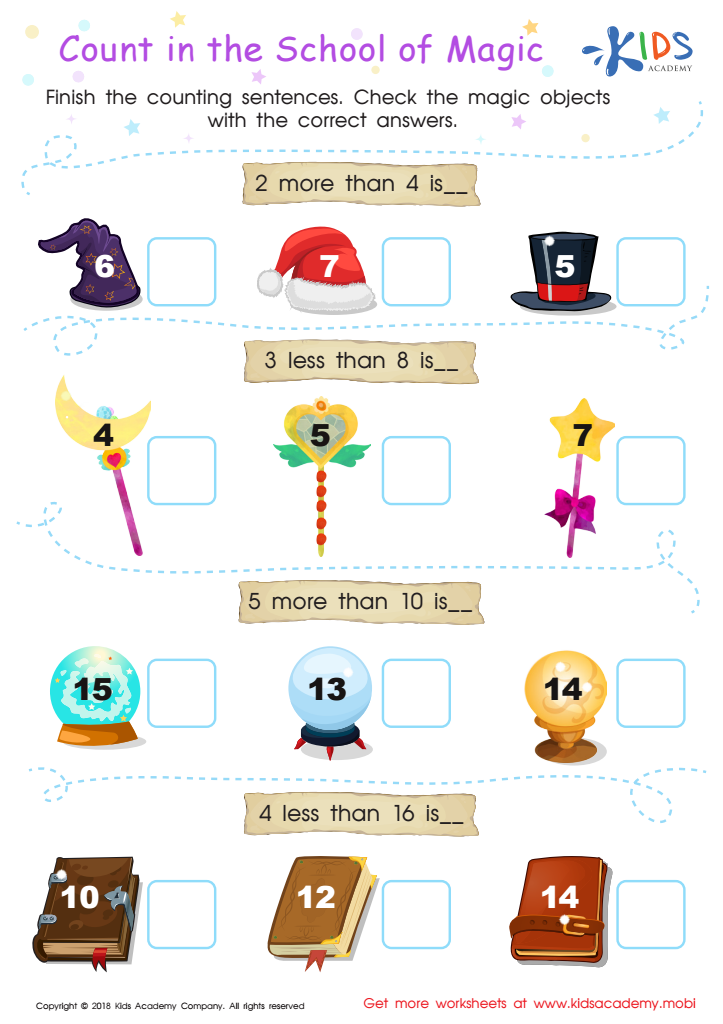
Count in the School of Magic Worksheet
Your math learners can explore the School of Magic with this worksheet. They'll read equations with addition and subtraction numbers under 20, count back and forth to find the answer, then complete the counting sentences. Fun pictures and easy accuracy make it an enjoyable and successful learning experience.
 Assign to My Students
Count in the School of Magic Worksheet
Worksheet
Join Kids Academy for Free
Who is primarily going to use this learning content?








Pattern identification and basic arithmetic skills, such as addition and subtraction, are fundamental cognitive milestones for children aged 6-8. First, recognizing patterns enhances a child's ability to predict and understand complex structures in mathematics and beyond. It lays the groundwork for problem-solving, logical reasoning, and the ability to make connections between different concepts. Patterns in numbers often illustrate more abstract mathematical principles, providing a visual and practical way for children to grasp otherwise challenging ideas.
Additionally, mastering addition and subtraction is crucial for everyday functionality. These skills are not only the foundation for more advanced math subjects but are also essential life skills that children will use daily, from managing money to understanding time. Proficiency in these areas can boost a child's confidence in their mathematical abilities, leading to a positive attitude toward math as they progress through their education.
From an educational perspective, early competence in these areas ensures that children are prepared for more rigorous academic challenges. Teachers and parents who invest time in nurturing these skills can identify potential learning difficulties early, allowing for timely interventions. Thus, emphasizing pattern identification alongside basic arithmetic fosters a holistic approach to learning, equipping children with the tools necessary for academic and real-world success.








